-

Top 1% of Defence Law Firms
-

Defended over 50,000 Cases
-

5 star google reviews
-

40 Years of Criminal Law Expertise

One glove, found near the scene
A daylight stabbing. A glove recovered near the scene. Forensic evidence said to carry DNA linking one man to the attack.
For the prosecution, that glove carried a great deal of weight. Its case against our client relied heavily on it, while co-defendants faced extremely serious allegations arising from the same incident.
If you are in his position, or love someone who is, you will know how a DNA “link” sounds. It sounds final.
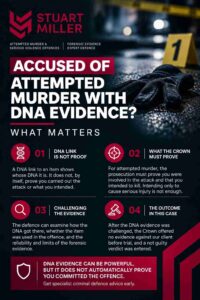
But a DNA link to an object is not the same as proof of who struck a blow or what anyone intended. The defence concentrated on the reliability and limits of that forensic link and refused to treat DNA as a shortcut to identification. Before trial, the Crown offered no evidence against him.
Stuart Miller Solicitors acts for people accused of serious violence, including attempted murder, where the case turns on forensic or identification evidence. This guide uses that case to explain what the Crown must prove and what to do now.
What was alleged
The prosecution alleged that our client was involved in an attempted murder following a stabbing in daylight. Co-defendants faced extremely serious allegations arising from the same incident.
The Crown’s case against him relied heavily on a glove recovered near the scene. It said the glove carried DNA linking him to the attack.
The details published here do not include the indictment wording, the role the Crown said he played, what other evidence it relied on or what the forensic evidence said in detail. We have not filled those gaps.
What is clear is where the dispute lay. It was not over whether a stabbing had happened. It was over whether a forensic link between a man and an item found near the scene could safely be treated as identifying him as a participant in the attack.
The law in plain English: attempted murder and DNA evidence
What the Crown must prove for attempted murder
A person attempts an offence if, with intent to commit it, they do an act that is more than merely preparatory (Criminal Attempts Act 1981, s.1). For attempted murder, that intent must be an intention to kill. Intending only to cause really serious injury is not enough (R v Whybrow (1951) 35 Cr App R 141).
Every element must be proved so that the jury is sure. That includes the first, practical one: that the defendant was involved. If the Crown says someone helped rather than struck, it must prove they intentionally assisted or encouraged the attack (R v Jogee [2016] UKSC 8). The details published here do not say which route the Crown took.
What a DNA link can show
A laboratory develops a DNA profile from material on an item and compares it with a reference sample. If they fit, a scientist may say the DNA is likely to have come from that person. That is a statement about source: whose DNA it is.
It is not, by itself, a statement about activity. It does not say when the DNA was deposited, how it got there, whether the person wore or handled the item, or whether the item was used in an attack. DNA can pass by direct contact and by indirect, or secondary, transfer through another person or surface. It can also remain on an item from earlier use.
Reading a DNA statistic
For a clear single-source profile, a scientist may give a random match probability. For mixtures or partial profiles, a likelihood ratio is commonly used, often with a verbal scale. These express how strongly the findings support one proposition over another.
They rest on assumptions: how many people contributed, how much DNA there was and which method was used. They do not tell a jury what happened. The Court of Appeal has considered how low-level and complex DNA evidence should be assessed and presented (see R v Reed and Reed [2009] EWCA Crim 2698 and R v Dlugosz [2013] EWCA Crim 2).
From the glove to the attack
Where the item is a glove recovered near a scene, the Crown needs three links, not one:
- the glove is connected to the attack;
- the DNA on it is the defendant’s; and
- it is there because the defendant wore it in the attack.
A finding on the second link does not supply the other two. Being found nearby is not the same as being worn during the offence. An item may have been left earlier or by someone else. This is general reasoning about recovered items. The details published here do not say which link the defence attacked.
Expert evidence has limits too
Expert opinion is admissible where it gives the court information outside its own knowledge (R v Turner [1975] QB 834). Forensic science providers are expected to work to the Forensic Science Regulator’s Code of Practice (Forensic Science Regulator Act 2021). A scientist’s evidence is weighed with everything else. It does not decide the case.
What was at stake
Attempted murder carries a maximum sentence of life imprisonment (Criminal Attempts Act 1981, s.4(1)). That is a discretionary maximum, not a prediction. The Sentencing Council’s attempted murder guideline sorts cases by culpability and harm, so the role played and the injury caused matter. We suggest no category or starting point, because the facts needed to assign one are not in the record.
The case material says others faced life-changing sentences. As someone accused of attempted murder, our client faced that statutory maximum in principle. What he faced in practice would have depended on facts and findings the record does not describe.
Before any verdict, someone accused of this offence may be remanded, or bailed on restrictive conditions, with work, study, housing and caring responsibilities under strain. A conviction can affect licence conditions and future employment. For someone without British citizenship it may affect immigration status. These are possibilities in cases like this, not facts about our client.
The wait, and the pressure of a case built around one item
The details published here give no timeline, and we have not reconstructed one. They say only that the Crown’s position changed before trial.
In general, an attempted murder case runs from arrest and interview through charge, sending to the Crown Court (Crime and Disorder Act 1998, s.51), preparation and trial. Forensic evidence adds steps of its own. The defence may need the laboratory’s underlying material, time to review it and, where appropriate, independent scientific advice.
Three measures of delay are easily confused: time under investigation, time from charge to trial and time spent in custody. If someone quotes you a figure, ask which one it is. If you are remanded, custody time limits apply. They are set by regulations and can be extended by the court, so ask your solicitor for the current limit.
A DNA finding can make a case feel closed before it has been tested. If others connected to the case face very long sentences, the pressure can be heavy. That is a general observation, not a description of our client’s experience. It is a reason to have the forensic link examined early rather than after the case has hardened.
How the defence was built
The case details we can publish are short, and we have stayed within them. They say the defence “concentrated on the reliability and limits of that forensic link” and “refused to treat DNA as a shortcut to identification”. Here is what each of those means in practice, and what we cannot say.
Refusing the shortcut to identification
The problem: a DNA link invites the conclusion that the named person is the person responsible.
The legal point: source and activity are different questions, and the Crown must prove the whole chain from glove to attack.
The action: the defence did not accept the shortcut. Because the case against our client relied heavily on the glove, that refusal went to the centre of the prosecution case.
Testing the reliability of the link
The problem: a forensic finding is only as sound as the way the item was recovered, handled, analysed and interpreted.
The action: the defence tested the reliability of the link. The details published here do not say how. It may have been through laboratory records, scientific evidence, cross-examination or legal argument, and we do not claim any of them.
Testing the limits of what the glove could show
Even a reliable finding has limits, as set out above. The defence concentrated on them: what the glove could establish and what the Crown still needed.
The record says that once this evidence was placed under proper pressure, the case against him fell away before trial.
A spokesman for Stuart Miller Solicitors said:
“One forensic item is not a case. Where the rest of the evidence is weak, a challenged DNA link can collapse completely.”
The record does not say which argument, if any, was decisive, or why the Crown decided as it did. We have not guessed.
The outcome, and what it did and did not mean
The Crown offered no evidence against our client before trial, and he was released from the allegation.
That is a specific procedural outcome. When the prosecution offers no evidence, the case against that defendant ends and a not guilty verdict is entered. It is not a police decision to take no further action, because the case had reached the Crown Court. It is also not a jury verdict after hearing the evidence. No court made findings about the glove, the DNA or his involvement.
So it does not mean a court has decided the DNA evidence was wrong, or that anyone else was responsible. It means the Crown did not proceed against him.
The outcome is his alone. The case material says others faced life-changing sentences. It does not say what was decided in their cases, and nothing here comments on them.
Practical matters can remain after a case like this. Any bail conditions end, and seized property and devices should be returned. Ask what happens to the DNA profile and fingerprints police hold. The retention rules for someone charged with a serious offence but not convicted are set by the Police and Criminal Evidence Act 1984 as amended, and depend on the offence and circumstances. You may also need to update an employer or regulator. Your solicitor should confirm in writing what was resolved and what remains to be done.
What to do now if you are accused of attempted murder on DNA evidence
Ask for a solicitor before answering questions

Police station advice is free. You can ask for the duty solicitor or name a firm. There is no single right approach to interview. Whether to offer an explanation about how your DNA might be on an item is exactly the decision to take with a solicitor, before the interview.
Ask what the forensic evidence actually says
Your solicitor should find out which item was tested and where it was found. They should also establish whether the profile is single-source or a mixture, what statistic is given and whether the scientist comments on how or when the DNA arrived. Where relevant, they can request the underlying laboratory material.
Tell your solicitor everything about the item and your movements
Have you owned, worn, borrowed, lent or handled anything similar? Who else had access to your belongings, and when? Where were you at the relevant time? Some answers feel awkward. Your solicitor needs them all, and needs them from you first.
Preserve; do not retrieve or dispose
Do not look for, wash, discard or replace clothing or other items. Do not delete messages or reset devices. CCTV, receipts, location history and work records that show where you were can be overwritten or lost quickly, so tell your solicitor where they exist.
Keep the case out of messages and away from other people
Do not contact co-suspects or witnesses, and do not discuss the case on social media or in group chats. Messages can be obtained and read out in court.
FAQs
-
Does DNA on a glove prove I carried out the attack?
No. DNA on a glove can indicate whose DNA it is. On its own, it does not show when it was deposited, how it got there, whether you wore the glove during the attack or whether the glove was used in it. The Crown must prove each of those links so that the jury is sure.
-
What must the prosecution prove for attempted murder?
That the defendant did an act more than merely preparatory to murder, intending to kill (Criminal Attempts Act 1981, s.1; R v Whybrow). Intending only serious injury is not enough. The Crown must also prove that the defendant was involved in the attack, and prove every element so that the jury is sure.
-
What does a DNA ‘match’ actually mean?
A laboratory compares a profile from the item with a reference sample and usually reports a statistic. That speaks to whose DNA is likely to be present, not how or when it arrived. Mixed or low-level samples are harder to interpret, and the assumptions behind the result can be examined.
-
Can my DNA get onto an item without me using it in an offence?
Potentially, yes. DNA can pass by direct contact, through another person or surface, or remain from earlier use. Whether that is realistic depends on the item, the amount and type of material and the wider evidence. It is a question for expert evidence, not an assumption either way.
-
Does it matter that the glove was found ‘near’ the scene?
Yes. Being found nearby does not prove an item was worn in the attack, and the Crown must connect it to the incident as well as to you. When and where it was recovered, how it was handled and whether others could have left it there may all matter, depending on the evidence.
-
Can I challenge DNA evidence, and do I need my own expert?
You can test it. Depending on the issues, that may involve the laboratory's records, cross-examining the Crown's scientist, legal argument or an independent expert. Not every case needs a defence expert. Expert costs may need prior approval under the legal-aid rules, so raise the question early.
-
If my co-defendants are convicted, does that make me guilty?
No. Each defendant's case must be proved separately. Another person's plea or conviction may be part of the background, but it does not prove that you were involved, what you intended or that you took part. The prosecution must prove its case against you on the evidence admissible against you.
-
What does it mean when the Crown offers no evidence?
The prosecution decides not to proceed against that defendant on the charge before the court, and a not guilty verdict is entered. It is a formal end to that charge, not a delay, a caution or a police decision to take no further action. It does not mean a court has made findings on the evidence.
-
What sentence can attempted murder carry?
The maximum is life imprisonment, which is discretionary rather than mandatory. The Sentencing Council's guideline sorts cases by culpability and harm, so the role played and the injury caused matter. A maximum is not a prediction, and nobody should be sentenced for a role the Crown cannot prove.