-

Top 1% of Defence Law Firms
-

Defended over 50,000 Cases
-

5 star google reviews
-

40 Years of Criminal Law Expertise

A murder charge, a university accommodation, and a question the prosecution eventually answered differently
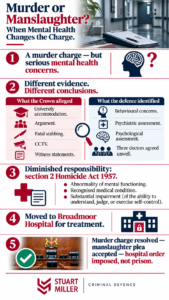
Our client was charged with murdering his partner. The prosecution alleged that he travelled to her university accommodation, argued with her and fatally stabbed her. The case relied heavily on CCTV footage and witness statements. On its face, it was a straightforward murder prosecution.
But the defence team saw something the police had not acted on. Our client’s behaviour throughout the proceedings raised serious questions about his mental health. The police had considered him fit to be interviewed. The defence disagreed, not about the interview itself, but about the bigger picture. Something was wrong, and it needed proper assessment.
If you are reading this because someone close to you has been charged with murder and you are worried about their mental health, two questions are probably running together. Can a mental health condition reduce a murder charge to manslaughter? And can a judge order hospital treatment instead of sending someone to prison? This guide answers both. It uses our client’s case to explain what diminished responsibility means in law, how psychiatric evidence can change the course of a prosecution and what a hospital order involves.
Stuart Miller Solicitors acts for people accused of serious violent offences, including murder, where psychiatric evidence and the defendant’s ability to participate in proceedings may be central to the case. The prosecution accepted a plea to manslaughter by reason of diminished responsibility, and the judge imposed a hospital order. This guide uses our client’s case to explain the law, the evidence and the process.
The Allegation
The Crown alleged that our client murdered his partner. The prosecution’s case was that he travelled to her university accommodation in London, had an argument with her and stabbed her to death before leaving the scene. The Crown relied heavily on CCTV footage and witness statements.
The defence did not dispute that the deceased had died or that our client had been present. What the defence raised was a fundamental question about our client’s mental state at the time of the killing and throughout the proceedings. The defence team had concerns about his behaviour from an early stage. Although the police had deemed him fit to be interviewed, the defence considered that his presentation raised serious questions about his mental health and whether he was receiving the assessment and treatment he needed.
Following charge and remand in custody, the defence instructed psychiatric and psychological experts. The medical evidence developed to the point where three separate doctors agreed that our client was unwell. He was subsequently moved to Broadmoor Hospital for treatment.
The defence then made representations concerning diminished responsibility. The prosecution ultimately accepted a guilty plea to manslaughter on that basis.
The record does not say the exact date of the alleged offence, the precise sequence of events at the university accommodation, the full contents of the CCTV footage or the detailed accounts given by individual witnesses. It does not say the specific medical diagnoses, the full wording of the doctors’ reports, the precise legal mechanism by which our client was transferred to Broadmoor or whether the hospital order included a restriction order under section 41 of the Mental Health Act 1983. We have not guessed at any of these details.
The dispute the record identifies is about the significance of our client’s mental health. Did the medical evidence meet the legal test for diminished responsibility, and could it explain the change from a murder prosecution to a manslaughter plea?
Murder and diminished responsibility: the law in plain English
What the Crown must prove for murder
Murder is a common law offence in England and Wales. There is no single statutory definition. The prosecution must prove two things so that the jury is sure:
- The defendant unlawfully caused the death of another person.
- The defendant intended to kill or cause really serious bodily harm.
A murder conviction carries a mandatory life sentence. There is no discretion. The judge must impose a life sentence and set a minimum term under Schedule 21 of the Sentencing Act 2020.
However, the law recognises that a person who has committed an unlawful killing may have a partial defence that changes the offence from murder to manslaughter. Diminished responsibility is one of those defences.
What is diminished responsibility?
Diminished responsibility is a partial defence to murder under section 2 of the Homicide Act 1957, as amended by section 52 of the Coroners and Justice Act 2009.
It is called a partial defence because it does not result in an acquittal. If established, it reduces what would otherwise be murder to manslaughter. The defendant must establish three legal requirements on the balance of probabilities, meaning the court must consider it more likely than not that each requirement is met:
- An abnormality of mental functioning: the defendant must have had an abnormality of mental functioning at the time of the killing.
- A recognised medical condition: that abnormality must have arisen from a recognised medical condition and must have substantially impaired the defendant’s ability to understand their conduct, form a rational judgment or exercise self-control.
- An explanation for the killing: the abnormality must have caused, or been a significant contributory factor in causing, the defendant’s conduct.
All three requirements must be met. A diagnosis alone is not enough. The court must consider the effect of the condition at the time of the killing, not merely the fact that a condition exists.
What does “substantial impairment” mean?
In R v Golds [2016] UKSC 61, the Supreme Court considered the meaning of “substantial impairment” in the diminished responsibility defence. The court held that “substantial” means more than merely trivial or minimal. It does not mean that the impairment must be total or overwhelming. The jury must apply the statutory test to the evidence in the individual case.
The difference between diminished responsibility and insanity
Diminished responsibility and insanity are separate legal concepts. They should not be confused simply because both can involve medical evidence.
Diminished responsibility is a partial defence to murder. It reduces the offence to manslaughter if the legal requirements are met. The burden of proof is on the defendant, on the balance of probabilities.
Insanity is a complete defence governed by the common law M’Naghten Rules. It can result in a special verdict of not guilty by reason of insanity. The legal test is different, and the outcomes are different.
The difference between diminished responsibility and fitness to plead
Fitness to plead concerns whether a defendant can understand and participate in the criminal proceedings. It is governed by the Criminal Procedure (Insanity) Act 1964.
Diminished responsibility concerns the defendant’s mental functioning at the time of the alleged killing. A defendant may be fit to plead but still have a mental health condition relevant to diminished responsibility. Equally, a person may be unfit to plead without necessarily meeting the test for diminished responsibility. These are separate legal questions requiring separate assessments.
Police interviews, mental health and the limits of “fit to be interviewed”
Being fit for interview is not the same as being well
Under PACE Code C, the police must consider whether a suspect is vulnerable and whether appropriate safeguards are needed during questioning. A person may be able to answer questions but still have mental health difficulties that affect their understanding, judgment, communication or ability to cope with the stress of a murder investigation.
In this case, the police considered our client fit to be interviewed. The defence did not challenge that assessment directly. What the defence challenged was the assumption that fitness for interview meant there were no mental health concerns requiring further investigation.
The record does not establish that the police interview was unlawful or that any particular PACE safeguard was breached. The point is that the defence considered further assessment necessary, and the medical evidence that followed vindicated that concern.
Appropriate adults and vulnerable suspects
Under PACE Code C, an appropriate adult must be present during the interview of a vulnerable person, including someone with a mental health condition or mental disorder. The appropriate adult’s role is to safeguard the interests of the suspect, ensure they understand what is happening and facilitate communication.
An appropriate adult is not a substitute for a solicitor. A vulnerable suspect should still receive legal advice. The record does not say whether an appropriate adult was present during our client’s interview. We have not speculated.
When the defence disagrees with the police assessment
The police’s initial view of a suspect’s mental health does not prevent further medical evidence being obtained. Nor does it determine whether the defendant meets the legal test for diminished responsibility. The defence is entitled to instruct its own psychiatric and psychological experts, and the court must consider the medical evidence as a whole.
In this case, the defence instructed experts after our client had been charged and remanded in custody. Three separate doctors agreed that he was unwell. The prosecution eventually accepted the medical evidence and the plea to manslaughter.
What was at stake
The sentence for murder
Murder carries a mandatory life sentence. The judge must set a minimum term under Schedule 21 of the Sentencing Act 2020. The starting point depends on the circumstances of the offence. In the most serious cases, a whole-life order may be imposed.
The sentence for manslaughter by diminished responsibility
Manslaughter carries a discretionary maximum of life imprisonment. The Sentencing Council’s manslaughter guideline provides an offence range of three to 40 years’ custody for manslaughter by reason of diminished responsibility. The guideline requires the judge to assess the degree of responsibility retained by the offender:
- High responsibility retained: starting point of 24 years, range of 15 to 40 years.
- Medium responsibility retained: starting point of 15 years, range of 10 to 25 years.
- Lower responsibility retained: starting point of seven years, range of three to 12 years.
These are guideline starting points, not automatic sentences. The judge must consider the medical evidence, the circumstances of the offence and the individual case.
Hospital orders as an alternative to prison
A hospital order under section 37 of the Mental Health Act 1983 authorises a person’s admission to and detention in a specified hospital for treatment. The court must be satisfied, on the evidence of two registered medical practitioners, that the offender is suffering from a mental disorder of a nature or degree that makes detention in hospital appropriate, and that hospital treatment is the most suitable way of dealing with the case.
A restriction order under section 41 of the Mental Health Act 1983 is a separate order that may be imposed where the court considers it necessary for the protection of the public from serious harm. The record does not say whether a section 41 restriction order was made in this case. We have not speculated.
The practical difference
The prosecution sought a prison sentence. The defence argued for a hospital order. The difference between the two is fundamental. A prison sentence punishes. A hospital order treats. For a person with a serious mental health condition, the appropriate disposal can be the difference between deterioration in custody and recovery in a therapeutic environment.
The judge imposed a hospital order. Our client was not sent to prison.
Other consequences are possibilities, not facts about our client. Criminal proceedings can affect family relationships, employment, housing and future opportunities. The precise consequences depend on the individual case and the terms of any court order.
The wait, and what psychiatric assessments mean for a murder case
The record gives limited detail about the timeline, and we have not built one beyond what is stated. It confirms that our client was charged with murder, remanded in custody, assessed by medical experts, moved to Broadmoor Hospital for treatment and ultimately entered a plea to manslaughter by reason of diminished responsibility.
Serious criminal proceedings become significantly more complicated when a defendant’s mental health is in question. The court may need to consider medical reports, psychiatric assessments, psychological evidence and the defendant’s current treatment needs. These issues can affect both the legal basis of the charge and the appropriate outcome at sentence.
Three separate doctors agreed that our client was unwell. The defence then called two doctors at the sentencing hearing. The process of obtaining those assessments, securing the transfer to Broadmoor and making representations to the prosecution takes time, and the wait can be agonising for families who may not fully understand what is happening or why the case appears to be stalling.
The record does not say how long the assessment process took or how our client’s family managed the period of uncertainty. We have not guessed.
How the defence was built
The record describes the defence strategy in clear terms. We set out what it says and stop where it stops.
Identifying mental health concerns the police had not acted on
- The problem: the police had considered our client fit to be interviewed and the prosecution was pursuing a murder charge. The defence team, however, had concerns about our client’s behaviour throughout the proceedings.
- The legal point: a person’s ability to answer police questions does not, by itself, determine whether they have a mental health condition or whether that condition may be relevant to a criminal charge. Fitness for interview and diminished responsibility are separate questions.
- The action: the defence identified the concerns and instructed psychiatric and psychological experts to assess our client.
- Why it mattered: the assessments provided specialist evidence about our client’s mental health that became the foundation for the entire defence strategy. Without those assessments, the murder charge would have proceeded unchallenged on mental health grounds.
Obtaining independent medical assessments
- The problem: the prosecution was pursuing a murder charge carrying a mandatory life sentence, while the defence considered that our client’s mental health required proper investigation.
- The legal point: diminished responsibility requires evidence of an abnormality of mental functioning arising from a recognised medical condition, with substantial impairment and the necessary explanation for the killing (Homicide Act 1957, s.2, as amended).
- The action: the defence instructed psychiatric and psychological experts. Three separate doctors agreed that our client was unwell. He was subsequently moved to Broadmoor Hospital for treatment.
- Why it mattered: the medical consensus provided the evidential basis for representations to the prosecution about the appropriate charge. Three doctors agreeing on the same conclusion is a powerful foundation for a diminished responsibility plea.
Making representations to the prosecution
- The problem: the original charge was murder, carrying a mandatory life sentence upon conviction. A trial on that charge would have exposed our client to the risk of a life sentence with a substantial minimum term.
- The legal point: where the statutory requirements for diminished responsibility are established on the balance of probabilities, the offence is reduced from murder to manslaughter (Homicide Act 1957, s.2).
- The action: the defence made representations to the prosecution relying on the medical assessments and the evidence about our client’s mental health.
- Why it mattered: the prosecution accepted a guilty plea to manslaughter by reason of diminished responsibility. The murder charge was effectively resolved without a trial.
Securing a hospital order at sentence
- The problem: although the prosecution accepted the manslaughter plea, it sought a prison sentence. A prison term for manslaughter by diminished responsibility can range from three to 40 years under the Sentencing Council’s guideline.
- The legal point: a hospital order under section 37 of the Mental Health Act 1983 is available where the court is satisfied, on the evidence of two registered medical practitioners, that the offender is suffering from a mental disorder that makes hospital detention appropriate.
- The action: the defence called two doctors to give evidence at the sentencing hearing and made lengthy submissions arguing that a hospital order was the appropriate disposal.
- Why it mattered: the judge imposed a hospital order rather than a prison sentence. Our client was directed to receive treatment in a secure hospital setting rather than being sent to prison.
A spokesman for Stuart Miller Solicitors said:
“Mental health evidence must be examined properly, not treated as an afterthought. In this case, the police considered our client fit to be interviewed, but the defence saw something that required further investigation. Three doctors agreed he was unwell, the prosecution accepted the diminished responsibility plea, and the judge imposed a hospital order instead of a prison sentence. That outcome would not have been possible without proper psychiatric assessment.”
We do not say any one step produced the outcome. The court’s decision followed the plea, the medical evidence and the sentencing submissions.
The outcome, and what it did and did not resolve
The prosecution initially pursued a murder charge. Following psychiatric and psychological assessments, representations from the defence and agreement by the prosecution, our client entered a guilty plea to manslaughter by reason of diminished responsibility. At sentence, the judge imposed a hospital order rather than a prison term.
Precisely:
- The murder charge was resolved by a plea to manslaughter. The prosecution accepted the plea on the basis of diminished responsibility. There was no trial on the murder charge.
- Our client pleaded guilty to manslaughter. This was a conviction, not an acquittal. Diminished responsibility is a partial defence that reduces the offence, not a complete defence that results in acquittal.
- The hospital order is not a prison sentence. It authorises detention in a specified hospital for treatment. The record does not confirm whether a restriction order under section 41 of the Mental Health Act 1983 was also imposed.
- The outcome does not mean our client is free to leave. A hospital order involves detention. The conditions of detention, the review process and the criteria for discharge are governed by the Mental Health Act 1983 and the terms of the order.
- The record does not specify the exact terms of the order. We have not speculated about the duration, the hospital or any restrictions.
Some things to consider after a hospital order:
- Ask your solicitor to confirm the exact statutory basis and terms of the order.
- Ask whether a restriction order under section 41 was also imposed.
- Ask which hospital is responsible for treatment and detention.
- Ask how decisions about leave, transfer and discharge are made and what review rights apply.
- Ask about the role of the Mental Health Tribunal and when the first review is likely to take place.
Ask your solicitor to confirm in writing what was resolved and what, if anything, remains.
What to do now if you are accused of murder and mental health is an issue
What helps depends on the stage you are at.
Tell your solicitor about mental health concerns immediately

Explain any diagnosed conditions, previous treatment, medication, hospital admissions or changes in behaviour. Do not assume that the police or prosecution already have the full picture. Your solicitor can consider whether medical records should be obtained and whether an independent psychiatric assessment is needed. In this case, the defence’s willingness to look beyond the police’s fitness assessment was the turning point.
Ask for legal advice before any police interview
Do not assume that you should answer questions without a solicitor simply because the police say you are fit to be interviewed. Police station advice is free. You can ask for the duty solicitor or name a firm. If you may be vulnerable, ask your solicitor to consider whether the safeguards in PACE Code C apply, including the need for an appropriate adult.
Keep records of treatment and medical appointments
Where possible, make sure your legal team knows about relevant medical appointments, medication, hospital admissions and previous assessments. Do not stop medication or change treatment without appropriate medical advice. Your solicitor can consider how relevant medical information should be obtained and presented to the court.
Understand the difference between the legal issues
Diminished responsibility, fitness to plead and the appropriate sentence are separate questions. A medical condition does not automatically establish diminished responsibility. Nor does a plea on that basis automatically mean a hospital order will follow. Ask your solicitor to explain which legal test applies, what evidence is needed and what outcomes the court can consider.
-
Can my murder charge be reduced to manslaughter because of my mental health?
Yes, if the legal requirements for diminished responsibility are established. Under section 2 of the Homicide Act 1957, as amended by the Coroners and Justice Act 2009, your abnormality of mental functioning must arise from a recognised medical condition, substantially impair one or more specified abilities and provide an explanation for the killing. The defence must be established on the balance of probabilities. A diagnosis alone is not enough, the court must consider the effect of the condition at the time of the killing.
-
What medical evidence do I need to establish diminished responsibility?
The evidence will depend on your circumstances and the issues in dispute. Psychiatric evidence is often central because the court needs to understand your mental functioning at the time of the killing. Psychological evidence and relevant medical records may also assist. In this case, three separate doctors agreed that the client was unwell. Your solicitor can consider which experts should be instructed and what questions they need to address.
-
Can I be interviewed by police if I have a mental health condition?
Yes, a mental health condition does not automatically prevent a police interview. However, the police must consider whether you are vulnerable and whether safeguards are required under PACE Code C. Depending on the circumstances, an appropriate adult may be needed. Being fit for interview does not mean you have no mental health concerns, and the defence is entitled to obtain its own psychiatric assessment regardless of the police's initial view.
-
What is the difference between diminished responsibility and being unfit to plead?
Diminished responsibility concerns your mental functioning at the time of the killing and can reduce murder to manslaughter. Fitness to plead concerns your ability to understand and participate in the criminal proceedings right now. They are separate legal questions requiring different assessments. A person may be fit to plead but still meet the test for diminished responsibility, or vice versa.
-
Can I be sent to hospital instead of prison after pleading guilty to manslaughter?
Yes. A court can impose a hospital order under section 37 of the Mental Health Act 1983 where the statutory conditions are satisfied. The judge must consider the medical evidence from two registered medical practitioners and decide whether hospital treatment is the appropriate disposal. A restriction order under section 41 is separate and may be imposed where the court considers it necessary for public protection. In this case, the judge imposed a hospital order despite the prosecution seeking imprisonment.
-
What happens if the prosecution disagrees with my psychiatric experts?
The prosecution may challenge the expert evidence, obtain its own medical reports or ask questions about the experts' conclusions. The court must assess the evidence rather than automatically accepting either side's opinion. Your solicitor can consider whether further expert reports, clarification or oral evidence is needed. In this case, the medical evidence was strong enough that the prosecution ultimately accepted the diminished responsibility plea.