-

Top 1% of Defence Law Firms
-

Defended over 50,000 Cases
-

5 star google reviews
-

40 Years of Criminal Law Expertise

Thirteen kilos of cocaine in a horsebox, a Snapchat video, and a block of salt
The lorry was stopped at the border. Inside the horsebox trailer, officers found thirteen kilos of cocaine. Our client was the driver. He was an Irish national driving back to Ireland from mainland Europe.
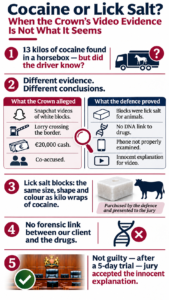
The Crown said he knew the drugs were there. The prosecution relied on Snapchat videos that appeared to show our client and a co-accused handling white blocks that looked like kilos of cocaine, the same kind of blocks that had been found hidden in the horsebox.
Our client said he knew nothing about the drugs. He had no forensic link to them. And the white blocks in the Snapchat videos? They were lick salt, the mineral blocks farmers give to livestock. They look remarkably like wrapped kilos of cocaine. Same size. Same shape. Same colour.
If you are reading this because you have been accused of importing drugs in a commercial vehicle, two questions are probably running together. Can a Snapchat video prove I was handling drugs? And what happens when the Crown’s evidence looks damning but has an innocent explanation? This guide answers both. It uses our client’s case to explain what the Crown must prove in a drugs importation case, how video evidence can be misleading and what a defence team can achieve by thinking creatively.
Stuart Miller Solicitors acts for people accused of serious drug offences, including importation and conspiracy to import controlled drugs. Our client was found not guilty after a five-day trial. This guide uses his case to explain the law, the evidence and the process.
The Allegation
The Crown charged our client with fraudulent evasion of a prohibition on the importation of a controlled drug, namely cocaine, and with possessing criminal property, namely twenty thousand euros in cash. He was charged alongside another individual.
The prosecution’s case was that our client, as the driver of the lorry, was knowingly concerned in the importation of thirteen kilos of cocaine concealed in the horsebox trailer. The Crown alleged that he had driven the vehicle from Europe to the UK with the drugs hidden in the back.
The Crown relied heavily on Snapchat videos that appeared to show our client and the co-accused handling white blocks similar in appearance to the kilos of cocaine found in the horsebox. The prosecution also pointed to the twenty thousand euros in cash as evidence of involvement in the drug trade.
Our client denied both charges. He said he had no knowledge of the drugs found in the horsebox. He was not forensically linked to the drugs, no DNA, no fingerprints, nothing connecting him to the packages. As for the Snapchat videos, he said the items he was handling were blocks of lick salt, the mineral supplements given to livestock, which are similar in size, shape and colour to wrapped kilos of cocaine.
The defence instructed forensic experts and sought full disclosure of all DNA results from the drugs and the surrounding areas to consolidate our client’s position. In a move that is unusual but effective, the defence team sourced actual lick salt blocks, purchased them and presented them to the jury during the trial so that jurors could see for themselves how closely the blocks resembled the items in the Snapchat videos.
The record does not say where the lorry was stopped, which border crossing or port was involved, what route the lorry had taken through Europe or how the cocaine was concealed within the horsebox. It does not say what the co-accused’s role was alleged to be or what the outcome of the co-accused’s case was. It does not say how the Snapchat videos were recovered or from whose device. We have added none of it.
The dispute the record identifies is about knowledge and identification. Did our client know the drugs were in the horsebox, and were the white blocks in the Snapchat videos cocaine or lick salt?
Drugs importation: the law in plain English
What the Crown must prove
Fraudulent evasion of a prohibition on the importation of a controlled drug is an offence under section 170(2) of the Customs and Excise Management Act 1979 (CEMA). The Crown must prove three things so that the jury is sure:
- A controlled drug was imported into the United Kingdom. The importation must have actually taken place. In this case, the cocaine was found in the horsebox at the border, so the importation was not in dispute.
- The importation was prohibited. The importation of Class A drugs, including cocaine, is prohibited under section 3 of the Misuse of Drugs Act 1971.
- The defendant was knowingly concerned in the fraudulent evasion of the prohibition. This is the critical element. The Crown must prove that the defendant knew the goods were prohibited and that they were being imported, and that the defendant played a knowing part in the evasion of the ban.
The phrase “knowingly concerned” has been considered in a number of cases. The leading authority is R v Latif [1996] 1 WLR 104, in which the House of Lords confirmed that the Crown must prove the defendant knew the goods were prohibited and was involved in the importation with that knowledge. Mere presence in a vehicle where drugs are found is not enough.
Knowledge is the central issue
In a drugs importation case involving a commercial vehicle, the question the jury must answer is whether the driver knew the drugs were concealed in the vehicle. The Crown may try to prove knowledge through:
- forensic evidence linking the defendant to the drugs;
- digital evidence, such as messages or videos;
- circumstantial evidence, such as the route taken, the nature of the cargo or the defendant’s behaviour;
- the defendant’s financial circumstances or connections to known drug traffickers; and
- the manner in which the drugs were concealed and whether the defendant had access to the concealment area.
None of these factors is conclusive on its own. The jury must consider the evidence as a whole.
Possessing criminal property
The second charge, possessing criminal property, falls under section 329 of the Proceeds of Crime Act 2002 (POCA). The Crown must prove that the defendant possessed property that constituted or represented the benefit of criminal conduct and that the defendant knew or suspected that it did.
In this case, the criminal property was twenty thousand euros in cash. The Crown’s case was that the cash was connected to the drug importation. The defence disputed that our client had any connection to the drugs or the cash.
Sentencing for drugs importation
The maximum sentence for fraudulent evasion of a prohibition on the importation of a Class A drug is life imprisonment under CEMA 1979. The Sentencing Council’s drug offences guideline looks at the defendant’s role, leading, significant or lesser, and the quantity and class of drugs involved.
Thirteen kilos of cocaine is a very significant quantity. Under the guideline, a leading role in the importation of that quantity would attract a starting point of 14 years, with a range of 12 to 16 years. Even a lesser role would attract a starting point of eight years, with a range of six to ten years.
The record does not say what sentence our client would have faced had he been convicted, and we do not speculate. The point is that the stakes were extremely high.
Snapchat videos, lick salt and the danger of visual assumptions
What a Snapchat video can and cannot show
Snapchat videos are short, often low-quality recordings that disappear after viewing unless saved. They can show people handling objects, but they rarely show the objects in sufficient detail to identify them conclusively.
In this case, the Crown relied on Snapchat videos that appeared to show our client and the co-accused handling white blocks. The prosecution argued that the blocks were kilos of cocaine, similar to those found in the horsebox.
The defence argued that the blocks were lick salt, mineral supplements given to livestock. Lick salt blocks are typically white or off-white, rectangular and roughly the same size as a kilo wrap of cocaine. To the untrained eye, and particularly on a low-resolution Snapchat video, the two can look virtually identical.
The jury needed to see the comparison for themselves. That is why the defence took the unusual step of purchasing actual lick salt blocks and presenting them in court.
The forensic gap
The record says our client was not forensically linked to the drugs. No DNA. No fingerprints. Nothing connecting him to the packages found in the horsebox.
In a case where the Crown alleges that the defendant handled thirteen kilos of cocaine, the absence of any forensic link is significant. Cocaine is a substance that transfers readily to skin, clothing and surfaces. A person who had handled thirteen kilos of wrapped cocaine would be expected to leave some forensic trace, particularly on the packaging.
The defence sought full disclosure of all DNA results from the drugs and the surrounding areas to confirm the absence of any link. The results supported our client’s position.
The phone evidence that went nowhere
The record describes an unusual feature of this case: our client’s phone was reviewed, but the contents did not prove helpful to the prosecution. The defence team did not raise the phone or its contents during the trial.
More significantly, the prosecution failed to examine the phone properly and did not adduce further content from it in evidence. In a case where the Crown relies on digital evidence from one source (Snapchat), the failure to exploit another source (the phone itself) is a gap that the defence is entitled to highlight.
The record does not say what was on the phone, what the prosecution’s examination involved or why the phone evidence was not taken further. We have not speculated. The point is that the Crown’s digital case was limited to the Snapchat videos, and those videos had an innocent explanation.
What was at stake
Fraudulent evasion of a prohibition on the importation of a Class A drug carries a maximum sentence of life imprisonment under section 170 of CEMA 1979. Thirteen kilos of cocaine is a quantity that would attract a very substantial sentence under the Sentencing Council’s drug offences guideline, regardless of the defendant’s role.
The possession of criminal property charge under section 329 of POCA carries a maximum of 14 years’ imprisonment. The twenty thousand euros in cash, if linked to the drug importation, would have added to the overall sentence.
A conviction would also have triggered confiscation proceedings under Part 2 of POCA, potentially resulting in the seizure of all the defendant’s assets. For an Irish national, a conviction would have carried immigration consequences, including the likelihood of deportation following the completion of any sentence.
Our client was acquitted of all charges. He received no sentence, faced no confiscation and was not subject to deportation proceedings arising from this case. The difference between a conviction and an acquittal in a case of this kind is the difference between a decade or more in prison and the preservation of his liberty, his career and his life in Ireland.
The wait, and what a five-day trial looks like for a lorry driver far from home
The record gives limited detail about the timeline, and we have not built one beyond what is stated. It confirms that our client was found not guilty after a five-day trial.
A five-day trial for a drugs importation case involving thirteen kilos of cocaine, Snapchat evidence, forensic analysis and cash is relatively short. The brevity suggests that the defence’s challenge to the Crown’s evidence was effective and that the jury did not need lengthy deliberation.
The record describes the defence preparation in terms that convey the intensity of the work: a comprehensive examination of the evidence, hours of conferences, the instruction of forensic experts, the pursuit of DNA disclosure and the sourcing of lick salt blocks for presentation to the jury. All of this had to be done within the constraints of the trial timetable.
For an Irish national facing trial in an English court, far from home and family, the experience is particularly isolating. The record does not say whether our client was on bail or remanded in custody during the trial, how long he had been in the UK since his arrest or what impact the proceedings had on his livelihood as a lorry driver. We have not guessed.
How the defence was built
The record describes the defence strategy in clear terms. We set out what it says and stop where it stops.
Challenging the Snapchat evidence with lick salt
- The problem: the Crown relied on Snapchat videos that appeared to show our client handling white blocks similar to the kilos of cocaine found in the horsebox. To a jury unfamiliar with the drug trade, the videos looked damning.
- The legal point: the Crown must prove that the items in the videos were cocaine and that our client knew they were cocaine. If the items could be something else, something innocent and readily available, the Crown’s case is weakened.
- The action: the defence team sourced actual lick salt blocks, purchased them and presented them to the jury during the trial. Jurors could hold the blocks, compare them to the images in the Snapchat videos and see for themselves how closely the two resembled each other.
- Why it mattered: the visual comparison was powerful. The jury could see that the white blocks in the videos were entirely consistent with lick salt, not cocaine. The Crown’s key piece of digital evidence was neutralised.
Exploiting the forensic gap
- The problem: the Crown alleged that our client was knowingly concerned in the importation of thirteen kilos of cocaine. If he had handled the drugs, forensic traces would be expected.
- The legal point: the absence of forensic evidence is not proof of innocence, but it is a gap in the Crown’s case that the jury is entitled to consider. The Crown must prove its case on the evidence, not on assumptions.
- The action: the defence instructed forensic experts and sought full disclosure of all DNA results from the drugs, the packaging and the surrounding areas of the horsebox. The results confirmed that our client was not forensically linked to the drugs.
- Why it mattered: the forensic gap undermined the Crown’s narrative that our client had handled the cocaine. If he had been involved in loading or concealing thirteen kilos of cocaine, the absence of any DNA or fingerprint evidence was difficult for the Crown to explain.
Highlighting the prosecution’s failure on phone evidence
- The problem: the Crown relied on Snapchat videos recovered from a device, but the prosecution failed to examine our client’s own phone properly and did not adduce further content from it.
- The legal point: the Crown has a duty to investigate and disclose all relevant material under the Criminal Procedure and Investigations Act 1996 (CPIA). A failure to examine a key device properly is a gap in the prosecution’s case that the defence is entitled to highlight.
- The action: the defence team reviewed the phone evidence and concluded that it did not assist the prosecution. The defence did not raise the phone or its contents during the trial, and the prosecution did not adduce further evidence from it.
- Why it mattered: the Crown’s digital case was limited to the Snapchat videos. The failure to exploit the phone evidence suggested that there was nothing on the phone that supported the prosecution’s case, which reinforced the defence’s position that our client was not involved in the importation.
Comprehensive evidence review and case conferences
- The problem: the case involved multiple strands of evidence, Snapchat videos, forensic analysis, phone data, cash and the circumstances of the border stop, all of which needed to be tested.
- The legal point: effective defence preparation requires a thorough understanding of every piece of evidence and a clear strategy for challenging the Crown’s case.
- The action: the defence team conducted a comprehensive examination of the evidence and held hours of case conferences to develop the strategy and coordinate the expert evidence.
- Why it mattered: the preparation allowed the defence to identify the critical weaknesses in the Crown’s case, the lick salt explanation, the forensic gap, the phone evidence failure, and to present those weaknesses clearly and persuasively to the jury.
A spokesman for Stuart Miller Solicitors said:
“The Crown had a Snapchat video that looked terrible for our client. White blocks, a lorry full of cocaine, twenty thousand euros in cash. But when we bought the actual lick salt blocks and put them in front of the jury, the video told a completely different story. The blocks were the same size, the same shape, the same colour. And our client had no forensic link to the drugs at all. The jury saw the truth, and they acquitted.”
We do not say any one step produced the verdict. A jury gives no reasons.
The verdict, and what it did and did not resolve
After a five-day trial, our client was found not guilty of fraudulent evasion of a prohibition on the importation of cocaine and of possessing criminal property.
Precisely:
- It was a verdict after a full trial. The Crown’s evidence was heard and tested over five days. It means the Crown did not prove its case so that the jury was sure.
- A jury gives no reasons. We cannot say whether the lick salt demonstration, the forensic gap, the phone evidence failure or anything else mattered most.
- It is not a finding about the drugs. The cocaine was found in the horsebox. That is not in dispute. The verdict is about whether our client knew the drugs were there and was knowingly concerned in their importation.
- It is not a finding about the co-accused. The record says nothing about the outcome of the co-accused’s case.
- It does not mean the Snapchat videos were fabricated. The videos existed. The verdict reflects the jury’s conclusion that the items in the videos were not necessarily cocaine and that our client was not knowingly involved in the importation.
Some things to consider after an acquittal:
- Ask your solicitor whether a defendant’s costs order is available if you funded your defence privately. Limits apply.
- The twenty thousand euros and any other property seized during the investigation should be returned. Ask your solicitor to confirm the process.
- Ask what data police retain from phone extractions, Snapchat records and forensic samples, and for how long.
- If you are a foreign national, ask your solicitor whether the acquittal resolves any immigration concerns arising from the arrest and charge.
Ask your solicitor to confirm in writing what was resolved and what, if anything, remains.
What to do now if you are accused of importing drugs in a commercial vehicle
What helps depends on the stage you are at.
Ask for a solicitor before answering any questions

Drugs importation is one of the most serious offences in the criminal calendar, carrying a maximum of life imprisonment. If you are stopped at a border or port and drugs are found in your vehicle, ask for legal advice before answering questions. Police station advice is free. You can ask for the duty solicitor or name a firm. Do not assume that explaining your route or your cargo will clear things up, anything you say is admissible in evidence.
Do not assume that video evidence proves involvement
Snapchat, WhatsApp and other video platforms produce low-quality recordings that can be misleading. A white block on a phone screen could be cocaine, but it could also be salt, flour, chalk or any number of innocent substances. The Crown must prove what the items were, not just what they looked like on a video. Tell your solicitor if there is an innocent explanation for anything captured on camera.
Challenge the forensic evidence
If the Crown alleges that you handled drugs, ask your solicitor about the forensic evidence. DNA, fingerprints and trace evidence can all link a person to a substance, but the absence of such evidence is equally significant. In this case, the complete lack of any forensic link between our client and thirteen kilos of cocaine was a powerful point in his defence.
Be honest about the contents of your vehicle
If you are a commercial driver, tell your solicitor exactly what was in your vehicle, who loaded it, where you picked it up and whether you had any reason to suspect that prohibited goods were concealed. A solicitor can only build an effective defence if they have the full picture. If you genuinely did not know the drugs were there, that is your defence, and the Crown must prove otherwise.
FAQs
-
Can I be convicted of importing drugs if I did not know they were in my vehicle?
The Crown must prove that you were "knowingly concerned" in the importation. If you genuinely did not know the drugs were concealed in your vehicle, the Crown's case may fail. However, the Crown may argue that you must have known based on the circumstances, the route, the cargo, the concealment method or your behaviour. The jury decides whether the Crown has proved knowledge beyond reasonable doubt.
-
Can a Snapchat video prove I was handling drugs?
A Snapchat video can show a person handling objects, but it rarely provides sufficient detail to identify the objects conclusively. The Crown must prove that the items in the video were controlled drugs, not merely that they looked like controlled drugs. In this case, the defence demonstrated that the white blocks in the videos were consistent with lick salt blocks used for livestock, which are similar in size, shape and colour to wrapped kilos of cocaine.
-
What is fraudulent evasion of a prohibition on importation?
It is an offence under section 170(2) of the Customs and Excise Management Act 1979. It involves being knowingly concerned in the fraudulent evasion of a prohibition on the importation of goods, including controlled drugs. The offence covers not only the person who physically brings the drugs into the country but also anyone who plays a knowing part in the importation, such as arranging transport, providing a vehicle or concealing the goods.
-
Does the absence of DNA on the drugs help my defence?
Yes, it can be significant. If the Crown alleges that you handled large quantities of drugs, the absence of any forensic link, DNA, fingerprints or trace evidence, is a gap in the prosecution's case that the jury is entitled to consider. It is not proof of innocence on its own, but it undermines the Crown's narrative and supports the defence's position that you were not involved.
-
What is possessing criminal property?
Possessing criminal property is an offence under section 329 of the Proceeds of Crime Act 2002. It involves possessing property that constitutes or represents the benefit of criminal conduct, knowing or suspecting that it does. In a drugs case, large amounts of cash found alongside the drugs may be charged as criminal property. The Crown must prove that you knew or suspected the cash was connected to criminal activity.
-
What sentence does drugs importation carry?
The maximum sentence for fraudulent evasion of a prohibition on the importation of a Class A drug is life imprisonment. The Sentencing Council's drug offences guideline sets starting points based on the defendant's role and the quantity of drugs. For thirteen kilos of cocaine, a leading role would attract a starting point of 14 years, a significant role 10 years and a lesser role 8 years. The exact sentence depends on the facts of the individual case.