-

Top 1% of Defence Law Firms
-

Defended over 50,000 Cases
-

5 star google reviews
-

40 Years of Criminal Law Expertise

A gun in a bush, a DNA match, and a defendant who was not there
The firearm was found outside, in a bush. It was not in a house, not in a car, not on anyone’s person. It was in an area our client was not in when it was discovered.
Six months earlier, his brother had been arrested and charged with possessing the same firearm. The brother’s case had already gone through the courts. Our client’s name was not on that charge sheet.
Then the forensic results came back. Our client’s DNA was on the gun. The Crown charged him with possession.
If you are reading this because your DNA has been linked to a weapon connected to a family member, one question is probably louder than all the others. How can they charge me when I was not even there? This guide answers that question. It uses our client’s case to explain what the Crown must prove in a firearm possession case built on DNA evidence, how secondary transfer works between family members and what a defence team can do to challenge the Crown’s assumptions.
Stuart Miller Solicitors acts for people accused of firearms offences, including cases where the Crown relies on forensic evidence to link a defendant to a weapon they have never touched. Our client was acquitted after a five-day trial. This guide uses his case to explain the law and the science.
The Allegation
The Crown alleged that our client was in possession of a firearm. The charge arose from the discovery of a gun in an outdoor location, a bush in an area our client was not present in at the material time.
The background to the charge was unusual. Six months before our client was charged, his brother had been arrested and charged with the same offence and the same firearm. The brother’s case had proceeded separately. Our client was not involved in that arrest and was not in the area when the weapon was later found.
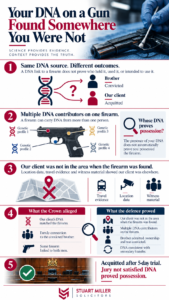
The Crown’s case against our client depended on DNA evidence. Forensic analysis identified our client’s DNA on the firearm. The prosecution treated that match as evidence of possession.
The defence case was clear: our client was not in possession of the firearm, had no knowledge of its existence or presence and was not in the area when it was discovered. The defence pointed to the fact that the DNA profile contained multiple contributors, including the brother, and that secondary transfer between family members who share living spaces, clothing and personal items was the most likely explanation for the DNA match.
The record does not say what type of firearm was involved, whether it was loaded, what specific section of the Firearms Act 1968 was charged or what the forensic scientist said about the statistical weight of the DNA match. It does not say what the brother’s trial involved or what evidence was given in his case. We have added none of it.
The dispute the record identifies is about possession. Could a DNA match on a firearm found in a bush our client was not in prove that he possessed it, particularly when his brother’s DNA was also on the weapon and his brother had already been convicted of possessing it?
Firearm possession and the limits of DNA evidence
What the Crown must prove
Possession of a firearm without a certificate is an offence under section 1 of the Firearms Act 1968. Possession of a prohibited weapon falls under section 5 of the same Act. Certain firearm offences carry a mandatory minimum sentence of five years’ imprisonment under section 51A. The record does not specify which section applied here.
To prove possession, the Crown must show that the defendant had the firearm in their custody or under their control and that they knew they had it. Possession can be:
- Actual: the firearm is on the defendant’s person, in their hand, pocket, waistband or bag.
- Constructive: the firearm is in a place the defendant controls, such as their home, vehicle or a storage unit, and they know it is there.
In either case, the Crown must prove knowledge. A defendant who does not know a firearm exists, or who has no connection to the place where it is found, cannot be in possession of it.
What DNA on a firearm can and cannot show
DNA evidence can show that a person’s genetic material was deposited on an object at some point. It cannot show:
- when the DNA was deposited;
- how it was transferred;
- whether the person touched the object directly or whether the DNA arrived through secondary or tertiary transfer; or
- whether the person knew the object existed or where it was.
These limitations are especially significant in a case like this one, where the firearm was found in an outdoor location the defendant was not in, and where a close family member with whom the defendant shared daily contact had already been convicted of possessing the same weapon.
Secondary transfer between family members
DNA transference occurs when a person’s genetic material is passed to an object they have not directly touched. Secondary transfer is the most common form: Person A’s DNA is transferred to an object via Person B.
Between family members who live together or spend significant time together, secondary transfer is not merely possible, it is expected. Family members share:
- living spaces, including kitchens, bathrooms, door handles and furniture;
- clothing, towels and bedding;
- vehicles, including steering wheels, gear sticks and door handles;
- personal items, including phones, keys and wallets; and
- physical contact, including handshakes, hugs and shared meals.
Any of these interactions can deposit Person A’s DNA on Person B’s hands, clothing or belongings. If Person B then handles a firearm, Person A’s DNA may be transferred to the weapon without Person A ever having touched it.
The Forensic Science Regulator’s guidance and the published forensic science literature both recognise secondary transfer as a well-documented phenomenon. The likelihood increases significantly where the individuals involved are in close and regular contact, as family members typically are.
Multiple DNA contributors
The record says the DNA profile on the firearm contained multiple contributors, including the brother. This is a critical detail.
When a DNA profile contains more than one contributor, the forensic scientist must consider how each contributor’s DNA came to be on the item. The presence of the brother’s DNA is readily explained, he was convicted of possessing the firearm. The presence of our client’s DNA requires its own explanation, and secondary transfer from the brother is a scientifically recognised possibility.
The Crown cannot simply point to a DNA match and assert possession. It must explain how the DNA got there in a way that is consistent with the defendant having possessed the weapon, and it must do so in the context of all the other evidence, including the fact that the defendant was not in the area when the firearm was found.
When the police target you because of who you know
Guilt by association is not the law
The record says our client is a well-known public figure. The record also says his brother had been arrested and charged with the same offence and the same firearm six months earlier. The combination of public profile and family connection may have brought our client to the attention of the police.
Being related to someone who has committed an offence is not itself an offence. The Crown must prove that the defendant personally possessed the firearm, knew of its existence and had control over it. A family connection to a convicted person is not evidence of possession, and a jury must not convict on the basis of association.
The significance of not being in the area
The record says our client was not in the area at the material time. This is a significant fact. If the defendant was not present where the firearm was found, the Crown’s case for actual possession is substantially weakened. The Crown would need to rely on constructive possession, arguing that the defendant controlled the location where the firearm was hidden and knew it was there.
A bush in a public area is not a location that any individual controls. The Crown’s case on constructive possession in these circumstances faces obvious difficulties, and the defence is entitled to point them out.
No comment interviews and adverse inferences
Our client gave a no comment interview at the police station. A defendant has the right to remain silent. However, under sections 34 to 38 of the Criminal Justice and Public Order Act 1994, a court or jury may in some circumstances draw an adverse inference from a defendant’s failure to mention facts when questioned that he later relies on in his defence.
The record does not say whether the Crown invited the jury to draw adverse inferences from the no comment interview or whether the judge directed the jury on the point. What the record does show is that no comment at the police station is not, by itself, evidence of guilt, and a jury must still be satisfied on the evidence as a whole.
What was at stake
Firearm possession offences carry severe penalties. Possession of a firearm without a certificate under section 1 of the Firearms Act 1968 carries a maximum of five years’ imprisonment. Possession of a prohibited weapon under section 5 can carry a mandatory minimum of five years under section 51A, with a higher maximum depending on the circumstances.
The record does not specify which charge our client faced, and we do not speculate about the hypothetical sentence he would have received had he been convicted. What the record does show is that the stakes were high: a conviction would have meant a custodial sentence of several years, a criminal record for a serious violent offence and the lifelong consequences that follow.
For a well-known public figure, a conviction would also have carried professional and reputational consequences that extend well beyond the courtroom. The record does not detail those consequences, and we have not speculated.
The brother’s conviction for the same offence and the same firearm provides a point of comparison. He was convicted. Our client was acquitted. The difference between those two outcomes is the difference between years in prison and freedom.
The wait, and what a six-month gap between arrests means
The record describes a timeline with a significant gap: the brother was arrested and charged approximately six months before our client. During that period, the brother’s case proceeded through the courts while our client was not under charge.
A six-month gap between related arrests is not unusual in firearms cases. Forensic analysis takes time. DNA profiles must be generated, compared and interpreted. The Crown may not decide to charge a second defendant until the forensic evidence is complete and the first defendant’s case has clarified the evidential picture.
For the second defendant, the wait can be disorienting. The family member’s case is in the public domain. The police may have already searched the defendant’s home, seized devices and taken DNA samples. The defendant knows the investigation is ongoing but does not know when, or whether, charges will follow.
The record does not say what our client knew during that six-month period or what steps, if any, he took to prepare for the possibility of being charged. We have not guessed.
How the defence was built
The record describes the defence strategy in clear terms. We set out what it says and stop where it stops.
Challenging the DNA evidence through secondary transfer
- The problem: the Crown had a forensic DNA match linking our client to a firearm found in a bush in an area he was not in. The match was the foundation of the prosecution’s case.
- The legal point: a DNA match shows contact at some point. It does not show when, how or in what circumstances. Secondary transfer between family members who share living spaces and daily contact is a well-documented and scientifically recognised phenomenon.
- The action: the defence instructed its own forensic expert to comment on the DNA evidence, including exploring secondary transfer as the most likely explanation for the presence of our client’s DNA on the firearm.
- Why it mattered: the expert’s evidence gave the jury a scientifically grounded alternative explanation for the DNA match that did not require our client to have ever touched the gun.
Highlighting the multiple DNA contributors
- The problem: the Crown’s case treated the DNA match as evidence of our client’s possession of the firearm.
- The legal point: the DNA profile contained multiple contributors, including the brother who had already been convicted of possessing the same weapon. The presence of the brother’s DNA on the firearm was explained by his conviction. The presence of our client’s DNA required its own explanation.
- The action: the defence drew the jury’s attention to the mixed DNA profile and argued that the most likely source of our client’s DNA on the firearm was secondary transfer from the brother, not direct contact by our client.
- Why it mattered: the mixed profile undermined the Crown’s narrative that the DNA match proved our client had handled the weapon. It showed that the DNA evidence was consistent with an innocent explanation.
Emphasising the defendant’s absence from the area
- The problem: the Crown needed to prove possession, which requires custody or control of the firearm and knowledge of its existence.
- The legal point: a defendant who is not in the area where a firearm is found cannot be in actual possession of it. Constructive possession requires control of the location and knowledge of the weapon, neither of which can be assumed from a DNA match alone.
- The action: the defence emphasised that our client was not in the area at the material time and that the firearm was found in a bush in a public space, not in a location our client controlled.
- Why it mattered: the absence from the area made the Crown’s case on possession significantly harder to prove and gave the jury a clear reason to doubt the prosecution’s narrative.
Separating our client from his brother’s conviction
- The problem: the brother had been convicted of possessing the same firearm. The Crown’s case against our client was built on the same weapon and the same forensic evidence.
- The legal point: each defendant must be tried on their own evidence. A family member’s conviction is not evidence of the defendant’s guilt. The jury must assess the case against our client on its own merits.
- The action: the defence ensured that the jury understood the distinction between the brother’s case and our client’s case, and that the brother’s conviction did not fill the gaps in the Crown’s evidence against our client.
- Why it mattered: the jury acquitted our client and convicted the brother. The different outcomes reflect the different evidence against each defendant.
A spokesman for Stuart Miller Solicitors said:
“A DNA match is not a conviction. In this case, our client was not in the area, the gun was in a bush, and the DNA profile included his brother, who had already been convicted of possessing the same weapon. The jury understood that DNA on a firearm does not prove possession, and they returned the right verdict.”
We do not say any one step produced the acquittal. A jury gives no reasons.
The verdict, and what it did and did not resolve
After a five-day trial, the jury acquitted our client of possession of a firearm. His brother, the co-defendant, was convicted.
Precisely:
- It was a verdict after a full trial. The Crown’s evidence was heard and tested over five days. It means the Crown did not prove possession so that the jury was sure.
- A jury gives no reasons. We cannot say whether the secondary transfer evidence, the absence from the area, the mixed DNA profile or anything else mattered most.
- It is not a finding that our client’s DNA was not on the firearm. The record says it was. The verdict reflects the jury’s conclusion that the DNA match did not prove possession beyond reasonable doubt.
- The brother’s conviction stands separately. The different outcomes for the two defendants reflect the different evidence in each case.
Some things to consider after an acquittal:
- Ask your solicitor whether a defendant’s costs order is available if you funded your defence privately. Limits apply.
- Property and devices seized during the investigation should be returned where no longer required.
- Ask what data police retain from forensic samples, including DNA profiles, and for how long. Under the Protection of Freedoms Act 2012, the retention of DNA from acquitted defendants is subject to strict rules.
- If the acquittal has affected your public profile or professional standing, consider whether any steps are needed to manage the reputational impact.
Ask your solicitor to confirm in writing what was resolved and what, if anything, remains.
What to do now if you are accused of possessing a firearm based on DNA evidence
What helps depends on the stage you are at.
Do not assume a DNA match means conviction
DNA on a firearm shows contact at some point. It does not show when, how or in what circumstances. If a family member or close associate has been linked to the same weapon, secondary transfer is a real and scientifically recognised possibility. Tell your solicitor about every aspect of your relationship with the person connected to the firearm and the spaces, items and vehicles you share.
Emphasise your whereabouts
If you were not in the area where the firearm was found, that fact is central to your defence. Gather any evidence that shows where you were at the material time, phone records, transport data, work logs, witness statements and CCTV. Tell your solicitor as early as possible.
Instruct a forensic expert
If the Crown’s case depends on DNA evidence, the defence should instruct its own forensic expert to review the Crown’s analysis. The expert can assess the quality of the DNA profile, the number of contributors, the statistical weight of the match and the likelihood of secondary transfer. In this case, the defence expert’s evidence was decisive.
Ask for a solicitor before any interview

Police station advice is free. Our client gave a no comment interview, which is a legitimate choice. Whether to comment or remain silent is a decision to take with a solicitor first. If you have already been interviewed, tell your solicitor exactly what was said and in what circumstances.
FAQs
-
Can I be convicted of possessing a firearm if my DNA is on it but I never touched it?
A DNA match alone is not sufficient for a conviction. The Crown must prove that you had the firearm in your custody or control and that you knew you had it. If your DNA can be explained by secondary transfer, particularly from a family member who has already been convicted of possessing the same weapon, the Crown's case may not meet the standard of proof required for a conviction. A jury must be sure, and reasonable doubt about how the DNA got there is a defence.
-
What is secondary DNA transfer and how does it happen between family members?
Secondary transfer occurs when Person A's DNA is deposited on an object via Person B. Between family members who share living spaces, clothing, vehicles and physical contact, secondary transfer is common and well-documented. If your brother handles a firearm after shaking your hand or touching your clothing, your DNA may end up on the weapon without you ever having touched it. The Forensic Science Regulator and the forensic science literature both recognise this as a real phenomenon.
-
Does it matter that I was not in the area where the firearm was found?
Yes, it matters significantly. Actual possession requires the firearm to be on your person or within your immediate control. If you were not in the area, the Crown cannot argue actual possession and must instead rely on constructive possession, proving that you controlled the location where the firearm was hidden and knew it was there. A bush in a public space is not a location any individual controls, which makes constructive possession very difficult to prove.
-
Can the police charge me because my family member was convicted of the same offence?
The police can investigate and the Crown can charge, but a family member's conviction is not evidence of your guilt. Each defendant must be tried on their own evidence. The Crown must prove that you personally possessed the firearm, knew of its existence and had control over it. Association with a convicted person, even a close family member, is not a substitute for evidence of your own involvement.
-
What does a mixed DNA profile mean for my case?
A mixed DNA profile contains genetic material from more than one person. In a firearm case, a mixed profile that includes both the defendant and a convicted co-defendant raises significant questions about how each person's DNA came to be on the weapon. The Crown must explain the defendant's DNA in a way that is consistent with possession, and the defence is entitled to argue that secondary transfer from the co-defendant is a more likely explanation.
-
What sentence does possession of a firearm carry?
It depends on the offence. Possession of a firearm without a certificate under section 1 of the Firearms Act 1968 carries a maximum of five years. Possession of a prohibited weapon under section 5 can carry a mandatory minimum of five years under section 51A, with a higher maximum. The exact sentence depends on the type of firearm, the circumstances and the defendant's history. The record does not specify which charge applied in this case.