-

Top 1% of Defence Law Firms
-

Defended over 50,000 Cases
-

5 star google reviews
-

40 Years of Criminal Law Expertise
After a public stabbing, everyone wanted a motive
The case record says the incident attracted public attention and early speculation about motive. It does not tell us where it happened, what was said or who was hurt, and we have not guessed.
It does tell us the defence did not offer a motive. It offered medical evidence. The defence did not dispute the sequence of events. It relied on expert material about long-standing neurological illness, including intractable epilepsy and post-ictal psychosis.
If you are reading this because someone you love has been arrested after a violent incident and is seriously unwell, you may be asking two questions at once. What did they do, and were they well enough to be responsible for it? Criminal law keeps those questions apart.
Our client was charged with attempted murder. A court found him not guilty by reason of insanity, and a hospital order followed. That is not the same as being cleared, and this guide explains why.
Stuart Miller Solicitors acts for people accused of attempted murder and other serious violence, including cases where medical evidence is central to criminal responsibility.
The Allegation
The prosecution case focused on a serious and frightening attack in a public place. Our client was charged with attempted murder following a stabbing.
The dispute was not about the sequence of events. The defence case, as recorded, was that at the material time he was not acting with a conscious criminal state of mind. The court accepted that he had committed the act but lacked the mental capacity required for criminal responsibility. Those are the record’s words.
The record does not give the date, the injuries, the evidence the Crown relied on or whether the Crown accepted the medical evidence. It does not say whether a jury or a judge returned the verdict. We have added none of it.
How the insanity defence for attempted murder works
What the Crown must prove for attempted murder
A person attempts an offence if, intending to commit it, they do an act that is more than merely preparatory (Criminal Attempts Act 1981, s.1). For attempted murder the intention must be to kill. Intending only really serious injury is not enough (R v Whybrow (1951) 35 Cr App R 141). The Crown must prove this so that the jury is sure.
What “insanity” means in law
“Insanity” is a legal label, not a medical diagnosis, and it sounds harsher than it is meant to. The test comes from M’Naghten’s Case (1843) 10 Cl & Fin 200.
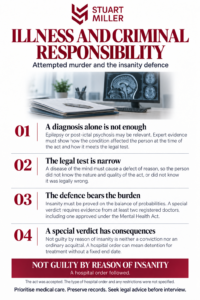
The defence must show that, at the time of the act, the person had a defect of reason caused by a disease of the mind. As a result, they either did not know the nature and quality of what they were doing, or did not know it was legally wrong.
“Disease of the mind” is also a legal term. It covers conditions internal to the person, and it is not limited to what doctors would call mental illness.
The defence must prove insanity on the balance of probabilities. A special verdict can only be returned on the evidence of at least two registered medical practitioners, one of them approved under the Mental Health Act 1983 (Criminal Procedure (Insanity) Act 1964, s.1).
Why it is not the same as “no intent”
You might expect that if someone was too ill to intend to kill, the Crown simply fails and they are acquitted. Where the cause is a disease of the mind, the law does not work that way. In R v Sullivan [1984] AC 156 the House of Lords held that such a person is dealt with under the law of insanity. The verdict is the special verdict, not an ordinary acquittal.
That is why a case can be put as “no conscious criminal state of mind” and still end in a verdict of not guilty by reason of insanity. The record does not say which part of the M’Naghten test applied here, and we do not say.
Epilepsy and post-ictal psychosis
Sullivan concerned a seizure, and it treated epilepsy as capable of being a disease of the mind for this purpose. “Post-ictal” means after a seizure. Post-ictal psychosis is a psychiatric disturbance that can follow seizures or clusters of them.
A diagnosis is not a defence. The court needs evidence of what was happening to this person at the time and how it meets the legal test. That is a question for expert evidence, not for assumptions about a condition in general. Having epilepsy or a psychiatric condition says nothing about whether someone is likely to be violent.
Four terms that are often confused
- Insanity. The cause is internal, such as epilepsy. The verdict is the special verdict.
- Sane automatism. There is a complete loss of control from an external cause, such as a blow to the head. This leads to a full acquittal (R v Quick [1973] QB 910).
- Diminished responsibility. This is a partial defence to murder only (Homicide Act 1957, s.2). It has no application to attempted murder.
- Fitness to plead. This asks whether the person can take part in a trial at all. It is a separate question about the time of trial, not the time of the offence.
What was at stake
Attempted murder carries a maximum of life imprisonment (Criminal Attempts Act 1981, s.4(1)(a)). That is a discretionary maximum, not a prediction. No sentence was passed here because the result was a special verdict, and we state no category or starting point.
The more unusual stake follows a successful insanity defence. A special verdict is not a conviction, but the court can then order detention in hospital. A hospital order is for treatment rather than punishment, yet it has no fixed end date. Release depends on clinical and risk assessment. For some patients it also depends on decisions by the Mental Health Tribunal or the Ministry of Justice.
So relying on insanity is a serious decision, taken with advice. The person’s own wishes matter if they can give instructions. Detention could turn out shorter or longer than a sentence would have been, and the label cannot predict which.
Before any verdict, a person may be remanded or bailed on conditions, with their illness, medication and care under strain. A special verdict can still affect work and some record checks, so ask your solicitor how.
The wait, and a case that is medical as well as criminal
A case like this runs from arrest and interview through charge, sending to the Crown Court (Crime and Disorder Act 1998, s.51) and preparation for trial. A medical defence adds work. Records must be gathered and expert reports commissioned, and the court needs evidence from at least two doctors before a special verdict.
Three measures of delay are easily confused: time under investigation, time from charge to trial and time spent in custody. If someone is remanded, custody time limits apply. They are set by regulations and can be extended, so ask your solicitor for the current limit.
Two systems are working at once. The criminal courts ask what happened and whether the person is legally responsible. The health service asks what the person needs. A seriously unwell person may be assessed or treated, or even moved to hospital, while the case is live (Mental Health Act 1983, ss.35, 36 and 48 in different circumstances).
For the person, private medical history may be examined in a public court. For relatives, there may be the strain of supporting someone who is unwell while being asked to explain events they did not see. The person who was attacked and their family are waiting too.
How the defence was built
Recognising that the question was medical
- The problem: the Crown’s case focused on a serious attack in public, and there had been public speculation about motive.
- The legal point: insanity does not dispute that an act occurred. It asks whether the law should hold the person responsible for it.
- The action: the defence centred on medical evidence rather than a factual dispute about the sequence of events.
- Why it mattered: it moved the contest from what happened to what this person’s state of mind was, and why.
Bringing in expert neurological evidence
The record says expert material addressed long-standing neurological illness, including intractable epilepsy and post-ictal psychosis. It does not identify the experts or their disciplines. It does not say how many reports there were, what each concluded or whether the Crown agreed them. We do not say.
In general, experts are needed to connect a diagnosis to the person’s condition at the relevant time (R v Turner [1975] QB 834).
Putting the legal test in front of the court, not just a diagnosis
The defence case was that at the material time he was not acting with a conscious criminal state of mind. In law, that must be tied to the M’Naghten test: a defect of reason from a disease of the mind, and one of its two limbs. The record does not say which limb was relied on.
A spokesman for Stuart Miller Solicitors said:
“The law does not ignore medical reality in serious cases. Where the evidence shows a person could not form the required state of mind, that has to be confronted squarely.”
The record describes no application, cross-examination or discussion with the Crown, so we claim none. We do not say any single step produced the result.
The Verdict
A court found our client not guilty by reason of insanity. The record says the court accepted that he had committed the act but lacked the mental capacity required for criminal responsibility. A hospital order followed.
Precisely:
- It is a special verdict. It is not a conviction, and it is not an ordinary acquittal where the Crown failed to prove its case.
- It is not a finding that nothing happened. The court accepted the act.
- It is not “being cleared” in the everyday sense. A hospital order means detention for treatment.
- The details are not in the record. We do not have who returned the verdict, whether fitness to plead arose, the type of hospital order, whether restrictions apply or how long it lasts.
After a special verdict:
- Someone subject to a hospital order has rights to apply to the Mental Health Tribunal. Ask early about timing.
- A special verdict and the order made can be appealed, with strict time limits (Criminal Appeal Act 1968).
- Families should ask what the order means for visits, contact and information.
Ask your solicitor to confirm in writing what was decided and what happens next.
What to do now if epilepsy, psychosis or another condition may be relevant
Put medical safety first
If someone is in a medical emergency, call 999. If they are in custody, tell custody staff about the diagnosis, medication and any recent seizure or episode. Ask for a healthcare professional. Do not assume officers will notice.
Ask for a solicitor before interview

Police station advice is free. You can ask for the duty solicitor or name a firm. Ask whether the person is fit to be interviewed and whether an appropriate adult is needed (PACE Code C). There is no single right approach to interview. It depends on the evidence and the person’s health.
Tell your solicitor what happened and what you saw before, during and after. Do not build an account around the word “insanity”. The test is technical, and lawyers and doctors assess it.
Gather the medical contacts
Note the GP, neurologist, hospital and care team, the medication list and any seizure diary. Give your solicitor the details. Do not alter, add to or “tidy” any records. The solicitor will obtain them properly.
Preserve evidence
CCTV, messages and devices can matter. Delete nothing and reset nothing.
Keep the case off social media
Do not discuss the incident online. Do not contact witnesses or the person who was attacked. Messages can be obtained and read out in court.
FAQs
-
What does not guilty by reason of insanity mean?
It is a special verdict. It means the court accepted that the defendant did the act, but that when they did it they met the legal test for insanity and so are not criminally responsible. It is not a conviction and it is not an ordinary acquittal. The court then decides what order to make, which can include a hospital order.
-
What is the legal test for insanity?
It comes from M'Naghten's Case (1843). The defence must show that, because of a defect of reason caused by a disease of the mind, the person either did not know the nature and quality of what they were doing or did not know it was legally wrong. It is a legal test, not a medical one, and a diagnosis alone does not meet it.
-
Can epilepsy or post-ictal psychosis support an insanity defence?
It can, but not automatically. The courts have treated epilepsy as a disease of the mind for this test (R v Sullivan). The evidence must show how the condition affected the person at the time of the act, and that the legal test is met. A diagnosis or a history of seizures does not settle the question, and post-ictal psychosis is assessed the same way.
-
Who has to prove insanity?
The defence. A defendant who relies on insanity must prove it on the balance of probabilities, a lower standard than the Crown's duty to make the jury sure. A special verdict also needs evidence from at least two registered medical practitioners, one of them approved under the Mental Health Act 1983.
-
Is insanity the same as automatism?
No. Both can involve losing control of one's actions, but the law separates them by cause. If the cause is internal, such as epilepsy, the law treats it as insanity and the verdict is the special verdict. If it is an external factor, such as a blow to the head, it may be sane automatism, which leads to a full acquittal. The medical evidence decides which applies.
-
What must the prosecution prove for attempted murder?
An act more than merely preparatory to murder, done with intent to kill (Criminal Attempts Act 1981, s.1). Intending only really serious injury is not enough (R v Whybrow). The Crown must prove this so that the jury is sure. Where insanity is raised, the court must also consider that separate question.