-

Top 1% of Defence Law Firms
-

Defended over 50,000 Cases
-

5 star google reviews
-

40 Years of Criminal Law Expertise
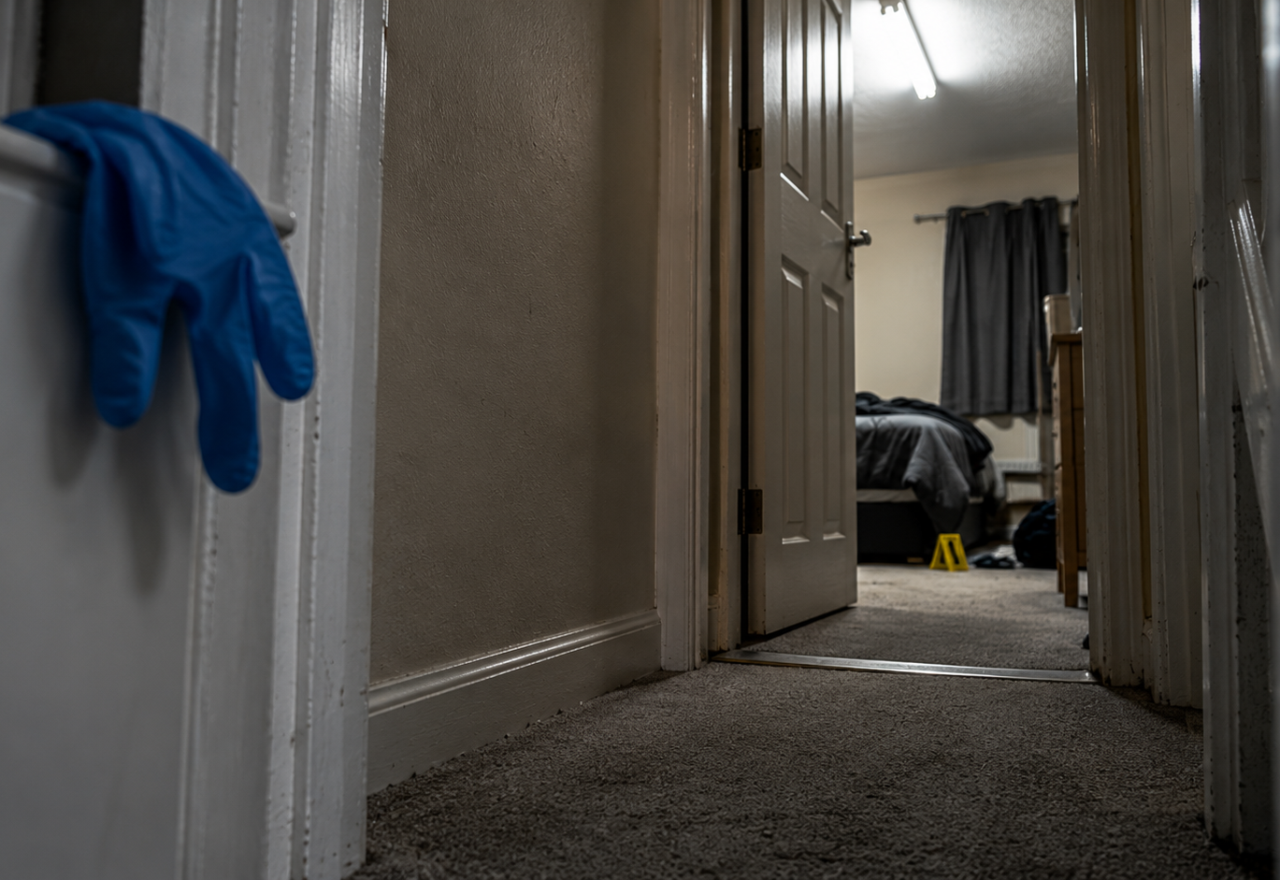
Searched on Monday, nothing found. Searched on Tuesday, drugs everywhere
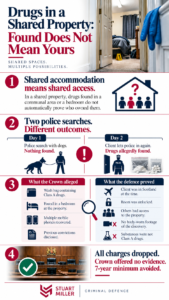
The police came to the address on the first day. They brought dogs. They searched the property. They found nothing.
Our client was away. He was in Scotland for training. The property was a shared house. The room was unlocked. Other people lived there and had access to every room.
The next day, our client returned. He gave the police access to the address himself. This time, the officers said they found a wash bag full of what they alleged was a significant quantity of Class A drugs in his bedroom.
If you are reading this because drugs have been found in a property you share with others, two questions are probably running together. Can they prove the drugs were mine? And what happens if I have previous convictions? This guide answers both. It uses our client’s case to explain what the Crown must prove in a possession with intent to supply case built on a contested search, and what a defence team can achieve by refusing to accept the prosecution’s evidence at face value.
Stuart Miller Solicitors acts for people accused of drug supply and related offences, including third strike cases carrying mandatory minimum sentences. The Crown offered no evidence on all charges against our client. This guide uses his case to explain the law, the evidence and the process.
The Allegation
The Crown alleged that our client was in possession of Class A drugs with intent to supply. The charge arose from the discovery of what the prosecution described as a wash bag full of a significant quantity of drugs in his bedroom at a shared property. The substances were said to have been tested and confirmed as Class A.
The Crown relied on three main pillars: the location of the drugs in our client’s bedroom, the quantity allegedly found and the presence of multiple mobile phones in the room, two iPhones and a Nokia. The prosecution also pointed to our client’s previous convictions for supplying Class A drugs, which meant the charge potentially engaged the third strike sentencing provisions.
The defence case was that our client knew nothing about the wash bag or its contents. He was away in Scotland for training when the drugs were allegedly placed in the property. The room was unlocked in a shared house. Other occupants had access to all rooms. He did not know what the others were doing in the property while he was away or who they allowed in. The phones found in the room were not his.
The defence also raised a fundamental question about the search itself. Police had searched the same address the day before, with dogs, and found nothing. Our client had not been back to the property between the two searches. How could a wash bag full of drugs be found in his bedroom on the second day when the same property had been cleared the day before?
The record does not say how many other people lived in the property, what their names were or whether any of them were charged. It does not say what specific Class A drug was initially alleged or what the reported weight was. It does not say what the previous convictions involved or when they occurred. We have added none of it.
The dispute the record identifies is about knowledge, possession and the reliability of the search. Could the Crown prove that our client knew about the drugs, intended to supply them and was responsible for their presence in the room?
Possession with intent to supply: the law in plain English
What the Crown must prove
Possession of a controlled drug with intent to supply is an offence under section 5(3) of the Misuse of Drugs Act 1971. The Crown must prove three things so that the jury is sure:
- Possession: the defendant had the drug in their custody or under their control and knew they had it.
- The substance is a controlled drug: the substance must be identified as a drug listed in the Misuse of Drugs Act 1971. Cocaine, heroin and MDMA are Class A. The classification matters for sentencing.
- Intent to supply: the defendant intended to pass the drug to another person. Supply includes distribution, not just sale.
All three elements must be proved. If the Crown cannot prove any one of them, the defendant is entitled to an acquittal.
Possession in a shared property
Possession can be actual, the drug is on the defendant’s person, or constructive, the drug is in a place the defendant controls and they know it is there.
In a shared property, constructive possession is not automatic. The Crown must prove that the defendant knew the drugs were in the property and had some degree of control over them. The fact that drugs are found in a room the defendant sometimes uses is evidence the Crown may rely on, but it is not conclusive. The jury must consider:
- whether the room was locked or unlocked;
- who else had access to the room;
- whether the defendant was present when the drugs were found;
- whether there is evidence linking the defendant to the drugs beyond their location; and
- whether there is an innocent explanation for the drugs being in the room.
The record says the room was unlocked, the property was shared, other occupants had access to all rooms and our client was in Scotland at the material time. Those facts go directly to the question of possession.
Intent to supply: what the Crown looks for
The Crown typically relies on a combination of factors to prove intent to supply, including:
- the quantity of drugs found;
- the presence of multiple mobile phones, which may suggest separate lines for personal use and supply;
- the presence of drug paraphernalia such as scales, deal bags or cutting agents;
- the defendant’s previous convictions; and
- the packaging and purity of the drugs.
None of these factors is conclusive on its own. The jury must consider the evidence as a whole. The record says the Crown relied on the quantity, the phones and the previous convictions. The defence disputed that the phones belonged to our client and challenged the reliability of the search that produced the drugs.
The third strike provisions
Under section 312 of the Sentencing Act 2020, a defendant aged 18 or over who is convicted of a third Class A drug trafficking offence must be sentenced to a minimum of seven years’ imprisonment unless the court is of the opinion that there are particular circumstances relating to the offence or the offender that would make it unjust to impose that sentence.
The third strike provisions apply to a defined list of drug trafficking offences, including possession with intent to supply Class A drugs. A previous conviction counts as a strike if it was for a qualifying offence and resulted in a custodial sentence.
The record says our client was facing a potential seven-year minimum sentence as a third strike offender. The practical stakes could not have been higher.
When the search does not add up
Two searches, two different results
The most striking feature of this case is the sequence of searches. On the first day, police attended the address with drug detection dogs and searched the property. They found nothing. Our client was not there. He was in Scotland.
On the second day, our client returned and gave the police access to the address. This time, officers said they found a wash bag containing what they alleged was a significant quantity of Class A drugs in his bedroom.
The defence raised the obvious question: if the property had been searched the day before, with dogs, and nothing was found, how could a wash bag full of drugs appear in the bedroom overnight, while the defendant was still away?
The record does not say what explanation the Crown offered for the discrepancy. The record does say that the defence alerted the court that something was seriously wrong with the case.
Body-worn footage and the missing discovery
In modern policing, officers are expected to wear body-worn video cameras during searches. The footage provides an independent record of what was found, where it was found and who found it.
The defence reviewed the police footage from the search. The record says there was no video of the drugs being found and no officer taking responsibility as the one who discovered them. In a case where the Crown’s entire case depends on the discovery of drugs in a specific location, the absence of footage showing that discovery is a significant gap.
The record does not say whether the absence of footage was explained by a technical failure, a policy breach or some other reason. The defence’s point was that the gap existed and that it undermined the reliability of the Crown’s account.
Challenging the forensic test report
The Crown’s initial position was that the substances found in the wash bag had been tested and confirmed as Class A drugs. The defence did not accept that assertion at face value.
Under the Criminal Procedure and Investigations Act 1996 (CPIA), the Crown has a duty to disclose all material that might reasonably be considered capable of undermining the prosecution case or assisting the defence case. The defence intimated questions for disclosure about the search and the forensic testing, putting the Crown on notice that the evidence would be challenged.
The Crown delayed serving disclosure. When the results finally came, the Crown confirmed that the substances it had alleged were Class A drugs were, in fact, not Class A drugs at all.
The record does not say what the substances actually were. The point is that the Crown’s own testing ultimately contradicted its initial case.

The police station statement and the right to silence
A prepared statement before no comment
At the police station, our client’s legal team submitted a carefully prepared written statement before he exercised his right to remain silent. The statement set out seven key points:
- He disputed the allegations.
- He denied knowing that cocaine was in the property and explained that he had been in Scotland for training, with confirmation available. The property was shared and the room was unlocked.
- He did not know what the other occupants were doing while he was away or who they allowed into the property.
- The other occupants would have had access to all rooms.
- It was he who gave the police access to the address.
- The phones found in the room were not his.
- He wished to give a no comment interview.
A prepared statement of this kind serves a specific legal purpose. Under section 34 of the Criminal Justice and Public Order Act 1994, a jury may draw an adverse inference from a defendant’s silence if he fails to mention a fact when questioned that he later relies on in his defence. By setting out his account in writing at the police station, our client protected himself against that risk while still exercising his right not to answer questions.
The record does not say whether the Crown later invited the jury to draw adverse inferences. The point is that the prepared statement was a deliberate tactical choice, not a refusal to engage.
What was at stake
As a third strike offender, our client was facing a mandatory minimum sentence of seven years’ imprisonment. That is not a starting point or a guideline, it is a statutory floor. The judge must impose at least seven years unless there are particular circumstances that make it unjust to do so.
The maximum sentence for possession with intent to supply a Class A drug is life imprisonment under the Misuse of Drugs Act 1971. The Sentencing Council’s drug offences guideline looks at the defendant’s role, leading, significant or lesser, and the quantity and class of drugs involved. In a third strike case, the guideline is effectively overridden by the statutory minimum.
A seven-year sentence would have meant years in prison, the loss of employment and housing, the disruption of family relationships and a criminal record that would follow our client for the rest of his life. The difference between seven years and no conviction is the difference between a life derailed and a life preserved.
Other consequences are possibilities, not facts about our client. They include confiscation proceedings under the Proceeds of Crime Act 2002, effects on immigration status for someone without British citizenship and the lifelong impact of a Class A drug trafficking conviction.
The wait, and what a collapsing case looks like from the inside
The record gives limited detail about the timeline, and we have not built one beyond what is stated.
What the record does describe is a process that will be familiar to many defendants in drug cases: the initial charge is brought on the basis of forensic and circumstantial evidence, the defence challenges that evidence, the Crown delays disclosure and the case begins to unravel.
The defence made a successful bail application despite the third strike implications. That is a significant achievement in itself. A defendant facing a mandatory minimum of seven years is often remanded in custody on the basis that the likely sentence provides a strong incentive to abscond. Securing bail allowed our client to remain at liberty while the case was tested.
The record does not say how long the case lasted from charge to discontinuance or how the delay in disclosure affected the timeline. We have not guessed.
How the defence was built
The record describes the defence strategy in clear terms. We set out what it says and stop where it stops.
Refusing to accept the prosecution case at face value
- The problem: the Crown alleged that a wash bag full of Class A drugs had been found in our client’s bedroom and that the substances had been tested and confirmed.
- The legal point: the Crown bears the burden of proof. The defence is entitled to test every element of the prosecution’s case, including the forensic evidence, and is under no obligation to accept assertions without verification.
- The action: the defence did not accept the prosecution’s initial test report and intimated questions for disclosure about the search and the forensic analysis.
- Why it mattered: the Crown eventually confirmed that the substances were not Class A drugs. The foundation of the prosecution’s case collapsed.
Exposing the contradictions in the search
- The problem: the Crown’s case depended on the discovery of drugs in our client’s bedroom during the second search.
- The legal point: the reliability of a search is a matter for the jury. If the search is inconsistent, poorly documented or contradicted by other evidence, the jury is entitled to doubt the Crown’s account.
- The action: the defence highlighted the fact that the property had been searched the day before, with dogs, and nothing had been found. The defence also reviewed the body-worn footage and found no video of the drugs being discovered and no officer taking responsibility for finding them.
- Why it mattered: the contradictions undermined the Crown’s narrative and alerted the court that something was seriously wrong with the case.
Securing bail despite third strike implications
- The problem: our client was facing a potential seven-year minimum sentence as a third strike offender. The Crown would have opposed bail on the basis that the likely sentence created a strong incentive to abscond.
- The legal point: bail is a right under the Bail Act 1976 unless one of the statutory exceptions applies. The court must consider the risk of absconding, further offending and interference with witnesses, and must impose conditions if they address those risks.
- The action: the defence made a successful bail application, allowing our client to remain at liberty while the case was challenged.
- Why it mattered: our client was not held in custody for a case that ultimately collapsed. He did not serve a single day in prison for charges that were later dropped.
Submitting a prepared statement at the police station
- The problem: our client wished to exercise his right to remain silent, but a bare no comment interview carried the risk of adverse inferences under section 34 of the Criminal Justice and Public Order Act 1994.
- The legal point: a prepared statement submitted at the police station can protect a defendant against adverse inferences by placing his account on record at the earliest opportunity, even if he declines to answer questions.
- The action: the defence submitted a detailed seven-point statement setting out the client’s denials, his alibi in Scotland, the shared nature of the property and the fact that the phones were not his, before he gave a no comment interview.
- Why it mattered: the statement preserved the client’s position and ensured that the key facts of his defence were recorded from the outset.
A spokesman for Stuart Miller Solicitors said:
“The Crown said the drugs were Class A. The Crown said they were found in our client’s bedroom. The Crown said he was a third strike offender facing seven years. We checked every one of those assertions, and the case fell apart. The drugs were not Class A, the search did not add up, and the Crown offered no evidence. That is what happens when the defence refuses to take the prosecution at its word.”
We do not say the outcome was inevitable. The Crown reviewed its evidence and made its own decision. What the record shows is that the defence’s willingness to challenge every element of the case was the catalyst for that review.
The outcome, and what it did and did not resolve
The Crown offered no evidence on all charges. Our client was formally acquitted.
Precisely:
- All charges were dropped. The Crown offered no evidence, which means the prosecution formally withdrew its case. This is a complete acquittal on every count.
- The substances were not Class A drugs. The Crown confirmed that the substances it had initially alleged were Class A were, in fact, not Class A. The foundation of the possession with intent to supply charge was removed.
- The seven-year minimum was avoided. As a third strike offender, our client was facing a mandatory minimum of seven years. The discontinuance means he faces no sentence at all.
- The outcome is not a finding about the search itself. The Crown’s decision to offer no evidence does not amount to a formal finding that the search was unlawful or that the drugs were planted. It reflects the Crown’s assessment that it could no longer sustain the charges.
Some things to consider after an outcome of this kind:
- Ask your solicitor whether a defendant’s costs order is available if you funded your defence privately. Limits apply.
- Property and devices seized during the investigation should be returned where no longer required.
- Ask what data police retain from forensic samples, phone extractions and search records, and for how long.
- If the arrest and charge have affected your employment, housing or immigration status, consider whether any steps are needed to address those consequences.
Ask your solicitor to confirm in writing what was resolved and what, if anything, remains.
What to do now if you are accused of possessing drugs found in a shared property
What helps depends on the stage you are at.
Do not accept the Crown’s forensic evidence without challenge
The Crown’s initial test results are not the final word. Forensic analysis can be wrong, incomplete or misinterpreted. The defence is entitled to its own expert opinion and to full disclosure of the Crown’s testing methodology. In this case, the Crown’s own re-testing contradicted its initial position. If your case depends on a forensic result, instruct an expert to review it.
Document your whereabouts
If you were away from the property when the drugs were allegedly found, gather every piece of evidence that shows where you were. Travel records, hotel receipts, work logs, training confirmations, phone location data and witness statements can all support an alibi. Tell your solicitor as early as possible.
Explain the shared nature of the property
Who else lived there? Who had keys? Was the room locked or unlocked? Who had access while you were away? The answers to these questions go directly to the question of possession. A jury cannot convict if there is a reasonable possibility that someone else placed the drugs in the room.
Submit a prepared statement at the police station

If you intend to give a no comment interview, consider submitting a prepared statement first. The statement should set out the key facts of your defence, your denials, your alibi, your explanation for the circumstances, so that the Crown cannot later argue that you failed to mention them. Your solicitor will draft the statement with you before the interview.
FAQs
-
Can I be convicted of possessing drugs found in a shared house if I was not there?
The Crown can bring the charge, but it must prove that you knew the drugs were there and had control over them. If the room was unlocked, other people had access and you were in another part of the country, the Crown's case on possession is significantly weakened. The jury must be sure that the drugs were yours, not merely that they were in a room you sometimes use.
-
What is a third strike drug trafficking offence?
Under section 312 of the Sentencing Act 2020, a defendant aged 18 or over who is convicted of a third Class A drug trafficking offence must receive a minimum sentence of seven years' imprisonment unless the court finds particular circumstances that make it unjust. Qualifying offences include possession with intent to supply Class A drugs, supply of Class A drugs and conspiracy to supply Class A drugs. Previous convictions count as strikes if they were for qualifying offences and resulted in custodial sentences.
-
Can the police search my home twice and find different things each time?
In theory, yes. A second search may reveal items that were missed in the first, or circumstances may have changed between the two searches. In practice, a significant discrepancy between two searches of the same property within a short period raises serious questions about the reliability of the evidence. The defence is entitled to challenge the search and to ask the Crown to explain the inconsistency.
-
What happens if the drugs turn out not to be Class A?
If the substances are not controlled drugs at all, the charge of possession with intent to supply a controlled drug cannot stand. If the substances are controlled drugs but of a lower class, for example, Class B rather than Class A, the charge may be amended, and the sentencing implications change significantly. In this case, the Crown confirmed the substances were not Class A and offered no evidence on all charges.
-
Does a prepared statement at the police station protect me from adverse inferences?
A prepared statement can significantly reduce the risk of adverse inferences under section 34 of the Criminal Justice and Public Order Act 1994. By setting out the key facts of your defence in writing at the earliest opportunity, you demonstrate that you have not withheld your account. The statement must be accurate and consistent with the defence you later run at trial. Your solicitor will advise you on the content and timing.
-
Can I get bail if I am facing a third strike charge?
Yes, bail is possible even in third strike cases. The court must consider the statutory exceptions under the Bail Act 1976, including the risk of absconding, further offending and interference with witnesses. The likely sentence is a factor, but it is not decisive on its own. If the defence can address the court's concerns through conditions, such as a curfew, electronic monitoring or a surety, bail may be granted. In this case, the defence secured bail despite the third strike implications.