-

Top 1% of Defence Law Firms
-

Defended over 50,000 Cases
-

5 star google reviews
-

40 Years of Criminal Law Expertise

A homeless man, a reported burglary and two blades used to cut food
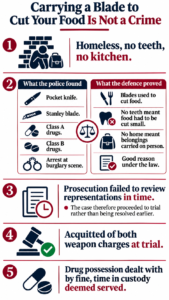
The police were called to reports of an alleged burglary. When they arrived at the scene, they arrested our client and searched him. Our client is a homeless man. He had no fixed address and no accommodation.
The search found a bladed article, an offensive weapon, Class A drugs and Class B drugs on his person. Our client made admissions in relation to the drugs. He did not dispute that he had them. But when it came to the two blades, a small pocket knife and a Stanley blade, he told the police he had a lawful reason for carrying them.
He was charged with possession of an offensive weapon (two counts) and remanded in custody, meaning the court ordered him to be held in prison while the case progressed rather than releasing him on bail.
At court, our client pleaded not guilty to both weapon charges. His explanation was straightforward. He is homeless. He has no teeth. He keeps all his belongings on his person because he has nowhere else to store them. He used the pocket knife and the Stanley blade to cut his food into small enough pieces to swallow, because he could not chew.
The defence made representations to the prosecution inviting them to review the case and discontinue the weapon charges. The prosecution did not review those representations in time. The matter proceeded to trial.
At trial, following further representations, the court considered the evidence and our client’s personal circumstances, including his lack of accommodation and the practical difficulties he faced in obtaining and eating food. The court acquitted him of both weapon offences.
If you are reading this because you have been charged with carrying a blade or an offensive weapon and you believe you had a good reason, this guide explains what the law says, what the Crown must prove and what the “good reason” defence means in practice. It uses our client’s case to walk you through the process.
Stuart Miller Solicitors acts for people accused of weapons offences, including cases where the defendant’s personal circumstances provide a lawful reason for possession. Our client was acquitted of both charges at trial. This guide uses his case to explain the law and the process.
The Allegation
The police were called to reports of an alleged burglary. On arrival, they arrested our client and searched him. The record does not say whether our client was suspected of involvement in the burglary or whether he was simply present at the scene when the police arrived. He was not charged with burglary.
The search revealed four categories of items: a bladed article, an offensive weapon, Class A drugs and Class B drugs. The record does not specify the exact type of each drug, the quantity found or precisely where on our client’s person the items were located.
Our client admitted possession of the drugs. He was charged and convicted in relation to those offences. The focus of this guide is the two weapon charges, which he contested.
The two weapon charges related to a small pocket knife and a Stanley blade. The prosecution’s case was that our client was in possession of these items in a public place without lawful authority or reasonable excuse.
Our client’s defence was that he had a good reason for carrying both items. He was homeless and had no teeth. He carried his belongings on his person because he had no home to store them in. He used the blades to cut his food into pieces small enough to swallow.
The defence made written representations to the prosecution before trial, inviting them to discontinue the weapon charges. The prosecution did not review those representations in time, and the case proceeded to trial. At trial, the court heard the evidence and acquitted our client of both charges.
Possession of a blade or offensive weapon: the law in plain English
What the Crown must prove
There are two main offences that cover carrying a knife or weapon in a public place in England and Wales.
The first is possession of an offensive weapon in a public place, contrary to section 1(1) of the Prevention of Crime Act 1953. An “offensive weapon” is defined as any article made or adapted for use for causing injury to the person, or intended by the person having it with them for such use. The Crown must prove that the defendant had the weapon in a public place and that they did not have lawful authority or reasonable excuse.
The second is possession of a bladed article in a public place, contrary to section 139(1) of the Criminal Justice Act 1988. A “bladed article” is any article which has a blade or is sharply pointed, other than a folding pocket knife with a cutting edge of three inches or less. The Crown must prove that the defendant had the article in a public place.
The record describes one item as a “bladed article” and one as an “offensive weapon”, and the charges are listed as “Possession of an Offensive Weapon x2”. The record does not specify which statute each count was brought under. We have not speculated.
The “good reason” and “reasonable excuse” defences
Both offences carry a statutory defence.
Under section 139(4) of the Criminal Justice Act 1988, it is a defence for the defendant to prove that they had “good reason or lawful authority” for having the bladed article with them in a public place. The defendant bears the burden of proving this defence, but only on the balance of probabilities, which is a lower standard than the criminal standard of “beyond reasonable doubt” that the Crown must meet.
Under section 1(1) of the Prevention of Crime Act 1953, the offence is only committed if the defendant has the weapon “without lawful authority or reasonable excuse”. The defendant must raise the issue of reasonable excuse, and the Crown must then disprove it beyond reasonable doubt.
The Court of Appeal in R v Jolie [2003] EWCA Crim 1543 confirmed that “good reason” is not limited to work-related purposes. A practical, everyday reason for carrying a blade can amount to a good reason if the court accepts it on the facts.
In our client’s case, the defence argued that his homelessness and his lack of teeth gave him a good reason to carry the blades. He had no kitchen, no cutlery drawer and no way to prepare food other than cutting it with the tools he carried on his person. The court accepted this explanation and acquitted him.
What “public place” means
Both offences require the possession to take place in a “public place”. A public place includes any highway and any other premises or place to which the public have or are permitted to have access, whether on payment or otherwise (section 139(7) of the Criminal Justice Act 1988 and section 1(4) of the Prevention of Crime Act 1953). A street, a park, a shop or the communal area of a building can all be public places. The record does not specify precisely where our client was when he was arrested, beyond the fact that the police attended the scene of a reported burglary.
The trial and the prosecution’s failure to review
Why the case went to trial
The defence made representations to the prosecution before the trial date, inviting the prosecutor to review the evidence and discontinue the weapon charges. The prosecution did not review those representations in time. As a result, the case proceeded to trial.
The Crown Prosecution Service operates under the Code for Crown Prosecutors, which imposes a continuing duty to review cases throughout the proceedings. If the evidential stage of the Full Code Test is no longer met, the prosecution should discontinue the case. In this instance, the prosecution’s failure to engage with the representations in time meant the matter had to be resolved at trial rather than before it.
What happened at trial
At trial, the defence made further representations. The court considered the evidence and our client’s personal circumstances, including his homelessness and the practical difficulties he faced in obtaining and eating food. The court acquitted our client of both weapon charges.
The record does not say whether the acquittal was directed by the judge at the close of the prosecution case or whether it followed a full trial with evidence from the defence. It does not say whether a jury was involved or whether the matter was heard in the magistrates’ court. We have not guessed.
What was at stake
Possession of an offensive weapon in a public place under section 1 of the Prevention of Crime Act 1953 carries a maximum sentence of four years’ imprisonment on indictment. Possession of a bladed article under section 139 of the Criminal Justice Act 1988 carries the same maximum.
The Sentencing Council’s guideline for possession of an offensive weapon and bladed articles sets starting points based on the type of weapon, the circumstances of the possession and the defendant’s culpability. Even at the lowest level of culpability, a conviction can result in a community order or a short custodial sentence. A second conviction for a bladed article carries a mandatory minimum sentence of six months’ imprisonment under section 139A of the Criminal Justice Act 1988, unless the court finds it would be unjust in the particular circumstances.
A conviction would also have meant a permanent criminal record for a weapons offence, with consequences for employment, travel and immigration status.
Our client was acquitted. He received no conviction, no sentence and no criminal record for the weapon charges. The drug charges were dealt with separately by way of a fine, and the court took the time he had already spent in police custody as sentence deemed served.
The wait and what remand in custody means for a defendant
Our client was remanded in custody, meaning he was held in prison while the case progressed. For a homeless person with no support network, being remanded in custody can be particularly difficult. The record does not say how long our client spent on remand or what conditions he was held under. We have not speculated.
What the record does confirm is that the court took the time our client had already spent in police custody as sentence deemed served for the drug offences. This means the court recognised that the time he had already served was sufficient punishment for the drug charges, and no further custodial sentence was imposed.
How the defence was built
The record describes the defence strategy in clear terms. We set out what it says and stop where it stops.
Establishing the factual basis for “good reason”
The problem: our client was charged with two counts of possession of an offensive weapon after police found a pocket knife and a Stanley blade on his person.
The legal point: both the Prevention of Crime Act 1953 and the Criminal Justice Act 1988 provide a defence of “reasonable excuse” or “good reason” for possession of a blade or weapon in a public place. The Court of Appeal in R v Jolie [2003] EWCA Crim 1543 confirmed that practical everyday reasons can amount to good reason.
The action: the defence presented evidence of our client’s personal circumstances, including his homelessness and his lack of teeth, to explain why he carried the blades and what he used them for.
Why it mattered: the court accepted that a homeless man with no teeth who uses a blade to cut his food has a good reason for carrying that blade. The factual basis of the defence was clear, consistent and supported by the evidence.
Separating the weapon charges from the drug admissions
The problem: our client had admitted possession of Class A and Class B drugs, which could have undermined his credibility in the eyes of the court.
The legal point: an admission to one offence does not prove guilt on another. Each charge must be considered on its own evidence. The Crown must prove each element of the weapon offences independently.
The action: the defence maintained a clear distinction between the drug charges, which our client admitted, and the weapon charges, which he contested. His honesty about the drugs supported his credibility when he explained his reason for carrying the blades.
Why it mattered: by being straightforward about the drugs, our client demonstrated to the court that he was not trying to deny everything. His explanation for the blades was credible precisely because he had been honest about the other items found on him.
Persisting through the prosecution’s failure to engage
The problem: the prosecution did not review the defence representations in time, meaning the case proceeded to trial despite the weakness of the evidence on the weapon charges.
The legal point: the Crown has a continuing duty under the Code for Crown Prosecutors to review its case and discontinue where the evidential threshold is not met. A failure to review does not strengthen the Crown’s case.
The action: the defence made further representations at trial and presented the evidence of our client’s circumstances to the court.
Why it mattered: the court considered the evidence and acquitted our client of both charges. The prosecution’s failure to engage before trial did not change the strength of the defence case.
A spokesman for Stuart Miller Solicitors said:
“Our client was homeless, had no teeth and carried a small knife to cut his food. The prosecution charged him with two weapon offences and failed to review our representations in time. At trial, the court heard the evidence, considered his circumstances and acquitted him on both counts. Carrying a blade to cut your food when you have no teeth and no home is a good reason under the law. That is what the court found, and that is what common sense dictates.”
We do not say the outcome was inevitable. The court considered the evidence and made its own decision. What the record shows is that the defence’s clear presentation of our client’s circumstances was decisive.
The outcome, and what it did and did not resolve
Our client was acquitted of both weapon charges at trial.
Precisely:
Both weapon charges resulted in acquittal. The court found that our client had a good reason for carrying the pocket knife and the Stanley blade. He received no conviction, no sentence and no criminal record for those offences.
The drug charges were dealt with separately. Our client received a fine for the possession of drugs. The court took the time he had already spent in police custody as sentence deemed served, meaning no further custodial sentence was imposed.
The outcome does not relate to the alleged burglary. The record says the police were called to reports of an alleged burglary, but our client was not charged with burglary. The record does not say whether anyone else was charged in connection with the burglary or what the outcome of that investigation was. We have not speculated.
Some things to consider after an acquittal:
- Ask your solicitor whether a defendant’s costs order is available if you funded your defence privately. Limits apply.
- Property and devices seized during the investigation should be returned where no longer required, though blades may be subject to forfeiture.
- Ask what data police retain from the arrest, search records and any other material gathered during the investigation, and for how long.
- If the remand in custody affected your accommodation, benefits or immigration status, consider whether any steps are needed to address those consequences.
- Ask your solicitor to confirm in writing what was resolved and what, if anything, remains.
What to do now if you are accused of carrying a blade or offensive weapon
What helps depends on the stage you are at.
Ask for a solicitor before answering any questions

Weapons charges carry custodial sentences. If the police find a blade or weapon on your person, ask for legal advice before answering questions. Police station advice is free. You can ask for the duty solicitor or name a firm. Do not assume that explaining why you have the item will clear things up without legal guidance. Anything you say is admissible in evidence.
Be clear about your reason for carrying the item
If you had a practical reason for carrying the blade or weapon, tell your solicitor the full details. The law recognises “good reason” and “reasonable excuse” as defences, but the court will assess whether your explanation is genuine and proportionate. The more specific and consistent your account, the stronger the defence.
Do not assume that admitting one charge weakens your defence to another
If you are facing multiple charges and you intend to admit some but contest others, tell your solicitor. An honest admission to one charge can actually support your credibility when you explain your defence to the others. Each charge is considered on its own evidence.
Ask your solicitor about making representations to the Crown
If the evidence against you is weak, your solicitor can make written representations to the Crown Prosecution Service inviting the prosecutor to review the case and discontinue the proceedings. In this case, the prosecution failed to review the representations in time and the matter went to trial, but the defence was successful at trial nonetheless. Early representations can resolve a case before it reaches court.
FAQs
-
Can I be charged with carrying a knife if I use it for a practical purpose?
Yes, the police can charge you, but the law provides a defence. Under section 139(4) of the Criminal Justice Act 1988, it is a defence to prove that you had "good reason" for having a bladed article in a public place. Under section 1(1) of the Prevention of Crime Act 1953, the Crown must prove that you had no "reasonable excuse". A practical purpose such as cutting food can amount to good reason if the court accepts your explanation on the facts. In this case, the court accepted that a homeless man with no teeth had a good reason to carry a blade to cut his food.
-
What counts as a "public place" for weapons offences?
A public place includes any highway and any premises or place to which the public have or are permitted to have access, whether on payment or otherwise. This covers streets, parks, shops, public transport, communal areas of buildings and many other locations. Both section 139(7) of the Criminal Justice Act 1988 and section 1(4) of the Prevention of Crime Act 1953 define "public place" in similar terms. If you are found with a blade or weapon in any of these locations, the offence may apply.
-
What is the difference between a "bladed article" and an "offensive weapon"?
A bladed article under section 139 of the Criminal Justice Act 1988 is any article that has a blade or is sharply pointed, other than a folding pocket knife with a cutting edge of three inches or less. An offensive weapon under section 1 of the Prevention of Crime Act 1953 is any article made or adapted for causing injury, or intended by the person carrying it for such use. Some items can fall into both categories. The key difference is that a bladed article is defined by its physical characteristics, while an offensive weapon can include any item depending on how it is intended to be used.
-
Who has to prove the "good reason" defence?
For a bladed article charge under section 139(4) of the Criminal Justice Act 1988, the defendant must prove good reason on the balance of probabilities. This is a lower standard than the criminal standard of "beyond reasonable doubt" that the Crown must meet. For an offensive weapon charge under section 1(1) of the Prevention of Crime Act 1953, the defendant must raise the issue of reasonable excuse, and the Crown must then disprove it beyond reasonable doubt. In practice, the defendant needs to provide a clear and credible explanation regardless of where the legal burden falls.
-
What sentence does possession of an offensive weapon carry?
The maximum sentence for possession of an offensive weapon in a public place under the Prevention of Crime Act 1953 is four years' imprisonment. The maximum for possession of a bladed article under the Criminal Justice Act 1988 is also four years. The Sentencing Council's guideline sets starting points based on the type of weapon, the circumstances and the defendant's culpability. A second conviction for a bladed article carries a mandatory minimum of six months' imprisonment under section 139A of the Criminal Justice Act 1988, unless the court finds it would be unjust. The exact sentence depends on the facts of each case.
-
What happens if the prosecution does not review my case before trial?
The Crown Prosecution Service has a continuing duty under the Code for Crown Prosecutors to review its cases and discontinue proceedings where the evidential threshold is not met. If the prosecution fails to review representations in time, the case will proceed to trial. At trial, the defence can present its case to the court directly. In this case, the prosecution did not review the defence representations before the trial date, but the court heard the evidence at trial and acquitted our client of both charges. A failure by the prosecution to engage does not prevent a successful outcome at trial.