-

Top 1% of Defence Law Firms
-

Defended over 50,000 Cases
-

5 star google reviews
-

40 Years of Criminal Law Expertise
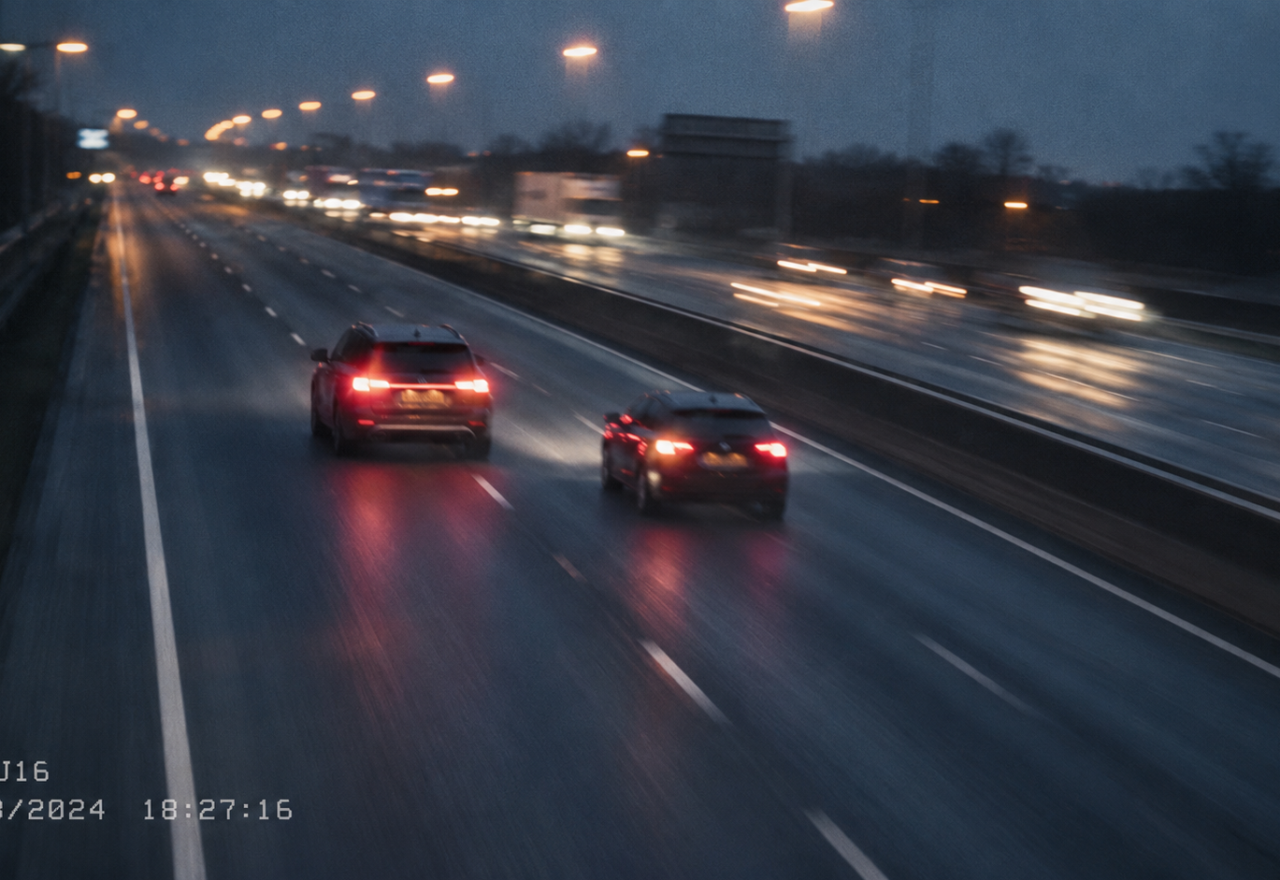
A collision on the M40, captured on camera, and a question the jury had to answer
The CCTV footage showed the collision. There was no dispute about that. A car travelling at approximately 80 miles per hour in the right-hand lane of the M40 lost control, crossed the carriageway and struck another vehicle in the left lane. Both cars left the motorway. One person died. Another was seriously injured.
The Crown said it was deliberate. The prosecution’s case was that our client had been driving dangerously before the collision, overtaking and undertaking other vehicles, and that the manoeuvre caught on camera was a conscious, reckless decision that caused the fatal crash.
Our client said he could not recall much of the incident. He had been involved in a catastrophic collision. The trauma had affected his memory.
If you are reading this because you or someone close to you has been involved in a fatal road traffic collision, two questions are probably running together. Can the CCTV prove it was deliberate? And what is the difference between dangerous and careless driving? This guide answers both. It uses our client’s case to explain what the Crown must prove, why expert evidence is not the last word and what a defence team can achieve by refusing to accept conclusions at face value.
Stuart Miller Solicitors acts for people accused of serious road traffic offences, including causing death by dangerous driving. Our client was acquitted of the most serious charges and convicted of the lesser offence of causing death by careless driving. This guide uses his case to explain the law, the evidence and the process.
The Allegation
The Crown charged our client with causing death by dangerous driving and causing serious injury by dangerous driving. Both charges arose from a single collision on the M40 motorway.
The prosecution’s case was that, before the point of impact, our client had been driving dangerously, overtaking and undertaking other vehicles at speed. The Crown then alleged that, at approximately 80 miles per hour in the right-hand lane, our client deliberately executed a dangerous manoeuvre that was captured on CCTV. The manoeuvre caused his car to lose control, cross the motorway and collide with another vehicle in the left lane. Both vehicles left the carriageway. One person in the other vehicle died. Another occupant sustained serious injuries.
The Crown relied heavily on the CCTV footage and on statements from several witnesses who alleged that our client had been driving dangerously in the moments before the collision.
The defence did not dispute that a collision occurred or that the consequences were tragic. What the defence disputed was the characterisation of the driving. The defence case was that our client’s driving was careless, not dangerous, that the loss of control was not a deliberate manoeuvre but an error of judgment that fell below the standard of a competent driver without falling far below it.
The record does not say what type of vehicles were involved, the weather conditions at the time, the traffic density on the M40 or the identities of the deceased and the injured person. It does not say what the witness statements described in detail or what the collision experts concluded about the precise mechanics of the impact. We have added none of it.
The dispute the record identifies is about the standard of driving. Was it dangerous, far below the standard of a competent driver, or careless, below the standard but not far below it?
Causing death by dangerous driving: the law in plain English
What the Crown must prove
Causing death by dangerous driving is an offence under section 1 of the Road Traffic Act 1988. The Crown must prove three things so that the jury is sure:
- The defendant was driving a mechanically propelled vehicle on a road or other public place.
- The defendant’s driving caused the death of another person. Causation does not require the defendant to be the sole cause. It is enough that the driving was a significant contributing cause.
- The defendant was driving dangerously. This is the element that distinguishes the offence from the lesser charge of causing death by careless driving.
The legal definition of dangerous driving
Section 2A of the Road Traffic Act 1988 defines dangerous driving. A person drives dangerously when:
- the way they drive falls far below what would be expected of a competent and careful driver; and
- it would be obvious to a competent and careful driver that driving in that way would be dangerous.
The word “far” is critical. It is the single word that separates dangerous driving from careless driving, and it is the word the jury must focus on.
The legal definition of careless driving
Careless driving, also known as driving without due care and attention, is defined under section 3 of the Road Traffic Act 1988. A person drives carelessly when their driving falls below, not far below, what would be expected of a competent and careful driver.
The difference between “below” and “far below” is a matter of degree, and it is for the jury to decide where on that spectrum the defendant’s driving falls. The distinction can seem subtle in the abstract, but in practice it is the difference between a sentence of over ten years and one of three years and three months.
Causing death by careless driving: the lesser alternative
Causing death by careless driving is an offence under section 2B of the Road Traffic Act 1988. It is a lesser alternative to causing death by dangerous driving, and a jury can convict on this charge even if the defendant was originally charged only with the more serious offence.
The maximum sentence for causing death by careless driving is five years’ imprisonment. The maximum for causing death by dangerous driving is life imprisonment, following the changes introduced by the Police, Crime, Sentencing and Courts Act 2022.
Causing serious injury by dangerous driving
Causing serious injury by dangerous driving is an offence under section 1A of the Road Traffic Act 1988. It carries a maximum sentence of two years’ imprisonment. The elements mirror those of causing death by dangerous driving, with the substitution of serious injury for death.
The record says our client was charged with both causing death and causing serious injury by dangerous driving, reflecting the fact that the collision resulted in one fatality and one serious injury.
CCTV, collision experts and the limits of technical evidence
What CCTV can and cannot show
CCTV footage of a road traffic collision can show the movement of vehicles, their speed, their position on the carriageway and the moment of impact. It is powerful evidence, and juries tend to give it significant weight.
What CCTV cannot show is the driver’s state of mind. A manoeuvre that looks sudden and dramatic on camera may be the result of a mechanical failure, a medical episode, a momentary distraction or a misjudgment of speed and distance. The camera records the vehicle’s movement, not the driver’s intention.
The Crown’s case in this instance treated the manoeuvre captured on CCTV as evidence of deliberate dangerous driving. The defence argued that the same footage was consistent with a loss of control that was careless rather than dangerous.
Collision investigation experts
Collision investigators are specialists who analyse the physical evidence from a road traffic collision, skid marks, vehicle damage, debris patterns, road geometry and CCTV footage, to reconstruct the events leading up to the impact.
Expert evidence is admissible where it gives the court information outside its own experience (R v Turner [1975] QB 834). Experts owe their duty to the court, not to the party who instructs them (Criminal Procedure Rules, Part 19). Their evidence is weighed alongside everything else, and the jury is not obliged to accept it.
In this case, the collision experts instructed by the defence sided with the prosecution’s analysis. That is a significant fact. It means the defence was challenging not only the Crown’s experts but also its own.
Why the defence did not accept the expert consensus
The record describes the defence’s approach in striking terms: the team did not accept what was being presented based on their own experience of driving and common sense.
This is a critical point. Expert evidence is not infallible. Collision reconstruction involves assumptions about speed, road conditions, vehicle handling and driver reaction times. Those assumptions can be tested, and the conclusions drawn from them can be challenged.
The defence team’s position was that a manoeuvre captured on CCTV, however dramatic it may appear, does not by itself prove that the driver intended to drive dangerously. A momentary loss of control at motorway speeds can have catastrophic consequences without amounting to driving that falls far below the standard of a competent driver.
The jury agreed. They found that the driving was careless, not dangerous.
Voluntary interviews and the right to silence
What a voluntary interview is
Our client was interviewed under caution but was not arrested. This is known as a voluntary interview, and it is governed by PACE Code C in the same way as an interview following arrest. The key difference is that the suspect is free to leave at any time and is not held in custody.
A voluntary interview does not carry less legal weight than a custodial interview. Anything said in a voluntary interview is admissible in evidence, and the same rules about cautions, legal advice and recording apply.
No comment and the limits of memory
Our client gave a no comment interview. The record explains the context: he had been involved in a very serious collision and could not recall very much. In a case involving a catastrophic motorway crash, the physical and psychological trauma can affect a person’s memory in ways that are well-documented in the medical literature.
A no comment interview in these circumstances is not an evasion. It is a recognition that the defendant cannot give a reliable account immediately after a traumatic event and that the investigation, including collision analysis and CCTV review, must be completed before a meaningful defence can be formulated.
Under sections 34 to 38 of the Criminal Justice and Public Order Act 1994, a jury may in some circumstances draw an adverse inference from a defendant’s silence. However, the inference cannot be the sole basis for a conviction, and the Crown must still prove its case on the evidence as a whole.
The record does not say whether the Crown invited the jury to draw adverse inferences from the no comment interview. We have not speculated.
What was at stake
Causing death by dangerous driving carries a maximum sentence of life imprisonment following the changes introduced by the Police, Crime, Sentencing and Courts Act 2022. Prior to those changes, the maximum was 14 years. The Sentencing Council’s guideline for causing death by dangerous driving sets starting points based on the level of culpability, ranging from a starting point of eight years for the highest level to two years for the lowest.
The record says our client was facing a sentence in excess of ten years had he been convicted of the original charges. That is consistent with a high-culpability case involving a motorway collision at speed with multiple victims.
Causing death by careless driving carries a maximum of five years’ imprisonment. The Sentencing Council’s guideline sets a starting point of 18 months for the highest level of carelessness, with a range of up to three years.
Our client was sentenced to three years and three months. The difference between that sentence and the ten-plus years he was facing on the original charges is the difference between a sentence from which a person can realistically rebuild their life and one that would have consumed more than a decade.
Other consequences of a conviction for causing death by dangerous driving include a mandatory disqualification from driving for at least two years, an extended retest requirement and the lifelong impact of a conviction for a homicide offence. The record does not detail the driving disqualification imposed in this case.
The wait, and what trial preparation looks like in a fatal collision case
The record gives limited detail about the timeline, and we have not built one beyond what is stated.
What the record does describe is a process that is characteristic of serious road traffic cases: the collision occurs, the police investigate, CCTV is recovered, collision experts are instructed, witness statements are taken and the defendant is interviewed. All of this takes time, and the defence cannot begin to formulate its case until the technical evidence is complete.
The record emphasises the importance of maintaining regular and detailed consultations with the defendant throughout the trial preparation. In a case where the defendant’s memory of the incident is affected by trauma, these consultations are essential. The defence team must understand the defendant’s account, however incomplete, and must align the legal strategy with what the defendant can and cannot say.
The record does not say how long the investigation lasted, when the charges were brought or how long the trial itself took. We have not guessed.
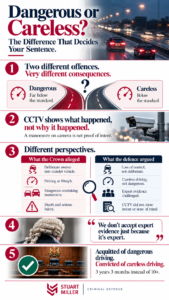
How the defence was built
The record describes the defence strategy in clear terms. We set out what it says and stop where it stops.
Conducting a thorough review of the CCTV footage
- The problem: the Crown’s case relied heavily on CCTV footage that appeared to show our client executing a dangerous manoeuvre at speed on the M40.
- The legal point: CCTV shows what a vehicle did. It does not show why the driver acted as they did or whether the driving fell far below the standard of a competent driver, as opposed to below it.
- The action: the defence team conducted a thorough, frame-by-frame review of the CCTV footage, analysing the vehicle’s movements in the context of the road layout, traffic conditions and the moments leading up to the loss of control.
- Why it mattered: the detailed review allowed the defence to challenge the Crown’s characterisation of the manoeuvre and to argue that the footage was consistent with a momentary loss of control rather than a deliberate act of dangerous driving.
Challenging expert evidence, including our own
- The problem: the collision experts instructed by the defence sided with the prosecution’s analysis. The technical consensus was against our client.
- The legal point: expert evidence is not binding on the jury. Experts owe their duty to the court, and their conclusions can be tested and challenged like any other evidence. The jury is entitled to reach its own conclusion based on the evidence as a whole, including common sense and their own experience of driving.
- The action: the defence did not accept the expert consensus. The team applied their own experience of driving and common sense to the evidence and argued that the experts’ conclusions did not necessarily follow from the footage and the physical evidence.
- Why it mattered: the jury accepted the defence’s argument. They found that the driving was careless, not dangerous, despite the expert evidence pointing the other way. This is a powerful illustration of the principle that expert opinion is evidence to be weighed, not a conclusion to be accepted without question.
Maintaining detailed consultations with the defendant
- The problem: our client could not recall much of the incident due to the trauma of the collision. His memory was incomplete, and the defence could not rely on a detailed account from him.
- The legal point: a defendant’s account, however limited, is central to the defence case. The legal team must understand what the defendant can and cannot say and must build the strategy around those limitations.
- The action: the defence team maintained regular and detailed consultations with our client throughout the trial preparation, ensuring that his version of events was clearly understood and that the defence strategy was aligned with his instructions.
- Why it mattered: the consultations ensured that the defence case was grounded in the defendant’s own experience and that the team did not advance arguments inconsistent with what the client could honestly say.
Focusing the jury on the legal distinction between dangerous and careless
- The problem: the collision was catastrophic, the consequences were tragic and the CCTV footage was dramatic. The emotional weight of the case risked overwhelming the legal distinction between dangerous and careless driving.
- The legal point: the jury must apply the legal test, not their emotional reaction to the outcome. The question is whether the driving fell far below the standard of a competent driver, not whether the consequences were severe.
- The action: the defence focused the jury’s attention on the precise legal distinction between “below” and “far below” and argued that the driving, while imperfect and tragic in its consequences, did not cross the threshold into dangerous driving.
- Why it mattered: the jury acquitted on the dangerous driving charges and convicted on the lesser offence of causing death by careless driving. They drew the line exactly where the defence argued it should be drawn.
A spokesman for Stuart Miller Solicitors said:
“Expert evidence is not the end of the argument. In this case, even our own experts agreed with the prosecution, but we did not accept that the driving was dangerous. We looked at the footage, we listened to our client, and we applied common sense. The jury agreed that careless is not the same as dangerous, and that distinction saved our client from more than ten years in prison.”
We do not say any one step produced the verdict. A jury gives no reasons.
The verdict, and what it did and did not resolve
Our client was acquitted of causing death by dangerous driving and causing serious injury by dangerous driving. He was convicted of the lesser offence of causing death by careless driving and sentenced to three years and three months’ imprisonment.
Precisely:
- The acquittal on the dangerous driving charges followed a trial. The Crown’s evidence was heard and tested. It means the Crown did not prove dangerous driving so that the jury was sure.
- The conviction for careless driving is a finding that the driving fell below, but not far below, the standard of a competent driver. The jury drew a clear distinction between the two standards.
- The sentence reflects the lesser offence. Three years and three months is a significant sentence, but it is substantially less than the ten-plus years our client was facing on the original charges.
- A jury gives no reasons. We cannot say whether the CCTV analysis, the challenge to the experts, the defendant’s account or anything else mattered most.
- The outcome does not diminish the tragedy. A person died and another was seriously injured. The verdict is about the legal characterisation of the driving, not about the severity of the consequences.
Some things to consider after a mixed outcome of this kind:
- Ask your solicitor to confirm in writing which charges were resolved and on what basis.
- Appeals against conviction or sentence have strict time limits, 28 days from the date of conviction or sentence. If an appeal is to be considered, take advice immediately.
- Ask about the driving disqualification period and the extended retest requirement.
- If the conviction affects your employment, insurance or immigration status, consider what steps are needed to manage those consequences.
Ask your solicitor to confirm in writing what was resolved and what, if anything, remains.
What to do now if you are accused of causing death by dangerous driving
What helps depends on the stage you are at.
Ask for a solicitor before any interview, including a voluntary one

A voluntary interview carries the same legal weight as a custodial interview. Anything you say is admissible in evidence. If you have been involved in a serious collision and your memory is affected by trauma, a no comment interview may be the safest course until the technical evidence is complete. Your solicitor will advise you on the risks and benefits.
Do not assume that CCTV proves dangerous driving
CCTV shows vehicle movements. It does not show the driver’s state of mind, the reason for a manoeuvre or whether the driving fell far below the standard of a competent driver. The same footage can be consistent with both dangerous and careless driving. Your solicitor should review the footage in detail and challenge the Crown’s interpretation where appropriate.
Do not assume that expert evidence is unchallengeable
Collision experts, medical experts and forensic scientists all provide opinions, not facts. Their conclusions depend on assumptions that can be tested. The jury is not obliged to accept expert evidence, and the defence is entitled to challenge it, even when the experts instructed by the defence agree with the prosecution. In this case, that willingness to challenge the consensus was decisive.
Preserve everything that supports your account
Dashcam footage, phone records, vehicle telemetry data, medical records and witness contact details can all be relevant. Do not delete messages, reset devices or dispose of any material connected to the incident. Tell your solicitor about every potential source of evidence, however minor it seems.
FAQs
-
What is the difference between dangerous driving and careless driving?
Dangerous driving is driving that falls far below the standard expected of a competent and careful driver, where it would be obvious to a competent driver that the driving was dangerous (Road Traffic Act 1988, s.2A). Careless driving is driving that falls below, but not far below, that standard (s.3). The word "far" is the critical distinction. It is a matter of degree for the jury to decide, and the difference in sentencing is substantial.
-
Can I be convicted of causing death by dangerous driving if the collision was an accident?
The term "accident" is not a legal defence. The question is whether the driving that led to the collision was dangerous or careless. A momentary error of judgment may amount to careless driving. A sustained course of driving that falls far below the standard of a competent driver may amount to dangerous driving. The jury decides where on the spectrum the driving falls based on all the evidence.
-
Does CCTV footage prove that my driving was dangerous?
CCTV footage shows what a vehicle did. It does not show why the driver acted as they did or whether the driving met the legal test for dangerous driving. A manoeuvre that looks dramatic on camera may be the result of a momentary loss of control, a mechanical issue or a misjudgment that falls short of the "far below" threshold. The defence is entitled to challenge the Crown's interpretation of the footage.
-
Can I challenge expert evidence if even my own experts agree with the prosecution?
Yes. Expert evidence is opinion, not fact. The jury is not obliged to accept it, and the defence is entitled to argue that the experts' conclusions do not necessarily follow from the evidence. In this case, the defence challenged the expert consensus and the jury agreed that the driving was careless rather than dangerous. The principle is that expert qualifications do not make an opinion unchallengeable.
-
What is a voluntary interview and should I attend one?
A voluntary interview is an interview under caution conducted without arrest. You are free to leave at any time, but anything you say is admissible in evidence and the same PACE rules apply as in a custodial interview. Whether to attend and whether to answer questions are decisions to take with a solicitor first. A no comment interview is a legitimate choice, particularly if your memory is affected by trauma or if the technical evidence has not yet been completed.
-
What sentence does causing death by dangerous driving carry?
The maximum sentence is life imprisonment, following the changes introduced by the Police, Crime, Sentencing and Courts Act 2022. The Sentencing Council's guideline sets starting points based on culpability, ranging from two years for the lowest level to eight years or more for the highest. The record says our client was facing a sentence in excess of ten years on the original charges.