-

Top 1% of Defence Law Firms
-

Defended over 50,000 Cases
-

5 star google reviews
-

40 Years of Criminal Law Expertise

A trial that went ahead without her
The jury heard the Crown’s case about a phone. It heard it without the defendant in court.
The record does not say why she was absent. It does not say when she stopped attending, whether she was on bail or what the court knew. We have not guessed at any of it.
It does say what the Crown’s case was built on: cell-site material and co-location data, said to link her to a drugs line and show she was a participant. Put plainly, the Crown treated the movement of a phone as the movement of the person.
If you are reading this because you are charged, or because someone close to you has missed court, two questions may be running together. Can they prove it from a phone? And what happens if I am not there? This guide answers both. It does not suggest that staying away is ever a sensible plan.
Stuart Miller Solicitors acts for people accused of drug supply and related offences, including cases built on phone evidence. Our client was found not guilty, and this guide uses her case to explain what the Crown must prove and what to do now.
The Allegation
The Crown alleged that our client was concerned in the supply of Class A drugs. Its case depended largely on mobile phone evidence. It argued that cell-site material and co-location data linked her to a drugs line and established her as a participant in the operation. Those are the Crown’s allegations, not findings.
The defence challenged the assumption that the movement of a phone was the movement of the person. It raised the point that a phone can be shared, taken or used by someone else. It also tested whether the Crown could prove knowledge and participation, not merely an association with a handset.
The record does not say which drug was alleged, how many charges there were or what tied the handset to her. It does not say what else the Crown relied on, whether defence evidence was called or what account, if any, was put on her behalf. We have added none of it.
The dispute the record identifies is about proof of her part. Could a handset’s movements be treated as hers, and could the Crown prove what she knew and did?
Concerned in the supply of Class A drugs: the law in plain English
What the Crown must prove
Being concerned in the supply of a controlled drug to another is an offence under section 4(3)(b) of the Misuse of Drugs Act 1971. It is wider than handing drugs over. Someone whose own acts form part of the supply can be caught.
Heroin and cocaine, including crack, are Class A drugs. The record does not say which drug was alleged here.
The Crown must prove what the defendant did and what they knew about it, so that the jury is sure. What the knowledge requirement involves is set out in case law, and your solicitor should explain how it applies to you.
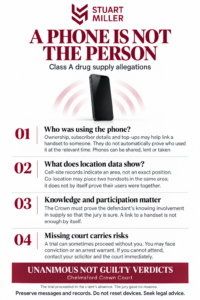
A phone is not the person
A phone case has two steps before it reaches the question the jury must decide. First, the Crown must show whose hands the handset was in. Second, it must show what that use proves about the person’s knowledge and part.
The first step is attribution, and it is not automatic. The Crown may try to attribute a handset through subscriber details, who topped it up, saved contacts, photographs, accounts logged in, patterns of use and a person’s other devices. Each of those has limits. People lend phones, share them, have them taken and leave them behind.
The record does not say what attribution evidence was used here.
What cell-site and co-location data can and cannot show
Cell-site analysis uses network records of which mast, and which sector of it, a handset connected to when it was used. A scientist can say whether use was consistent with an area. The area can be wide, and the data does not give an exact position.
Co-location analysis compares the records of different handsets to see whether they were in the same area at the same times. At most that suggests the handsets were in the same wide area. It does not show that their users were together, who the users were or why they were there.
Treating a phone’s movement as its user’s movement adds a further assumption. That was the assumption challenged here.
Expert opinion is admissible where it gives the court information outside its own experience (R v Turner [1975] QB 834). Experts owe their duty to the court (Criminal Procedure Rules, Part 19), and forensic providers are expected to meet quality standards set by the Forensic Science Regulator. A scientist’s evidence is weighed with everything else.
Knowledge and participation
Even if a handset is attributed to someone, the Crown must show what its use means. Messages sent, calls made and presence in an area are evidence of what a handset did. On their own they are not knowledge or participation by the person it is attributed to.
If you do not attend court: trial in absence
A Crown Court can try you in your absence. But the power is meant to be used with great care, and the risk of going ahead without you falls on you.
The leading authority is R v Jones [2002] UKHL 5. A defendant can waive the right to be present, and a court may go ahead without them, but only in the most guarded way. Among the matters the court weighs are:
- whether the absence is deliberate, or has an explanation;
- whether an adjournment would solve the problem, and for how long;
- whether the defendant is represented, and whether their lawyers can take instructions and cope;
- how far the defendant would be disadvantaged;
- the risk that the jury draws a wrong conclusion from the absence;
- the seriousness of the offence; and
- the public interest, and the interests of witnesses and other defendants, in a trial taking place reasonably promptly.
Where a trial goes ahead, the judge directs the jury that absence is not evidence of guilt and should not be held against the defendant. The detail depends on the case.
None of this makes absence safe. A defendant who is not there:
- can be convicted, and in some circumstances sentenced, without being present;
- may be arrested on a warrant, and if on bail may face a separate offence of failing to surrender (Bail Act 1976, s.6);
- may put at risk money or promises given by a surety; and
- is not there to give evidence or to instruct lawyers as the evidence unfolds. Lawyers act on instructions. Without them, they may be unable to put an account or take points that depend on what the defendant says, and may be unable to continue.
The record does not say why our client was absent, whether the defence opposed the trial going ahead or what instructions the team held. The outcome here is not a reason to stay away.
If you cannot attend because of illness, a crisis or fear, tell your solicitor and the court at once and give evidence. If you have already missed a hearing, call your solicitor now. Options narrow with delay.
What was at stake
Being concerned in the supply of a Class A drug carries a maximum sentence of life imprisonment (Misuse of Drugs Act 1971, Sch 4). That is a discretionary maximum, not a prediction.
The Sentencing Council’s drug offences guideline looks closely at role, which it describes as leading, significant or lesser, and at the quantity of drugs. An allegation of being a participant in a drugs line is an allegation about role. We state no category or starting point, because the quantity and the facts a court would find are not in the record. Nobody should be sentenced for a role the Crown cannot prove.
Absence adds stakes of its own. A defendant who does not attend may be arrested and brought back, may face a separate Bail Act matter and may be remanded because of missed hearings.
Other consequences are possibilities, not facts about our client. They include a permanent record, confiscation proceedings in some cases, effects on work, housing and caring responsibilities, and, for someone without British citizenship, immigration consequences.
The wait, and what a trial in absence means for the people around it
The record gives no timeline, and we have not built one. What follows is general context.
Phone cases generate a lot of material: handset extractions, message logs, network records and analysts’ reports. The defence has to review it, ask what is missing and, where it makes sense, get independent advice. That takes time, and any expert may need funding approval.
Three measures of delay are easily confused: time under investigation, time from charge to trial and time spent in custody. If someone is remanded, custody time limits apply. They are set by regulations and can be extended, so ask your solicitor for the current limit.
A trial that goes ahead without the defendant is hard to read about from outside. Families may not know where the person is, or may be carrying the consequences of missed hearings themselves. Those are general observations, not a description of our client’s circumstances, which the record does not give.
How the defence was built
The record describes the defence in a few lines. We set out what it says and stop where it stops.
Challenging the idea that a phone’s movement is the person’s
- The problem: the Crown’s case treated the movement of a phone as the movement of the person.
- The legal point: a handset’s records show what the handset did. Linking them to a person is a separate step the Crown must prove.
- The action: the defence challenged the assumption directly.
- Why it mattered: the Crown’s case depended largely on phone evidence.
Raising shared, taken or borrowed use
The record says the case raised a familiar issue in modern drugs prosecutions: a phone can be shared, taken or used by someone else. It does not say what evidence was put to the jury on that, or whether the defence called any.
Testing knowledge and participation, not association with a handset
The defence tested whether the Crown could prove knowledge and participation, not merely an association with a handset. That is the question that decides the offence, and phone data does not answer it by itself.
Working within a trial in absence
The trial continued without our client. The record does not say whether the defence opposed that, what instructions were held or what account was put. We claim no application, expert evidence or cross-examination.
A spokesman for Stuart Miller Solicitors said:
“Failing to attend court can look damaging, but it is not a substitute for evidence. The prosecution still has to prove the allegation, and in this case it could not.”
That is a point about the Crown’s burden of proof. It is not advice to stay away from court, which carries the risks set out above.
We do not say any one step produced the verdicts. A jury gives no reasons.
The verdicts, and what they did and did not resolve
At Chelmsford Crown Court, a jury returned unanimous not guilty verdicts after a trial that proceeded in our client’s absence.
Precisely:
- It was a verdict after a trial. The Crown’s evidence was heard and tested. It means the Crown did not prove its case so that the jury was sure.
- A jury gives no reasons. We cannot say whether the phone challenge, the absence or anything else mattered most.
- It is not a finding about who used the phone, or that no drugs line operated. The record says nothing about other defendants.
- It does not say the absence helped or hurt. The record is silent.
Some things do not end with a verdict:
- The record does not say whether any warrant, Bail Act matter or other proceeding arose from the absence. A not guilty verdict on the supply charges does not by itself resolve any of those.
- Ask what data police hold from phones and other sources, and for how long.
- If you paid privately, ask whether a defendant’s costs order is available. Limits apply.
- Property and devices should be returned.
Ask your solicitor to confirm in writing what was resolved and what remains.
What to do now if you are accused of being concerned in the supply of Class A drugs
What helps tonight depends on the stage you are at.
Ask for a solicitor before answering questions about the phone

Police station advice is free. You can ask for the duty solicitor or name a firm. In some circumstances a court can draw an inference if you later rely on something you could reasonably have mentioned when questioned. Whether, when and how to give an account is a decision to take with a solicitor first.
Say who had access to the phone
Who owned it, paid for it and knew the passcode? Who had the SIM? Was it lent, lost or taken? Where was it when you were somewhere else? Some answers feel awkward. A solicitor can only judge the Crown’s attribution case if they know what is true.
Preserve what shows where you were
Keep receipts, transport records, work logs, messages and anything showing your own movements. CCTV can be overwritten within days, so tell your solicitor where it might exist. Do not delete messages, reset devices or close accounts. If you hold a phone or SIM you are worried about, speak to your solicitor before doing anything with it.
FAQs
-
Can the police use my phone's location to prove I was involved in a drugs line?
They can use it as part of their case, but it does not decide it. Location data supports an inference about you only if the Crown proves the handset was with you and that you were its user. Phones are shared, lent, taken and left behind. The Crown must also prove what the use shows you knew and did.
-
What if someone else was using my phone?
The Crown must still prove that you were the user at the relevant times. It may rely on subscriber details, top-ups, contacts, photographs, accounts and patterns of use, and each can be tested. Tell your solicitor as early as you can who has had access to your handset and SIM, and when, and what happened to them.
-
Does owning or paying for a phone prove I used it for supply?
No. Ownership or payment is evidence the Crown may use to argue who the user was, but it does not show who used the handset at a particular time or what that person knew or did. Phones are lent, shared and supplied by others. The Crown must prove your own participation, not just your link to a handset.
-
Can a trial go ahead if I do not attend court?
Yes, in some circumstances. The Crown Court has a discretion to try a defendant in their absence, but must use it with great care and in the most guarded way (R v Jones [2002] UKHL 5). It looks at whether the absence is deliberate, whether an adjournment would help and how far you would be disadvantaged. It is a risk you should not take.
-
If I am absent, will the jury assume I am guilty?
It should not. Juries are directed that absence is not evidence of guilt and must not be held against the defendant, although the detail depends on the case. But absence still carries real risks, including that nobody can give your account as the evidence unfolds. Do not rely on a direction to protect you.
-
Can I be convicted and sentenced if I am not there?
Yes. If the trial goes ahead in your absence you can be convicted, and in some circumstances sentence can be passed without you too. A conviction is not undone simply because you were not present. Appeals are possible but have strict time limits, so take advice at once rather than waiting to be found.
-
What sentence can being concerned in the supply of Class A drugs carry?
The maximum is life imprisonment, which is discretionary and not a prediction. The Sentencing Council's drug offences guideline looks at role, such as leading, significant or lesser, and at the quantity of drugs, so what the Crown proves about your part matters. Nobody should be sentenced for a role the Crown has not proved.