-

Top 1% of Defence Law Firms
-

Defended over 50,000 Cases
-

5 star google reviews
-

40 Years of Criminal Law Expertise
Seven defendants, two cars, one shooting, and the only driver to walk free
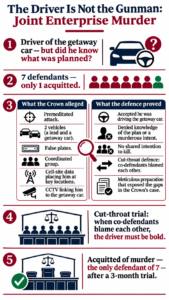
A man was shot dead on a busy road in North London. The prosecution said it was a premeditated, gang-related attack carried out by a coordinated group of seven males. Two vehicles were involved, both displaying false registration plates. A Jaguar was used to deliver the gunman to the scene and to take him away afterwards.
Our client was the driver of that Jaguar.
He did not deny it. What he denied was knowing what was about to happen. He said he had no knowledge of the plan, no awareness that anyone in the group was armed and no intention to assist in a killing.
The trial lasted three months. Seven defendants sat in the dock. Co-defendants pointed fingers at each other in what lawyers call a cut-throat trial, the most dangerous kind of multi-handed case, where every defendant’s evidence is a potential weapon against every other.
If you are reading this because you have been accused of murder as a driver in a group incident, two questions are probably running together. Can they convict me for a shooting I did not carry out? And what happens when the other defendants try to blame me? This guide answers both. It uses our client’s case to explain what the Crown must prove in a joint enterprise murder trial when the defendant is the driver, and what a defence team can achieve through bold decisions and meticulous preparation.
Stuart Miller Solicitors acts for people accused of the most serious violent offences, including multi-handed murder trials. Our client was the only defendant of seven to be acquitted. This guide uses his case to explain the law, the evidence and the process.
The Allegation
The Crown alleged that our client was guilty of murder on a joint enterprise basis. The charge arose from a fatal shooting on a main road in North London in September 2021. The deceased was a young man. The prosecution described the incident as a premeditated gang-related attack.
The Crown’s case was that a group of seven males coordinated the shooting. Two vehicles were involved, both displaying false registration plates. A Jaguar was used to deliver the gunman to the scene and to extract him afterwards. The group used an area behind some garages to congregate before and after the shooting. The prosecution alleged that our client was the driver of the Jaguar.
The Crown relied on extensive CCTV footage, including footage of the area behind the garages where the group was said to have gathered. Cell-site evidence was used to show the locations of the defendants’ phones at the time of the offence. After the shooting, attempts were made to destroy the Jaguar by fire, but the attempt was only partially successful. DNA was recovered from a latex glove worn by the gunman during the shooting.
Our client accepted that he was the driver of the Jaguar. What he denied was any knowledge of what was to take place. He said he did not know that anyone in the group was armed, that a shooting was planned or that his driving would be used to facilitate a killing.
The record does not say what our client’s relationship was with the other defendants, how he came to be driving the Jaguar, what he was told about the purpose of the journey or what he saw in the area behind the garages. It does not say what the co-defendants alleged about him or what evidence they gave in their own defence. It does not say whether the DNA on the latex glove matched any of the defendants. We have added none of it.
The dispute the record identifies is about knowledge and intention. Our client was the driver. The question the jury had to answer was whether he knew what was planned and whether he shared the intention to kill or cause really serious harm.
Joint enterprise murder and the driver’s role: the law in plain English
What the Crown must prove
Murder is a common law offence. The Crown must prove that the defendant unlawfully killed another person and that, at the time, the defendant intended to kill or cause really serious harm. The sentence is mandatory life imprisonment.
In a joint enterprise case, the Crown does not have to prove that the defendant fired the gun. It can argue that the defendant is guilty as a secondary party, someone who assisted or encouraged the principal offender and shared the relevant intention.
The law on joint enterprise was restated by the Supreme Court in R v Jogee [2016] UKSC 8. The court corrected a long-standing error that had allowed juries to convict on the basis that a defendant merely foresaw what the principal might do. Foresight is evidence of intention, but it is not the same thing. After Jogee, the Crown must prove that the secondary party:
- intended to assist or encourage the principal offender’s acts; and
- intended that the principal would act with the mental element required for the offence, in a murder case, an intention to kill or cause really serious harm.
The driver in a joint enterprise shooting
A driver’s role in a joint enterprise shooting is a question of fact for the jury. The Crown may argue that the driver was essential to the plan, delivering the gunman to the scene, waiting during the shooting and extracting the gunman afterwards. If the driver knew what was planned and intended to assist, the driver is as guilty of murder as the gunman.
But driving a vehicle is not, by itself, proof of knowledge or intention. A person may drive others to a location without knowing what they plan to do there. A person may be asked to drive a car at short notice without being told the purpose of the journey. A person may suspect something is wrong but not know that a killing is about to take place.
The jury must consider:
- what the driver knew before the journey began;
- what the driver was told about the purpose of the trip;
- what the driver saw and heard at the congregation point;
- whether the driver was aware that anyone in the group was armed;
- what the driver did during and after the incident; and
- whether the driver’s actions are consistent with knowledge of the plan or with an innocent explanation.
Conditional intention
The law recognises that a defendant may have a conditional intention, an intention to assist if a particular event occurs. In a joint enterprise case, the Crown may argue that the driver agreed to assist the group whatever happened, including a shooting. The jury must decide whether the evidence supports that conclusion.
The record says our client denied any knowledge of what was to take place. The defence case was that he did not have even a conditional intention to assist in a killing because he did not know a killing was planned.
Cut-throat trials: when co-defendants become the enemy
What a cut-throat trial is
A cut-throat trial is a multi-handed trial in which co-defendants seek to shift blame onto one another. Each defendant’s evidence may implicate the others, and the defence teams may cross-examine each other’s clients as aggressively as the Crown cross-examines them.
In a trial with seven defendants, the dynamics are extraordinarily complex. Each defendant has their own legal team, their own instructions and their own strategy. The evidence given by one defendant may directly contradict the evidence given by another. The jury must assess each defendant’s case individually, but the sheer volume of competing accounts can make that task overwhelming.
The risks for the driver
In a cut-throat trial involving a shooting, the driver is often the easiest target for co-defendants. The gunman may say the driver knew everything. The organisers may say the driver was part of the plan. The passengers may say the driver was told what was going to happen. Each co-defendant has an incentive to minimise their own role and maximise the driver’s.
The record describes this case as requiring “bold and brave decisions.” In a cut-throat trial, the driver’s defence team must decide whether to attack the co-defendants’ evidence, whether to give evidence themselves and how to navigate the competing narratives without exposing their client to devastating cross-examination from six other defence teams.
The decision to give evidence
In a cut-throat trial, the question of whether the defendant should give evidence is one of the most consequential a defence team faces. If the defendant gives evidence, they risk being cross-examined not only by the Crown but by the legal teams of six co-defendants, each of whom may seek to implicate them. If the defendant does not give evidence, the jury may draw adverse inferences under section 35 of the Criminal Justice and Public Order Act 1994.
The record does not say whether our client gave evidence. We have not stated that he did or did not. The point is that the decision was taken deliberately, with full awareness of the risks on both sides, and as part of the “bold and brave” strategy the record describes.
CCTV, cell-site evidence and the limits of digital proof
What the CCTV showed
The Crown relied on extensive CCTV footage, including footage of the area behind the garages where the group was said to have congregated before and after the shooting. The police carried out extensive CCTV work to trace the movements of the two vehicles and the individuals involved.
CCTV can show who was in an area, what vehicles were present and how a group moved together. It cannot show what someone knew, what they intended or what conversations took place inside a vehicle. The leading authority on identification from CCTV is R v Turnbull [1977] QB 224, which requires the court to consider the quality of the image, the circumstances of the recording and whether there is supporting evidence.
The record does not say what the CCTV showed our client doing at the critical moments or whether the footage identified him individually in the area behind the garages. We have not guessed.
What cell-site evidence can and cannot show
Cell-site analysis uses network records of which mast a handset connected to when it was used. A scientist can say whether use was consistent with an area. The data does not give an exact position, and it shows where a phone was, not where the person was.
In a case with seven defendants and multiple vehicles, cell-site data can be used to show that the defendants’ phones were in the same area at the same time. But co-location of phones does not prove a shared plan, and the presence of a phone in an area does not prove that its owner knew what was about to happen there.
Expert opinion is admissible where it gives the court information outside its own experience (R v Turner [1975] QB 834). Experts owe their duty to the court (Criminal Procedure Rules, Part 19).
The DNA on the glove
The record says DNA was recovered from a latex glove worn by the gunman during the shooting. The record does not say whose DNA was on the glove or whether it matched any of the seven defendants. The point is that the DNA evidence related to the gunman, not to the driver. Our client’s case was that he was the driver, not the gunman, and the DNA evidence did not link him to the shooting itself.
What was at stake
Murder carries a mandatory life sentence. There is no discretion. The judge must impose a life sentence and set a minimum term under Schedule 21 of the Sentencing Act 2020.
For a murder involving the use of a firearm brought to the scene, the starting point for the minimum term is 30 years for an adult defendant. The judge may increase or decrease the minimum term based on aggravating and mitigating factors, including the defendant’s role, the degree of planning and the number of people involved.
Had our client been convicted, he would have faced a life sentence with a minimum term of potentially 25 to 30 years or more. At his age, that could have meant spending the rest of his life in prison.
The record says six of the seven defendants were convicted. Our client was the only one acquitted. The difference between his outcome and theirs is the difference between freedom and a life sentence.
Other consequences are possibilities, not facts about our client. They include the lifelong impact of a murder conviction, the loss of any realistic prospect of rehabilitation during adulthood and, for anyone without British citizenship, immigration consequences including deportation.
The wait, and what a three-month trial means for seven defendants
The record gives limited detail about the timeline, and we have not built one beyond what is stated. It confirms that the trial lasted three months and that our client was acquitted.
A three-month trial with seven defendants is one of the most demanding proceedings in the criminal courts. The volume of evidence is vast: extensive CCTV footage from multiple cameras, cell-site data for seven defendants’ phones, forensic evidence from the scene and the vehicles, witness statements, phone extractions and the competing accounts of seven co-defendants.
The record describes the defence preparation as extensive, involving detailed and meticulous instructions. In a cut-throat trial, the preparation must go beyond the Crown’s case. The defence must anticipate what each co-defendant will say, prepare for cross-examination from six other defence teams and develop a strategy that protects the client from the competing narratives.
For the defendants, three months in the dock means three months of listening to evidence about a killing, watching co-defendants point fingers and waiting for the jury to decide whether the Crown’s case is strong enough to convict. The psychological toll is immense.
The record does not say whether our client was on bail or remanded in custody during the trial, how long the investigation lasted before the charges were brought or what impact the proceedings had on his family. We have not guessed.
How the defence was built
The record describes the defence strategy in clear terms. We set out what it says and stop where it stops.
Accepting the driving, denying the knowledge
- The problem: the Crown’s case placed our client behind the wheel of the Jaguar used to deliver and extract the gunman. CCTV and cell-site evidence supported his presence at the scene.
- The legal point: driving a vehicle is not proof of knowledge or intention. The Crown must prove that the driver knew what was planned and shared the intention to kill or cause really serious harm (R v Jogee [2016] UKSC 8).
- The action: the defence accepted that our client was the driver. It denied that he had any knowledge of what was to take place, any awareness that anyone was armed or any intention to assist in a killing.
- Why it mattered: by accepting what the evidence plainly showed, the defence avoided fighting a losing battle on identification and focused the jury’s attention on the real question, what our client knew and intended.
Navigating the cut-throat dynamics
- The problem: seven defendants, one killing, and six co-defendants who had every incentive to shift blame onto the driver.
- The legal point: in a cut-throat trial, each defendant’s evidence is potentially a weapon against every other defendant. The defence must anticipate the co-defendants’ strategies and protect the client from hostile cross-examination.
- The action: the record describes the decisions taken as “bold and brave.” The defence team prepared extensively, taking detailed and meticulous instructions to ensure that every possible line of attack from the co-defendants was anticipated and addressed.
- Why it mattered: the cut-throat dynamics could easily have overwhelmed a less prepared defence. The meticulous preparation allowed the team to navigate the competing narratives and protect our client’s position.
Challenging the inference from presence
- The problem: the Crown’s case treated our client’s presence as the driver as evidence of his participation in the killing.
- The legal point: presence at the scene is not participation in a joint enterprise. The Crown must prove shared intention, not proximity (R v Jogee [2016] UKSC 8).
- The action: the defence challenged the assumption that driving the Jaguar meant our client knew what was planned. The defence argued that a driver can be used by others without being told the full picture.
- Why it mattered: the jury was directed to consider whether the Crown had proved knowledge and intention, not merely presence. The acquittal suggests the jury was not satisfied that the Crown had met that burden.
Preparing for a three-month trial
- The problem: a three-month trial with seven defendants, extensive CCTV, cell-site data, forensic evidence and competing accounts requires an extraordinary level of preparation.
- The legal point: effective defence in a multi-handed trial requires a thorough understanding of every piece of evidence, every co-defendant’s likely account and every potential line of cross-examination.
- The action: the defence team prepared extensively, taking detailed and meticulous instructions from our client and reviewing the vast body of evidence.
- Why it mattered: the preparation allowed the defence to respond to the Crown’s case and the co-defendants’ evidence as it unfolded over three months, maintaining a consistent and credible defence throughout.
A spokesman for Stuart Miller Solicitors said:
“Being the driver does not make you the gunman. In this case, our client accepted he was behind the wheel, but he did not know what was about to happen. In a cut-throat trial with seven defendants, where everyone is pointing fingers at everyone else, it takes bold decisions and meticulous preparation to protect a client’s position. Our client was the only one of seven to be acquitted, and that result speaks for itself.”
We do not say any one step produced the acquittal. A jury gives no reasons.
The verdict, and what it did and did not resolve
After a three-month trial, our client was acquitted of murder. He was the only defendant of seven to be acquitted.
Precisely:
- It was a verdict after a full trial. The Crown’s evidence was heard and tested over three months. It means the Crown did not prove its case so that the jury was sure.
- A jury gives no reasons. We cannot say whether the challenge to knowledge, the cut-throat dynamics, the acceptance of driving or anything else mattered most.
- It is not a finding about who fired the gun or about the guilt or innocence of the other six defendants. The record says nothing about the sentences imposed on the co-defendants.
- It does not mean our client was not there. He accepted he was the driver. The verdict is about what the Crown could prove about his knowledge and intention, not about his location.
- The outcome is unique among the seven defendants. Six were convicted. One was acquitted. The different outcomes reflect the different evidence against each defendant and the jury’s individual assessment of each case.
Some things to consider after an acquittal:
- Ask your solicitor whether a defendant’s costs order is available if you funded your defence privately. Limits apply.
- Property and devices seized during the investigation should be returned where no longer required.
- Ask what data police retain from phone extractions, cell-site records and CCTV footage, and for how long.
- If the acquittal is connected to an ongoing investigation into the wider gang or the other defendants, ask your solicitor whether there is any risk of further charges.
Ask your solicitor to confirm in writing what was resolved and what, if anything, remains.
What to do now if you are accused of murder as a driver in a joint enterprise case
What helps depends on the stage you are at.
Ask for a solicitor before answering any questions

Murder is the most serious charge in the criminal calendar. If you are arrested in connection with a shooting, ask for legal advice before answering questions. Police station advice is free. You can ask for the duty solicitor or name a firm. Do not assume that explaining your role as the driver will clear things up, anything you say is admissible in evidence, and the Crown may use your own words to prove knowledge and intention.
Be honest about what you knew and what you did not
If you were the driver, tell your solicitor the full truth about what you were told before the journey, what you saw at the scene, whether you knew anyone was armed and what you understood the purpose of the trip to be. A solicitor can only build an effective defence if they have the complete picture. If you genuinely did not know a shooting was planned, that is your defence.
Prepare for the cut-throat dynamics
If you are one of several defendants, understand that your co-defendants may seek to blame you. The driver is often the easiest target. Your legal team must anticipate the co-defendants’ strategies and prepare for hostile cross-examination from their legal teams. The record describes this case as requiring “bold and brave decisions”, that is the reality of a cut-throat trial.
Do not assume that driving makes you guilty
The Crown must prove that you knew what was planned and shared the intention to kill or cause really serious harm. Driving a vehicle is evidence the Crown may rely on, but it is not proof of knowledge or intention by itself. The jury must consider the evidence as a whole, and the burden of proof remains on the Crown throughout.
FAQs
-
Can I be convicted of murder if I was only the driver?
Yes, in law. Under the doctrine of joint enterprise, a driver who assists the principal offender and shares the intention to kill or cause really serious harm can be convicted of murder even if they did not fire the gun. However, the Crown must prove that shared intention. Driving the vehicle is not, by itself, proof of knowledge or intention. The jury must be satisfied that you knew what was planned and intended to assist.
-
What is a cut-throat trial?
A cut-throat trial is a multi-handed trial in which co-defendants seek to shift blame onto one another. Each defendant's evidence may implicate the others, and the defence teams may cross-examine each other's clients. Cut-throat trials are particularly dangerous for defendants whose role, such as driving, makes them easy targets for co-defendants seeking to minimise their own involvement.
-
Does accepting that I was the driver weaken my defence?
Not necessarily. If the evidence plainly shows you were the driver, through CCTV, cell-site data or witness evidence, denying it may damage your credibility with the jury. By accepting what the evidence shows and focusing the dispute on knowledge and intention, the defence can direct the jury's attention to the real question: did you know what was planned? In this case, the defence accepted the driving and was acquitted.
-
What is joint enterprise?
Joint enterprise is a legal principle that allows more than one person to be convicted of the same offence. In murder cases, following the Supreme Court's decision in R v Jogee [2016] UKSC 8, the Crown must prove that the secondary party intended to assist or encourage the principal offender and intended that the principal would act with an intention to kill or cause really serious harm. Mere presence or association is not enough.
-
Can cell-site data prove I was involved in a shooting?
Cell-site data shows where a mobile phone was at a particular time, not where the person was or what they were doing. In a multi-handed case, cell-site data may show that the defendants' phones were in the same area, but co-location does not prove a shared plan. The Crown must prove knowledge and intention through other evidence as well.
-
What sentence does murder carry for a driver in a joint enterprise shooting?
Murder carries a mandatory life sentence for all defendants, including drivers. The judge sets a minimum term under Schedule 21 of the Sentencing Act 2020. For a murder involving a firearm brought to the scene, the starting point is 30 years for an adult. The judge may adjust the minimum term based on the defendant's role, the degree of planning and other factors. A driver who played a lesser role may receive a lower minimum term than the gunman, but the sentence is still life imprisonment.