-

Top 1% of Defence Law Firms
-

Defended over 50,000 Cases
-

5 star google reviews
-

40 Years of Criminal Law Expertise

Two weeks to prepare for a murder trial
The team came into the case two weeks before trial. The previous legal team could not continue due to professional embarrassment. Thousands of pages of evidence had to be reviewed. Experts had to be instructed. Site visits had to be carried out. Witness statements had to be taken. All of it in fourteen days, before a jury was sworn in a murder trial.
If you are reading this because you or someone close to you is facing a serious charge and the trial date is approaching, two questions are probably running together. Can anything meaningful be done at this stage? And does a forensic link to a weapon mean a conviction is inevitable? This guide answers both. It uses our client’s case to explain what the Crown must prove when it relies on DNA, cell site and CCTV evidence, and what a defence team can achieve even at the eleventh hour.
Stuart Miller Solicitors acts for people accused of the most serious violent offences, including murder, aggravated burglary and robbery. Our client was acquitted of murder and pleaded guilty on a limited basis to manslaughter. This guide uses his case to explain the law, the evidence and the process.
The Allegation
The Crown alleged that our client was part of a group of armed men riding e-bikes who had carried out what the prosecution described as a “violent rampage” in a town centre. He was charged with murder, aggravated burglary and robbery.
The prosecution’s case was that, before the fatal incident, the group had entered a house and attacked an occupant, and had also accosted a male on a bicycle and robbed him. The murder itself was alleged to have followed a chance meeting with the deceased, during which the group inflicted catastrophic injuries including the severing of both hands.
The Crown relied on cell site evidence from mobile phones, call records and DNA evidence recovered from a knife at the scene , a knife that belonged to the deceased and which forensic analysis matched to our client.
The defence case was that our client was not armed, that the group had happened upon the deceased by chance and that our client did not physically participate in the fatal attack by other co-defendants, notwithstanding the forensic connection to a weapon found at the scene.
The record does not identify every co-defendant, their roles or the exact sequence of events. It does not say where our client was positioned during the attack or what the CCTV showed him doing at the critical moment. We have added none of it.
The dispute the record identifies is about participation and intention. Did our client take part in a fatal attack, and did he share the intention required for murder? Or was his connection to the scene something less than the Crown alleged?
Murder, joint enterprise and the limits of forensic evidence
What the Crown must prove in a murder case
Murder is a common law offence. The Crown must prove that the defendant unlawfully killed another person and that, at the time, the defendant intended to kill or cause really serious harm. The sentence is mandatory life imprisonment.
In a joint enterprise case, the Crown does not have to prove that the defendant struck the fatal blow. It can argue that the defendant is guilty as a secondary party, someone who assisted or encouraged the principal offender and shared the relevant intention.
The law was restated by the Supreme Court in R v Jogee [2016] UKSC 8. The court corrected a long-standing error that had allowed juries to convict on the basis that a defendant merely foresaw what the principal might do. Foresight is evidence of intention, but it is not the same thing. After Jogee, the Crown must prove that the secondary party:
- intended to assist or encourage the principal offender’s acts; and
- intended that the principal would act with the mental element required for the offence , in a murder case, an intention to kill or cause really serious harm.
Manslaughter as an alternative verdict
Manslaughter is a lesser alternative to murder. A defendant can be guilty of manslaughter where there is an unlawful killing but the specific intention required for murder cannot be proved. There are several routes to a manslaughter verdict, including unlawful act manslaughter and gross negligence manslaughter, and in a joint enterprise case the defendant’s role and intention are central to which route, if any, applies.
A plea to manslaughter on a limited basis means the defendant admits a defined and bounded role in the killing, which the court accepts as the basis for sentence. A basis of plea must be realistic in light of the evidence, and the court can hold a Newton hearing if the Crown disputes it (R v Newton [1983] 77 Cr App R 13).
The record says our client was acquitted of murder and pleaded guilty on a limited basis to manslaughter. We do not go beyond the terms of that plea.
What DNA on a weapon can and cannot show
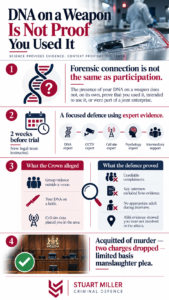
DNA evidence is powerful but limited. A DNA match on a weapon can show that the defendant’s genetic material was deposited on that item at some point. It cannot show:
- when the DNA was deposited;
- how it was transferred;
- whether the defendant touched the weapon directly or whether the DNA was transferred by secondary contact; or
- whether the defendant used the weapon in the offence alleged.
Secondary and tertiary transfer of DNA is a well-documented phenomenon. A defendant’s DNA can end up on an object through handshakes, shared clothing, surfaces touched by others or innocent contact with a person who later handled the item. The forensic sciences body of literature and the Forensic Science Regulator’s guidance both recognise these limitations.
In this case, the knife bearing our client’s DNA belonged to the deceased. That fact alone raises questions about how and when any contact occurred. The record does not set out the full forensic analysis, and we have not speculated on it.
What cell site evidence can and cannot show
Cell site analysis uses network records of which mast, and which sector of it, a handset connected to when it was used. A scientist can say whether use was consistent with an area. The area can be wide, and the data does not give an exact position.
Treating a phone’s movement as its user’s movement adds a further assumption. A phone can be shared, lent, taken or carried by someone else. The Crown must prove that the handset was with the defendant and that the defendant was its user at the relevant times.
Expert evidence on cell site is admissible where it gives the court information outside its own experience (R v Turner [1975] QB 834). Experts owe their duty to the court (Criminal Procedure Rules, Part 19). A scientist’s evidence is weighed with everything else.
Police station interviews and the appropriate adult requirement
Before our firm was instructed, our client had been represented by other solicitors at the police station. He initially gave a no comment interview and then gave an account in a subsequent interview. The Crown sought to rely on that account to argue dishonesty.
The problem was that the subsequent interview had been conducted without the presence of an appropriate adult.
Under Code C of the Police and Criminal Evidence Act 1984 (PACE), an appropriate adult must be present during the interview of a juvenile or a vulnerable person. The appropriate adult’s role is to safeguard the interests of the person being interviewed, to ensure they understand what is happening and to facilitate communication.
Where an interview is conducted in breach of Code C, the defence can apply to exclude the interview under section 78 of PACE on the basis that its admission would have such an adverse effect on the fairness of the proceedings that it ought not to be admitted. The court weighs the breach, the circumstances and the impact on the fairness of the trial.
The defence applied to exclude the interview on the grounds that no appropriate adult had been present. Following legal argument, the court excluded the interview. The Crown could no longer rely on it.
The record does not set out the full legal argument or the court’s reasoning. The outcome is what the record records.
What was at stake
Murder carries a mandatory life sentence. There is no discretion. The judge must impose a life sentence and set a minimum term that the defendant must serve before being considered for parole. The starting points for the minimum term are set out in Schedule 21 of the Sentencing Act 2020, and the facts of a murder involving a weapon brought to the scene by the defendant can attract a starting point of 25 years for an adult.
Aggravated burglary under section 10 of the Theft Act 1968 , burglary with a weapon of offence , carries a maximum of life imprisonment. Robbery under section 8 of the Theft Act 1968 also carries a maximum of life imprisonment.
Manslaughter carries a maximum of life imprisonment, but it is a discretionary maximum, not a mandatory one. Sentencing is governed by the Sentencing Council’s manslaughter guidelines, which look at the defendant’s role, the degree of participation and the harm caused.
Our client was sentenced to seven years and ten months’ imprisonment following his plea on a limited basis to manslaughter. The acquittal on murder and the dropping of the burglary and robbery charges materially altered the sentencing landscape.
Other consequences of these charges, had the Crown succeeded in full, would have included an indeterminate life sentence with a very substantial minimum term, a lifelong label as a convicted murderer and the collapse of any realistic prospect of rehabilitation during adulthood.
The wait, and what two weeks to trial looks like for a defence team
The record describes a timeline in stark terms: the firm came into the case two weeks before trial. Everything had to be done in that period.
Reviewing thousands of pages of evidence in two weeks requires a focused team working to a disciplined schedule. The defence had to:
- read and analyse the Crown’s served evidence;
- identify the expert issues on DNA, cell site and CCTV and instruct suitable experts;
- commission enhancement of CCTV footage to identify key features;
- carry out site visits of the area to understand the geography and test the Crown’s narrative;
- take witness statements from the client’s family lawyer and from an alibi witness;
- prepare an application to exclude the police interview;
- prepare for cross-examination of the Crown’s witnesses, including the complainants on the burglary and robbery counts; and
- consider whether an intermediary was needed and arrange a psychology assessment.
The record does not describe the hours involved or the division of work between the solicitors, counsel and experts. What the record does describe is the scope of the task and the fact that it was completed in time for trial.
How the defence was built
The record describes the defence strategy in detail. We set out the key elements and stop where the record stops.
Instructing the right experts at speed
- The problem: the Crown’s case rested on technical forensic and digital evidence , DNA on a knife, cell site data from mobile phones and CCTV footage said to identify our client.
- The legal point: expert evidence must be tested, not accepted. The Crown’s experts owe duties to the court, but the defence is entitled to its own expert opinion where the evidence is contested (Criminal Procedure Rules, Part 19).
- The action: the defence instructed DNA, cell site, CCTV and psychology experts, along with an intermediary, within the two weeks available.
- Why it mattered: without independent expert review, the Crown’s technical evidence can go unchallenged. The defence experts allowed the team to test the accuracy of the Crown’s conclusions and to identify weaknesses in the forensic and digital case.
Enhancing CCTV to test identification
- The problem: the Crown relied on CCTV footage to identify our client as a member of the group.
- The legal point: identification evidence must be scrutinised in accordance with the principles in R v Turnbull [1977] QB 224. The quality of the image, the circumstances of the recording and any supporting evidence all matter.
- The action: the defence commissioned enhancement of the CCTV footage to identify key features and to test whether the person said to be our client was in fact our client.
- Why it mattered: CCTV identification in fast-moving, multi-handed incidents is notoriously difficult. Enhancement can reveal distinguishing features that either confirm or undermine the Crown’s case.
Site visits and alibi evidence
- The problem: the Crown’s narrative described a sequence of events across a specific geography. The defence needed to understand the area to test that narrative.
- The legal point: a defendant is entitled to put forward an alibi and to call evidence in support of their account (Criminal Procedure and Investigations Act 1996, s.6A).
- The action: the defence conducted multiple site visits and took witness statements from the client’s family lawyer and from an alibi witness, to show mindset, whereabouts and to verify the client’s account.
- Why it mattered: evidence of what the client was doing, where he was and his state of mind went directly to the question of whether he shared the intention required for murder.
Excluding the police interview
- The problem: the Crown wanted to rely on an account given by our client in a police interview to argue dishonesty. That interview had been conducted without an appropriate adult present.
- The legal point: Code C of PACE requires an appropriate adult for juveniles and vulnerable persons. Section 78 of PACE allows the court to exclude evidence where its admission would adversely affect the fairness of the proceedings.
- The action: the defence applied to exclude the interview following legal argument.
- Why it mattered: the interview was excluded. The Crown could no longer invite the jury to draw conclusions about the client’s honesty from that account.
Dismantling the burglary and robbery charges
- The problem: our client faced three charges , murder, aggravated burglary and robbery. Each carried the maximum penalty of life imprisonment and together they painted a picture of sustained group violence.
- The legal point: every charge must be proved separately on its own evidence. A defendant is entitled to an acquittal on any count the Crown cannot prove.
- The action: the defence demonstrated the unreliability of the aggravated burglary complainant and obtained a concession from the robbery complainant , who personally knew our client , that our client was not one of the men who had robbed him that evening.
- Why it mattered: the Crown offered no evidence on both the burglary and robbery charges. The jury considered only the murder count, and the picture of a “violent rampage” was significantly narrowed before deliberations began.
Focusing the murder case on participation and intention
- The problem: the forensic connection between our client and a knife at the scene was potentially the Crown’s strongest evidence on murder.
- The legal point: DNA on a weapon shows contact at some point. It does not show participation in the fatal attack, nor does it establish the intention required for murder.
- The action: the defence was able to show that our client was not armed, that the group had happened upon the deceased by chance and that our client did not physically participate in the murderous attack by other co-defendants.
- Why it mattered: the jury acquitted of murder. The limited basis plea to manslaughter reflected a bounded admission consistent with the evidence as it emerged.
A spokesman for Stuart Miller Solicitors said:
“Coming into a murder case two weeks before trial is not where any defence team wants to be. But the Crown’s burden does not change because of the time pressure. Forensic evidence, cell site data and CCTV all have to be tested, and in this case that testing made the difference between a murder conviction and an acquittal.”
We do not say any one step produced the outcome. A jury gives no reasons.
The outcome, and what it did and did not resolve
Our client was acquitted of murder. He pleaded guilty on a limited basis to manslaughter and was sentenced to seven years and ten months’ imprisonment. The Crown offered no evidence on the aggravated burglary and robbery charges.
Precisely:
- The murder acquittal followed a trial. The Crown’s evidence was heard and tested. It means the Crown did not prove murder so that the jury was sure.
- The manslaughter conviction was by plea on a limited basis. It reflects a defined and bounded role, accepted by the court as the basis for sentence.
- The burglary and robbery charges ended because the Crown offered no evidence. That is a formal acquittal on those counts.
- A jury gives no reasons. We cannot say whether the DNA challenge, the excluded interview, the alibi evidence or anything else mattered most on the murder count.
- The outcome is not a finding about the roles of the co-defendants. The record says nothing about the outcomes for the others charged.
Some things to consider after a mixed outcome of this kind:
- Ask your solicitor to confirm in writing which charges were resolved and on what basis.
- If a basis of plea has been accepted, make sure the written document is kept and understood.
- Property and devices seized during the investigation should be returned where no longer required. Ask your solicitor to confirm the process.
- Appeals against sentence have strict time limits. If the sentence is to be considered for appeal, take advice immediately.
What to do now if you are accused of murder on a joint enterprise basis
What helps depends on the stage you are at.
Ask for a solicitor before any interview

Police station advice is free. You can ask for the duty solicitor or name a firm. If you are a juvenile or a vulnerable person, an appropriate adult must be present for any interview. If an interview has already taken place in breach of that requirement, tell your solicitor. The interview may be challengeable.
Do not assume forensic evidence proves participation
DNA on a weapon shows contact. It does not show that you used the weapon or that you took part in the offence. Cell site data shows where a handset was. It does not show who was using it. Tell your solicitor the truth about any contact you had with any item or person connected to the case, and let the defence experts test the Crown’s conclusions.
If a previous legal team has withdrawn, act immediately
Legal teams occasionally withdraw from cases due to professional embarrassment or other reasons. If this happens close to trial, finding new representation urgently is critical. A capable team can achieve a great deal in a short time, but every day matters. Do not delay.
Preserve everything that supports your account
Alibi evidence, witnesses who can speak to your mindset and whereabouts, and documents that corroborate your movements can all be decisive. Tell your solicitor about every potential source of supporting evidence, however minor it seems.
FAQs
-
Can I be convicted of murder because my DNA is on a weapon?
No, not on that basis alone. DNA on a weapon shows that your genetic material was deposited on the item at some point. It does not show when, how or in what circumstances. The Crown must still prove that you participated in the killing and that you had the intention required for murder. Secondary and tertiary DNA transfer are well-documented, and the defence is entitled to test the Crown's forensic conclusions with its own expert.
-
What is joint enterprise and how does it apply to murder?
Joint enterprise is a legal principle that allows more than one person to be convicted of the same offence. In murder cases, following the Supreme Court's decision in R v Jogee [2016] UKSC 8, the Crown must prove that the secondary party intended to assist or encourage the principal offender and intended that the principal would act with an intention to kill or cause really serious harm. Mere presence or association is not enough.
-
What is an appropriate adult and why does it matter at the police station?
An appropriate adult is a person required under PACE Code C to be present during the interview of a juvenile or vulnerable person. Their role is to safeguard the interests of the detainee, ensure they understand what is happening and facilitate communication. If an interview is conducted without an appropriate adult when one was required, the defence may apply to exclude the interview under section 78 of PACE on fairness grounds.
-
Can a police interview be excluded from evidence?
Yes, in some circumstances. Section 78 of PACE gives the court a discretion to exclude evidence where its admission would have such an adverse effect on the fairness of the proceedings that it ought not to be admitted. Breaches of PACE Codes , such as the absence of an appropriate adult, denial of legal advice or oppressive questioning , are common grounds for exclusion applications. The defence must make the application and persuade the court.
-
What is a limited basis plea?
A limited basis plea is a guilty plea on a defined and bounded basis of fact. The defendant admits the offence on specific terms, which must be realistic in light of the evidence. If the Crown disputes the basis, the court can hold a Newton hearing to determine the facts for sentence (R v Newton [1983] 77 Cr App R 13). The basis of plea affects sentencing significantly, because the court sentences on the basis accepted.
-
Can a defence team really prepare a murder trial in two weeks?
It is extremely demanding, but it is possible. A capable team can review the evidence, instruct experts, carry out site visits, take witness statements and prepare applications to exclude evidence in a compressed timeframe. What matters is focus, experience and the willingness to work intensively. The Crown's burden of proof does not change because of the defence's timeline, and a well-prepared defence can achieve a decisive outcome even at short notice.