-

Top 1% of Defence Law Firms
-

Defended over 50,000 Cases
-

5 star google reviews
-

40 Years of Criminal Law Expertise
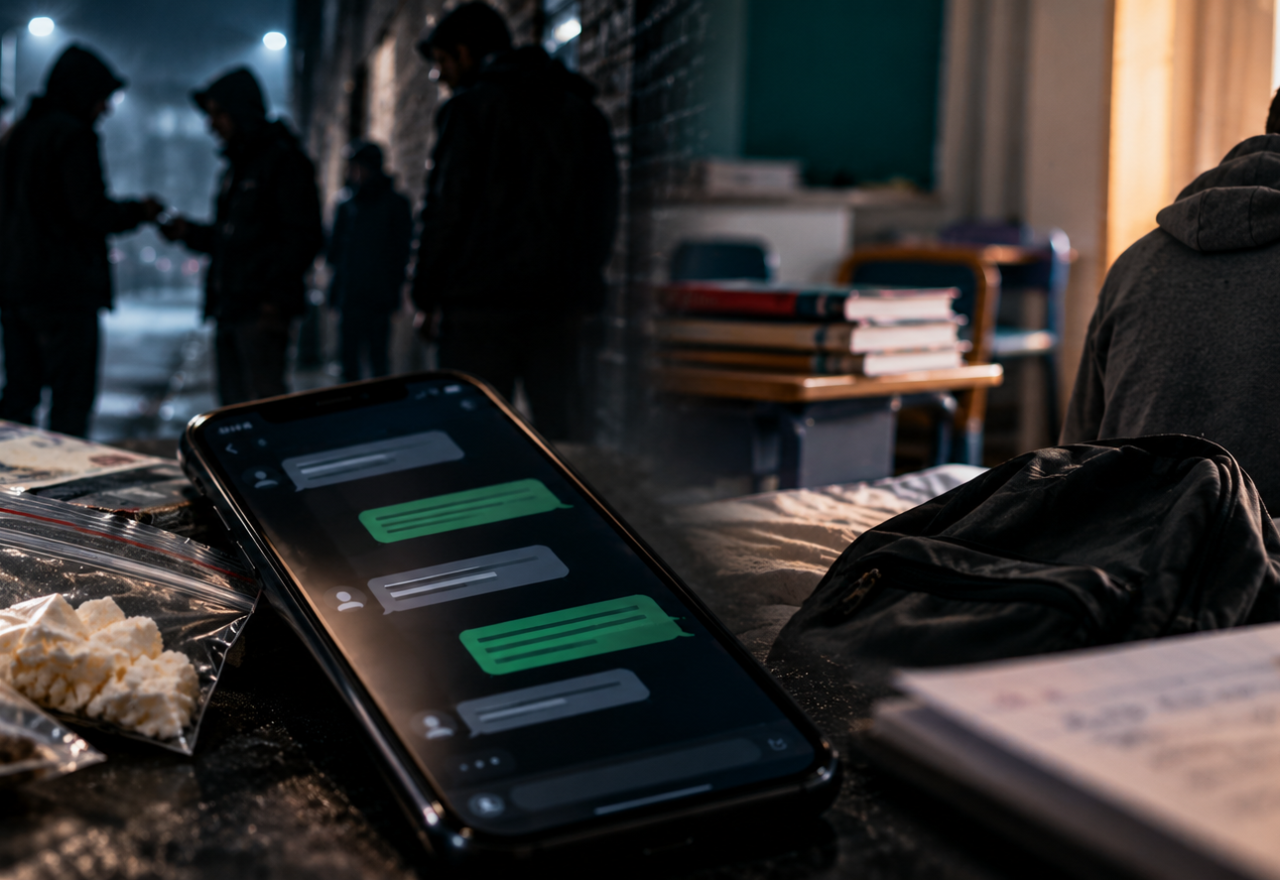
A phone on one side, school records on the other
On the Crown’s side of this case: a phone, bulk marketing messages, runners in another town and addresses it said had been taken over. On the defence side: family testimony and school records showing a sharp decline in attendance, behaviour and stability.
The Crown said our client ran a dedicated line supplying heroin and crack cocaine from London into another town. It presented him as an organiser. The defence said he was not acting through free choice, but under compulsion.
The case record gives no dates, no messages and no account from our client. We have not guessed at any of them.
If you are reading this because someone you love has been arrested, you may be turning over a question that sounds contradictory. How can a person be accused of running a drugs line and also have been controlled by others? The law does not treat those as opposites. It does insist on evidence.
Stuart Miller Solicitors acts for people accused of drug supply, conspiracy and serious violence offences, including multi-handed Class A cases built on phone evidence and cases where exploitation is central. This guide uses that case to explain what the Crown must prove, what the law says about exploitation and what to do now.
The Allegation
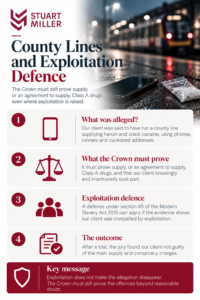
The Crown alleged that our client ran a dedicated county line supplying heroin and crack cocaine from London into another town. It said the line worked through bulk marketing messages, local runners and cuckooed addresses.
Cuckooing means taking over a vulnerable person’s home to store or sell drugs. The people living in those homes are often victims themselves. Nothing here comments on anyone’s part but our client’s.
It was a multi-handed prosecution. The Crown relied heavily on phone evidence, communication patterns and the overall structure of the operation. These are the Crown’s allegations, not findings.
The defence case was fundamentally different: that he was not acting through free choice, but under compulsion. It ran a defence under the Modern Slavery Act 2015, supported by expert evidence on criminal exploitation, family testimony and school records.
The record describes the verdicts as covering “the main supply and conspiracy charges”. It does not give the count wording or list any other counts. It does not say what our client accepted or denied about his involvement, so this page does not either.
County lines exploitation defence: the law in plain English
What the Crown must prove for supply and conspiracy
Supplying a controlled drug, offering to supply it, or being concerned in its supply is an offence under section 4 of the Misuse of Drugs Act 1971. Heroin and cocaine, including crack, are Class A drugs.
A conspiracy is an agreement. Under section 1 of the Criminal Law Act 1977, the Crown must prove that two or more people agreed a course of conduct that would involve supplying the drug. It must also prove the defendant was a party to that agreement and intended it to be carried out (R v Saik [2006] UKHL 18).
In a multi-handed case the Crown must prove each defendant’s part separately. “Controlling a line” describes a role. It is not a separate element of the offence, but it shapes what the Crown says each person agreed to do and what sentence follows.
A phone shows use, not free will
Phone evidence can be powerful. It can show which handset sent which messages, when and to whom. It can show patterns, such as bulk messages going to many numbers at once.
But a pattern shows what was done. It does not show why, or whether the person doing it had a choice. The Crown may say a handset’s use shows control. The defence may say it was held on someone else’s instructions. The Crown has to prove who used it and what that use means.
How section 45 of the Modern Slavery Act 2015 works
Section 45 gives a statutory defence to some people who commit offences because of slavery or relevant exploitation, which includes human trafficking. The test depends on age when the act was done.
- Adults (18 or over): the act was done because the person was compelled to do it. The compulsion is attributable to slavery or relevant exploitation. A reasonable person in the same situation, with the person’s relevant characteristics, would have had no realistic alternative.
- Under 18: the act was done as a direct consequence of the person being, or having been, a victim of slavery or relevant exploitation. A reasonable person in the same situation, with the person’s relevant characteristics, would have done it. Compulsion is not required.
The record does not give our client’s age when the alleged acts were done, so it does not say which test applied.
The defence has limits. It does not cover every offence, because the Act lists offences to which it does not apply, so the exact charge matters. It is not made out by showing someone was vulnerable. The evidence has to connect exploitation to the act and to the person’s ability to choose. And the Crown can point to evidence of choice, such as money, freedom of movement, chances to leave or seek help, or what the person said and did.
Who must prove what under section 45 is a technical question governed by the Act and case law. Ask your solicitor for the current rule.
Other ways exploitation can matter
Exploitation can matter even where section 45 does not fit.
- Knowledge and intention. The Crown must prove the defendant knowingly joined the agreement. Evidence of control can bear on that.
- Duress. The common-law defence is narrow. It needs a threat of death or serious injury and no safe way to avoid it. It can fail if the person voluntarily associated with criminal activity (R v Hasan [2005] UKHL 22).
- Whether to prosecute. Prosecutors are expected to consider whether prosecuting a potential victim of exploitation is in the public interest.
- Sentence. Role is central, and pressure or coercion can be relevant.
The National Referral Mechanism
The National Referral Mechanism, or NRM, is the Government’s process for identifying potential victims of modern slavery. A referral and decision can bring evidence and support. It does not decide guilt, which is for the court, and it does not automatically stop a prosecution. The record does not mention an NRM referral or decision in this case.
Expert and lay evidence
Opinion evidence is admissible where it gives the court information outside its own experience (R v Turner [1975] QB 834). An expert on criminal exploitation can explain how grooming and control work and what indicators may look like. The jury, not the expert, decides whether the defendant was in fact compelled.
Family testimony and school records are different. They can show change over time. A jury will still want to know what changed, when and why.
What was at stake
Supplying Class A drugs carries a maximum sentence of life imprisonment (Misuse of Drugs Act 1971, Sch 4). A conspiracy carries the same maximum (Criminal Law Act 1977, s.3). A maximum is not a prediction.
The Sentencing Council’s drug offences guideline looks closely at role, which it describes as leading, significant or lesser, and at the quantity of drugs. An allegation of controlling a line is an allegation about role. We state no category or starting point, because the quantity and the facts a court would find are not in the record. If the person was under 18 when the offence was committed, different sentencing principles apply.
Whatever the label, nobody should be sentenced for a role the Crown cannot prove.
Before any verdict, someone accused of this offence may be remanded, or bailed on conditions, with school, work and family under strain. A conviction can bring a permanent record, confiscation proceedings in some cases and, for someone without British citizenship, immigration consequences.
Those are possibilities in cases like this, not facts about our client. The record says nothing about custody or bail.
The wait, and what a case like this asks of a family
The record gives no timeline, and we have not built one. What follows is general context.
A multi-handed Class A case runs from arrest and interview through charge, sending to the Crown Court (Crime and Disorder Act 1998, s.51), preparation and trial. Phone cases produce a lot of material: handset extractions, message logs and mast data. The defence has to review it, ask what is missing and keep each defendant’s case separate from the rest.
An exploitation defence adds more work. Records may have to be obtained from third parties, such as schools, and there are procedures for that. An expert has to be instructed, and their work needs funding approval. Evidence from relatives has to be gathered.
Three measures of delay are easily confused: time under investigation, time from charge to trial and time spent in custody. If someone is remanded, custody time limits apply. They are set by regulations and can be extended, so ask your solicitor for the current limit.
The record does say that family testimony was part of the defence. Giving evidence in open court about how someone you love changed is not a small thing to ask of anyone. That is a general observation. The record does not describe our client’s family.
How the defence was built
The record describes the defence in a few lines. We set out what it says and stop where it stops.
Replacing the ‘willing organiser’ picture with a different case
- The problem: the Crown presented him as a willing organiser of a line.
- The legal point: whether someone acted through free choice goes to what the Crown can prove about knowledge, intention and role. If section 45 is raised, it also goes to the statutory test.
- The action: the defence advanced what the record calls a fundamentally different case, that he was not acting through free choice but under compulsion.
- Why it mattered: the dispute moved from what the structure of the line looked like to who was making the decisions in it.
Putting a Modern Slavery Act defence before the jury, with expert support
The defence relied on section 45, supported by expert evidence on criminal exploitation. The record does not identify the expert or discipline and does not describe the report. It does not say whether the judge left the defence to the jury or which test applied. We do not say.
Using family testimony and school records
Family testimony and school records showed a sharp decline in attendance, behaviour and stability. The defence argued those changes were consistent with grooming, coercion and control rather than the emergence of a so-called line holder.
That is a defence submission, not a finding. The record does not say when the changes began, what else the records showed or how the Crown answered them.
Treating phones as evidence of use, not of free will
The Crown relied heavily on phone evidence. The defence theme, in the firm’s words, was that phones, messages and movement data do not automatically prove free will. The record does not say the defence disputed who used a handset, what messages said or how data was read, and we do not claim it did.
A spokesman for Stuart Miller Solicitors said:
“Digital evidence can look overwhelming. But phones, messages and movement data do not automatically prove free will. Where exploitation is properly evidenced, the whole case changes.”
We do not say any single step produced the verdicts. A jury gives no reasons, and the record does not say what persuaded it.
The Verdict
At Wood Green Crown Court, a jury found our client not guilty of the main supply and conspiracy charges.
Precisely:
- It was a verdict after a trial. The evidence was heard and tested. It means the Crown did not prove its case so that the jury was sure.
- The record refers to the “main” charges. It lists no others, and does not say whether other counts were on the indictment or how they ended.
- It is not a finding that he was a victim of exploitation. A jury gives no reasons. We cannot say whether it accepted the section 45 defence, found the Crown’s case unproved, or both.
- It is not a finding that no line operated, or about anyone else’s role. The record says nothing about other defendants.
Some matters do not end with a verdict:
- Bail conditions end, and seized property and phones should be returned.
- Ask what data police hold from phones and other sources, and for how long.
- An NRM referral is a separate process. Ask whether one is appropriate now.
- If there is still any pressure or threat from the people involved, tell your solicitor and the police, and ask about safeguarding and support.
- School, work and record checks may need handling. Ask how.
Ask your solicitor to confirm in writing what was resolved and what remains.
What to do now if you may need a county lines exploitation defence
What helps tonight depends on the stage you are at.
Ask for a solicitor before answering questions

Police station advice is free. You can ask for the duty solicitor or name a firm. If you are under 18, or may be vulnerable, an appropriate adult should be present at interview (PACE Code C).
There is no single right approach to interview. In some circumstances a court can draw an inference if you later rely on something you could reasonably have mentioned when questioned. That can include exploitation. Whether, when and how to give an account is a decision to take with a solicitor first.
Keep away from those controlling you, and from co-suspects
Do not try to sort it out by message, call or social media. Do not contact co-suspects or witnesses, and do not retaliate. Contact can be misread, can breach bail conditions and can put you at risk.
Be candid about phones, money and addresses
Whose phone was it? Who paid for it? Who knew the passcode? Where did you stay, and who arranged it? Where did money go? Some answers feel awkward. A solicitor can only judge the Crown’s case if they know what is true.
Preserve; do not wipe or dispose
Do not delete messages, reset devices or close accounts. If you hold a phone, SIM or item you are worried about, speak to your solicitor before doing anything with it.
FAQs
-
Can exploitation be a defence to a county lines drug charge?
Sometimes. If the evidence supports it, section 45 of the Modern Slavery Act 2015 gives a statutory defence to some people who commit offences because of slavery or relevant exploitation. Exploitation can also bear on whether the Crown can prove knowledge and intention. It is not automatic, and the Crown can argue that the person chose to take part.
-
Is the test different if I was under 18 at the time?
Yes. For someone under 18 when the act was done, the test asks whether it was a direct consequence of being, or having been, a victim of slavery or relevant exploitation, and whether a reasonable person in the same situation and with the same relevant characteristics would have done it. Compulsion is not required. Ask your solicitor which test applies to your age at the time.
-
Who has to prove what when the defence is raised?
The defence has to put the issue before the court on evidence. Where the burden of proof then falls is a technical question governed by the Act and case law, so ask your solicitor for the current position. Separately, the Crown must always prove every element of the offence itself so that the jury is sure.
-
Can phone and message evidence prove I ran a line?
It can be strong evidence of who used a handset, when and how, and it can show patterns such as bulk messages. It does not by itself show who controlled the operation, why a handset was used or whether the person had a choice. The Crown must attribute the use to you and prove what it means.
-
What sentence can supplying Class A drugs carry, and why does role matter?
The maximum is life imprisonment, which is discretionary rather than a prediction. The Sentencing Council's drug offences guideline looks closely at role, such as leading, significant or lesser, and at the quantity of drugs, and pressure or coercion can be relevant. Different principles apply to under-18s. Nobody should be sentenced for a role the Crown has not proved.
-
What evidence can show that someone was exploited?
It can include evidence from family and others, school, GP and social-care records, messages, phone and location data, and expert evidence on criminal exploitation. None is a test on its own. The court asks whether the evidence connects exploitation to the offence and to the person's ability to choose. Tell your solicitor early so records can be obtained properly.