-

Top 1% of Defence Law Firms
-

Defended over 50,000 Cases
-

5 star google reviews
-

40 Years of Criminal Law Expertise

A night out, an argument, a friend dead, and a question of who was telling the truth
Two friends went out drinking. They argued. One was assaulted. Later that night, one of them was dead.
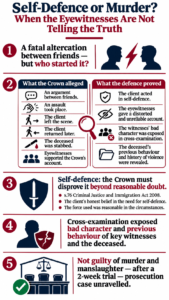
The Crown said our client returned to the address and stabbed his friend in a deliberate act of retaliation. The prosecution had eyewitnesses, people who were there, who said they saw the whole thing. Their account was clear, consistent and damning.
Our client said it was a lie. He said he acted in self-defence. He said the truth had been distorted, and that the people the Crown was relying on as witnesses had their own reasons for telling the story they told.
If you are reading this because you have been accused of murder after a violent incident you say was self-defence, two questions are probably running together. Can the Crown convict me when I was defending myself? And what happens when the witnesses against me are not telling the truth? This guide answers both. It uses our client’s case to explain what the Crown must prove when self-defence is raised, how eyewitness evidence can be challenged and what thorough cross-examination can reveal.
Stuart Miller Solicitors acts for people accused of serious violent offences, including murder and manslaughter. Our client was acquitted of both murder and manslaughter after a two-week trial. This guide uses his case to explain the law, the evidence and the process.
The Allegation
The Crown alleged that our client murdered a friend following a fatal altercation after a night of drinking. The prosecution’s case was that our client and the deceased had been out together and had got into an argument earlier in the evening. During that argument, our client was assaulted. The Crown alleged that, having been assaulted, our client returned to the address later and stabbed the deceased, causing his death.
The prosecution relied on key witnesses who were said to be eyewitnesses to the entire incident. Their evidence was the foundation of the Crown’s case.
Our client maintained that he was acting in self-defence throughout. He said the prosecution’s account was a distortion of the truth, a lie constructed by witnesses who had their own agenda. He did not deny that a stabbing took place or that the deceased had died. What he denied was that the stabbing was unlawful. He said he used force to defend himself in circumstances where he honestly believed it was necessary.
The defence case required detailed instructions and a careful, piece-by-piece analysis of the evidence. The record describes the process as fitting together the pieces of a puzzle. Through extensive analysis and thorough cross-examination of the key witnesses, the defence revealed crucial evidence of bad character and the previous behaviour of the deceased. The prosecution’s case unravelled.
The record does not say the name of the deceased, the specific location of the incident, the nature of the earlier argument, what weapon was used, the time of night or the precise sequence of events as described by the eyewitnesses. It does not say what the bad character evidence involved or what the deceased’s previous behaviour consisted of. We have added none of it.
The dispute the record identifies is about the truth of what happened and the lawfulness of the force used. Was our client acting in self-defence, or was the stabbing an unlawful act of retaliation?
Murder, manslaughter and self-defence: the law in plain English
What the Crown must prove for murder
Murder is a common law offence. The Crown must prove two things so that the jury is sure:
- The defendant unlawfully caused the death of another person.
- The defendant intended to kill or cause really serious bodily harm.
The word “unlawfully” is critical when self-defence is raised. If the force used was lawful, because the defendant was acting in self-defence, the killing is not unlawful, and the offence of murder is not made out.
What is self-defence?
Self-defence is a complete defence to murder and to all other offences against the person. It is not a partial defence like diminished responsibility or loss of control. If the jury accepts that the defendant was acting in self-defence, the verdict is not guilty, full stop.
The law on self-defence is set out in section 76 of the Criminal Justice and Immigration Act 2008, which codified the common law position, and section 3 of the Criminal Law Act 1967, which provides that a person may use such force as is reasonable in the circumstances in the prevention of crime.
The defence has two limbs:
- Honest belief: the defendant must have honestly believed that the use of force was necessary in the circumstances. The belief does not have to be reasonable, it must be honest. A defendant who honestly but mistakenly believes they are about to be attacked is entitled to rely on self-defence (R v Williams (Gladstone) [1987] 3 All ER 411).
- Reasonable force: the force used must have been reasonable in the circumstances as the defendant honestly believed them to be. The jury must consider whether the degree of force used was proportionate to the threat as the defendant perceived it.
The Crown must disprove self-defence
This is the most important point in any self-defence case. Once the defendant raises self-defence, the burden of proof shifts to the Crown. The defendant does not have to prove that they were acting in self-defence. The Crown must disprove it so that the jury is sure.
If the jury is left in any doubt about whether the defendant was acting in self-defence, they must acquit. The doubt does not have to be large. It does not have to be supported by evidence from the defence. It is enough that the Crown has not eliminated the possibility.
Manslaughter as an alternative verdict
Manslaughter is a lesser alternative to murder. In a case involving a fatal stabbing, the jury may consider voluntary manslaughter on the basis of loss of control under sections 54 and 55 of the Coroners and Justice Act 2009. Loss of control requires:
- a loss of self-control;
- a qualifying trigger, either a fear of serious violence or things said or done of an extremely grave character causing a justifiable sense of being seriously wronged; and
- that a person of the defendant’s sex and age, with a normal degree of tolerance and self-restraint, might have reacted in the same or a similar way.
Our client was acquitted of both murder and manslaughter. The jury was not satisfied that the Crown had proved either offence.
Self-defence and the use of a weapon
The fact that a defendant used a knife or other weapon does not automatically mean the force was unreasonable. The jury must consider the circumstances as the defendant honestly believed them to be, including the nature of the threat, the number of attackers, the availability of escape and the speed at which events unfolded. A person facing an imminent threat of serious violence may be entitled to use a weapon in self-defence, even if the weapon causes fatal injuries.
The law recognises that a person acting in genuine fear for their safety cannot be expected to weigh the precise degree of force with the calm deliberation of a courtroom. Section 76(7) of the Criminal Justice and Immigration Act 2008 provides that the jury must consider that a person acting in self-defence may not be able to weigh to a nicety the exact measure of any necessary action.
Eyewitness evidence, bad character and the power of cross-examination
The limits of eyewitness evidence
Eyewitness evidence is powerful but unreliable. Decades of psychological research and judicial experience have shown that eyewitnesses can be mistaken, biased, influenced by suggestion or motivated by self-interest. The leading authority on identification evidence is R v Turnbull [1977] QB 224, which requires the court to consider the circumstances of the observation and the reliability of the witness.
In a case involving a violent altercation between people who know each other, the eyewitnesses are often participants or associates of the participants. They may have their own reasons for telling a particular version of events. They may have been drinking. They may have been involved in the violence themselves. Their evidence must be tested rigorously.
Bad character of non-defendant witnesses
Under section 100 of the Criminal Justice Act 2003, evidence of the bad character of a person other than the defendant, including prosecution witnesses and the deceased, is admissible if it is important explanatory evidence or has substantial probative value in relation to a matter in issue in the proceedings.
In a self-defence case, the bad character of the deceased and the prosecution’s eyewitnesses can be critically important. If the deceased had a history of violence, aggression or provocation, that evidence may support the defendant’s account that he was the one being attacked. If the prosecution’s witnesses have convictions for dishonesty, violence or perverting the course of justice, that evidence may undermine their credibility.
The record says that cross-examination of the key witnesses revealed crucial evidence of bad character and the previous behaviour of the deceased. The record does not say what that evidence was. We have not speculated. The point is that the evidence was sufficient to unravel the prosecution’s case.
The role of cross-examination
Cross-examination is the process by which the defence tests the prosecution’s evidence by questioning the Crown’s witnesses in court. It is the most powerful tool available to the defence, and in a case where the truth is disputed, it can be decisive.
Effective cross-examination requires meticulous preparation. The defence must know the witness’s statement inside out, identify every inconsistency, every gap and every potential motive for dishonesty, and then confront the witness with those points in a controlled and strategic manner.
The record describes the cross-examination in this case as “thorough” and says it “revealed crucial evidence.” That is the result of the detailed instructions and careful analysis the record also describes. The defence team fitted the pieces of the puzzle together, and the picture that emerged was very different from the one the Crown had painted.
What was at stake
Murder carries a mandatory life sentence. There is no discretion. The judge must impose a life sentence and set a minimum term under Schedule 21 of the Sentencing Act 2020. For a murder involving a knife, the starting point for the minimum term is 25 years for an adult defendant.
Manslaughter carries a discretionary maximum of life imprisonment. The Sentencing Council’s manslaughter guideline sets starting points based on culpability. For voluntary manslaughter by loss of control, the starting point can range from three to 24 years depending on the degree of responsibility retained.
Had our client been convicted of murder, he would have faced a life sentence with a minimum term of potentially 25 years or more. Had he been convicted of manslaughter, the sentence would have been lower but still substantial.
Our client was acquitted of both offences. He received no sentence. The difference between a life sentence and freedom is the most consequential distinction in the criminal law.
Other consequences are possibilities, not facts about our client. They include the lifelong impact of a murder conviction, the loss of employment and housing, the disruption of family relationships and, for anyone without British citizenship, immigration consequences including deportation.
The wait, and what a two-week trial means for a defendant claiming self-defence
The record gives limited detail about the timeline, and we have not built one beyond what is stated. It confirms that our client was acquitted after a two-week trial.
A two-week trial for a murder case involving self-defence, multiple eyewitnesses and bad character evidence is relatively compact. The brevity suggests that the defence’s cross-examination was effective and that the prosecution’s case collapsed under scrutiny more quickly than the Crown may have anticipated.
The record emphasises that detailed instructions were crucial and that a careful consideration and analysis of the evidence was required to fit all the pieces of the puzzle together. In a self-defence case, the defendant’s account is the foundation of the defence. If the instructions are incomplete, inconsistent or unclear, the defence cannot be presented effectively. The record suggests that the defence team invested significant time in taking detailed instructions from our client and in analysing the evidence before the trial began.
For a defendant who says he acted in self-defence, the trial is an intensely personal experience. He must sit in the dock and listen to witnesses describe a version of events he says is false, knowing that the jury’s decision will determine whether he spends the rest of his life in prison or walks free.
The record does not say whether our client was on bail or remanded in custody during the trial, how long the investigation lasted before the charges were brought or what impact the proceedings had on his family and his relationship with the deceased’s family. We have not guessed.
How the defence was built
The record describes the defence strategy in clear terms. We set out what it says and stop where it stops.
Taking detailed and meticulous instructions
- The problem: the Crown’s case depended on eyewitness accounts that presented a clear and damning narrative. Our client said the narrative was a distortion of the truth.
- The legal point: in a self-defence case, the defendant’s account of what happened, what he believed and why he used force is the foundation of the defence. The instructions must be detailed, consistent and credible.
- The action: the defence team took detailed and meticulous instructions from our client, ensuring that every aspect of the incident was explored, every inconsistency was addressed and every piece of the puzzle was understood.
- Why it mattered: the instructions allowed the defence to build a coherent and credible self-defence case that could withstand the scrutiny of cross-examination and the competing accounts of the prosecution’s witnesses.
Analysing the evidence to fit the puzzle together
- The problem: the prosecution’s case was built on multiple strands of evidence, eyewitness accounts, the sequence of events, the earlier argument and the alleged return to the address. Each strand needed to be tested.
- The legal point: the Crown must prove its case as a whole. If individual strands of evidence are weakened or contradicted, the overall case may collapse.
- The action: the defence conducted a careful consideration and analysis of all the evidence, fitting the pieces of the puzzle together to identify the gaps, inconsistencies and alternative explanations that the Crown had overlooked or suppressed.
- Why it mattered: the analysis revealed that the prosecution’s narrative did not hold together when tested against the full body of evidence. The pieces of the puzzle, when properly assembled, told a different story.
Cross-examining the key witnesses
- The problem: the Crown’s case depended on key eyewitnesses who claimed to have seen the entire incident. Their evidence was the foundation of the prosecution’s case.
- The legal point: eyewitness evidence must be tested rigorously. Under section 100 of the Criminal Justice Act 2003, evidence of a non-defendant’s bad character is admissible if it has substantial probative value. The credibility of the witnesses is a matter for the jury.
- The action: the defence conducted thorough cross-examination of the key witnesses, revealing crucial evidence of bad character and the previous behaviour of the deceased.
- Why it mattered: the cross-examination unravelled the prosecution’s case. The witnesses’ credibility was fundamentally undermined, and the jury was left with a very different picture from the one the Crown had presented.
Maintaining the self-defence case throughout
- The problem: the Crown alleged that our client returned to the address and stabbed the deceased in an act of retaliation. If the jury accepted that narrative, self-defence was not available.
- The legal point: self-defence is a complete defence to murder and manslaughter. The Crown must disprove it beyond reasonable doubt. The defendant is entitled to use such force as is reasonable in the circumstances as he honestly believed them to be (Criminal Justice and Immigration Act 2008, s.76).
- The action: the defence maintained the self-defence case consistently throughout the trial, supported by the detailed instructions, the evidence analysis and the cross-examination of the prosecution’s witnesses.
- Why it mattered: the jury acquitted of both murder and manslaughter. They were not satisfied that the Crown had disproved self-defence beyond reasonable doubt.
A spokesman for Stuart Miller Solicitors said:
“The Crown had eyewitnesses who told a clear story. Our client said it was a lie. The difference between those two positions was the cross-examination. When we tested the witnesses properly, the bad character evidence came out, the deceased’s previous behaviour was exposed, and the prosecution’s case fell apart. Self-defence is not a technicality, it is a fundamental right, and the Crown must disprove it beyond reasonable doubt.”
We do not say any one step produced the acquittals. A jury gives no reasons.
The verdict, and what it did and did not resolve
After a two-week trial, our client was found not guilty of murder and not guilty of manslaughter.
Precisely:
- The acquittals followed a full trial. The Crown’s evidence was heard and tested over two weeks. It means the Crown did not prove its case so that the jury was sure.
- The acquittal covers both murder and manslaughter. The jury was not satisfied that the Crown had proved murder, and it was not satisfied that the Crown had proved the lesser alternative of manslaughter. This is a complete acquittal on all charges.
- A jury gives no reasons. We cannot say whether the self-defence evidence, the bad character cross-examination, the eyewitness credibility or anything else mattered most.
- It is not a finding that the deceased was not stabbed. The stabbing is not in dispute. The verdict is about whether the stabbing was unlawful or whether it was a lawful act of self-defence.
- It is not a finding about the eyewitnesses’ character beyond the trial. The bad character evidence was admitted for the purposes of the trial. The verdict does not amount to a formal finding about the witnesses’ conduct outside the courtroom.
Some things to consider after an acquittal:
- Ask your solicitor whether a defendant’s costs order is available if you funded your defence privately. Limits apply.
- Property and devices seized during the investigation should be returned where no longer required.
- Ask what data police retain from phone extractions, CCTV footage and forensic samples, and for how long.
- If the acquittal has affected your relationship with the deceased’s family or the wider community, consider whether any steps are needed to manage the personal impact.
Ask your solicitor to confirm in writing what was resolved and what, if anything, remains.
What to do now if you are accused of murder and you acted in self-defence
What helps depends on the stage you are at.
Ask for a solicitor before answering any questions

Murder is the most serious charge in the criminal calendar. If you are arrested after a fatal incident, ask for legal advice before answering questions. Police station advice is free. You can ask for the duty solicitor or name a firm. If you acted in self-defence, it is critical that your account is recorded accurately from the outset. A prepared statement may be appropriate to ensure that the key facts of your defence are on record before you give a no comment interview.
Give detailed instructions to your legal team
In a self-defence case, your account is the foundation of the defence. Tell your solicitor everything: what happened before the incident, what was said, who was present, what you believed was about to happen, why you used force and what you did afterwards. The more detail you provide, the more effectively your legal team can test the prosecution’s evidence and present your defence.
Do not assume that eyewitnesses are unchallengeable
Eyewitness evidence is not infallible. Witnesses can be mistaken, biased, influenced by others or motivated by self-interest. If you believe the prosecution’s witnesses are not telling the truth, tell your solicitor why. If you know of bad character evidence, previous convictions or previous behaviour that undermines their credibility, share that information. The defence is entitled to apply for the admission of non-defendant bad character evidence under section 100 of the Criminal Justice Act 2003.
Preserve everything that supports your account
Keep messages, call records, social media posts, photographs and anything that shows the context of the incident, the relationship between you and the deceased and the events leading up to the altercation. Do not delete messages, reset devices or close accounts. Tell your solicitor about any CCTV that may exist in the area and any witnesses who may have seen what happened.
FAQs
-
Can I be convicted of murder if I was acting in self-defence?
No. Self-defence is a complete defence to murder. If the jury accepts that you were acting in self-defence, the verdict must be not guilty. The Crown must disprove self-defence beyond reasonable doubt. You do not have to prove that you were acting in self-defence, the burden is on the prosecution to eliminate it as a possibility. If the jury is left in any doubt, they must acquit.
-
What is the legal test for self-defence?
The test has two parts. First, you must have honestly believed that the use of force was necessary in the circumstances. The belief does not have to be reasonable, it must be honest. Second, the force you used must have been reasonable in the circumstances as you honestly believed them to be. The jury must consider that a person acting in self-defence may not be able to weigh the exact measure of force with precision (Criminal Justice and Immigration Act 2008, s.76).
-
Does using a knife mean my self-defence claim will fail?
No, not automatically. The fact that a weapon was used does not mean the force was unreasonable. The jury must consider the circumstances as you honestly believed them to be, including the nature of the threat, the number of attackers and the speed at which events unfolded. A person facing an imminent threat of serious violence may be entitled to use a weapon in self-defence, even if the weapon causes fatal injuries.
-
Can the defence use the bad character of the deceased or prosecution witnesses?
Yes, in some circumstances. Under section 100 of the Criminal Justice Act 2003, evidence of the bad character of a non-defendant is admissible if it is important explanatory evidence or has substantial probative value in relation to a matter in issue. In a self-defence case, evidence of the deceased's previous violence or the witnesses' dishonesty may be highly relevant to the question of who was the aggressor and whether the witnesses are credible.
-
What is the difference between self-defence and loss of control?
Self-defence is a complete defence that results in an acquittal if accepted. Loss of control is a partial defence that reduces murder to manslaughter (Coroners and Justice Act 2009, ss.54–55). Self-defence requires an honest belief that force was necessary and that the force used was reasonable. Loss of control requires a loss of self-control, a qualifying trigger and that a person of normal tolerance might have reacted similarly. In this case, the jury acquitted of both murder and manslaughter, meaning they accepted self-defence or were not satisfied that the Crown had disproved it.
-
What if I was the one who returned to the address?
The fact that you returned to a location does not automatically mean you were the aggressor. The jury must consider the full context: why you returned, what happened when you arrived, whether you were facing a continuing threat and whether the force you used was reasonable in the circumstances. The Crown must prove that you were not acting in self-defence, and your return to the address is only one part of the evidence the jury must consider.