-

Top 1% of Defence Law Firms
-

Defended over 50,000 Cases
-

5 star google reviews
-

40 Years of Criminal Law Expertise
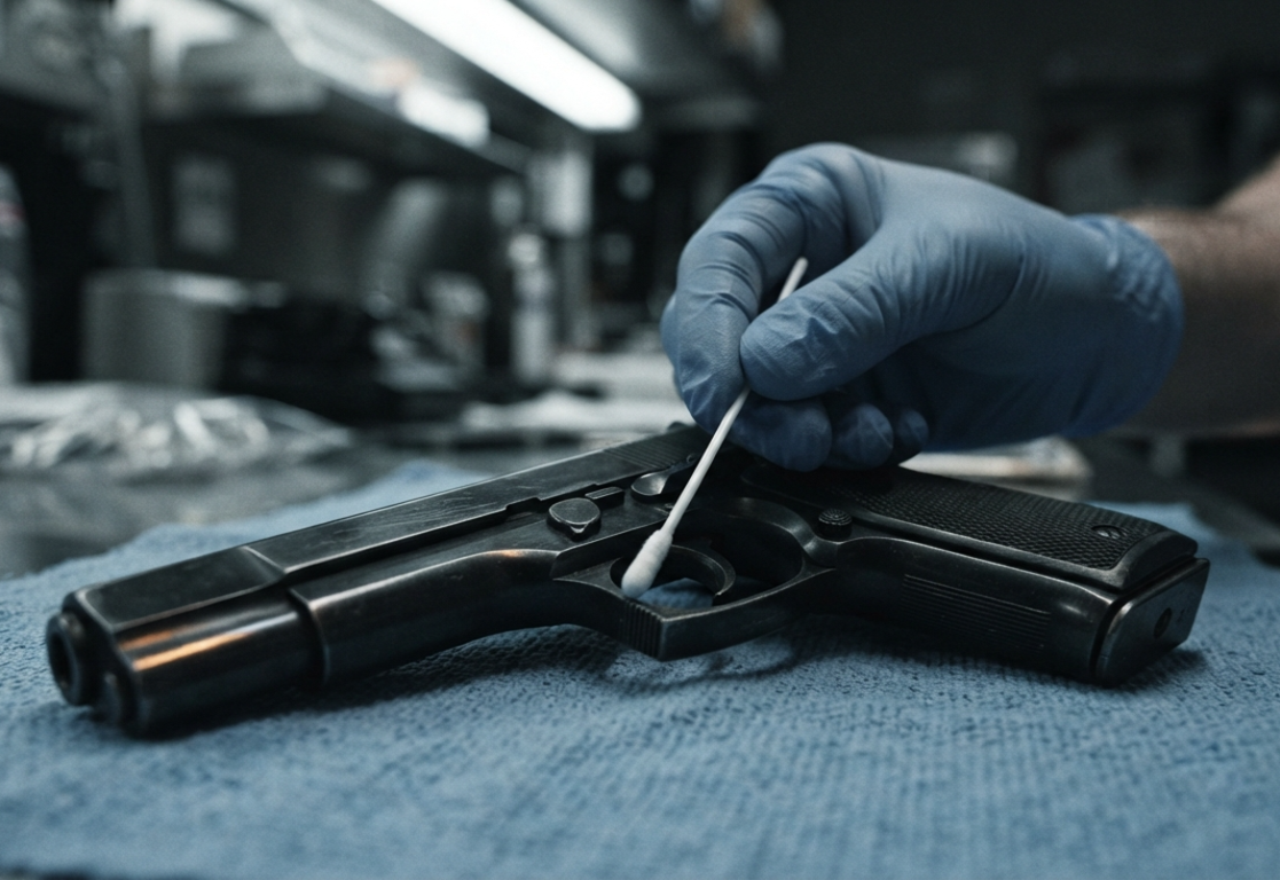
A loaded gun in the passenger’s waistband, and your DNA on the trigger
The police stopped a car. The driver was our client. In the front passenger seat was a co-defendant. When officers searched the two men, they found weapons and drugs. The co-defendant had a loaded firearm in his waistband. He told the officers it was his. At first, only he was charged with possessing it.
Then the forensic results came back. Our client’s DNA was on the trigger and the barrel.
The Crown added a firearm charge. The potential sentence: a further five years in prison, on top of the drug offences our client had already admitted.
If you are reading this because your DNA has been linked to a weapon you have never touched, one question is probably louder than all the others. How can they charge me with something that was his? This guide answers that question. It uses our client’s case to explain what the Crown must prove in a firearm possession case built on DNA evidence, how transference works and what a defence team can do to challenge it.
Stuart Miller Solicitors acts for people accused of firearms and drug offences, including cases where the Crown relies on forensic evidence to link a defendant to a weapon. Our client’s firearm charge was dropped before trial. This guide uses his case to explain the law and the science.
The Allegation
The Crown alleged that our client was in possession of a firearm and ammunition, a bladed article and Class A and B drugs with intent to supply. The charges arose from a vehicle stop in Bristol. Our client was the driver. A co-defendant was the front seat passenger.
When stopped and searched, both men were found in possession of weapons and drugs. The loaded firearm was recovered from the co-defendant’s waistband after he told officers he had it. Initially, only the co-defendant was charged with possession of the firearm.
The position changed when forensic DNA analysis matched our client to the trigger and barrel of the gun. The Crown then charged our client with possession of the firearm and ammunition as well.
The defence case was straightforward: our client disputed ever having touched or been in possession of the gun. The defence submitted a statement on his behalf explaining that he had been in close contact with the co-defendant, sharing personal items, clothing, a vehicle and living spaces, and that the DNA on the firearm was the result of transference, not direct contact.
The record does not say what type of firearm was involved, what specific drugs were found or in what quantities. It does not say what the bladed article was or where it was found. It does not say whether the DNA match was a full profile or a partial one, or what statistical weight the forensic scientist assigned to it. We have added none of it.
The dispute the record identifies is about possession. Did our client possess the firearm, or was his DNA on it because of the ordinary contact between two people who lived and moved in the same spaces?
Firearm possession and the limits of DNA evidence
What the Crown must prove
Possession of a firearm without a certificate is an offence under section 1 of the Firearms Act 1968. Possession of a prohibited weapon falls under section 5. The record does not specify which section applied here. Certain firearm offences carry a mandatory minimum sentence of five years’ imprisonment under section 51A of the Firearms Act 1968, and the record refers to a potential five-year sentence, which is consistent with that provision.
To prove possession, the Crown must show that the defendant had the firearm in their custody or under their control and that they knew they had it. Possession can be actual, the firearm is on the defendant’s person, or constructive, the firearm is in a place the defendant controls and they know it is there.
In a vehicle with two occupants, the question of who possessed what is not always straightforward. The Crown may argue joint possession, meaning that both occupants had control of the firearm and knew of its presence. But joint possession must be proved, not assumed. The fact that a firearm was found in a car does not, by itself, prove that every occupant possessed it.
What DNA on a firearm can and cannot show
DNA evidence can show that a person’s genetic material was deposited on an object. It cannot show:
- when the DNA was deposited;
- how it was transferred;
- whether the person touched the object directly; or
- whether the person knew the object existed.
These limitations are critical in a firearm case. A DNA match on a trigger or barrel is consistent with the defendant having handled the weapon. It is also consistent with the defendant’s DNA having been transferred to the weapon through contact with someone else who handled it.
DNA transference: the science in plain English
DNA transference occurs when a person’s genetic material is passed to an object they have not directly touched. There are two main types:
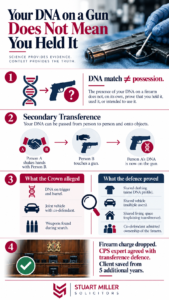
- Secondary transfer: Person A shakes hands with Person B. Person B then picks up a gun. Person A’s DNA may now be on the gun, even though Person A never touched it.
- Tertiary transfer: Person A’s DNA is on a surface, a car seat, a piece of clothing, a door handle. Person B touches that surface and then touches the gun. Person A’s DNA may transfer to the gun through Person B.
The Forensic Science Regulator’s guidance and the body of published forensic science literature both recognise secondary and tertiary transfer as real and well-documented phenomena. The likelihood of transfer increases where people share close living spaces, clothing, vehicles and personal items, precisely the circumstances described in this case.
Expert opinion on DNA transfer is admissible where it gives the court information outside its own experience (R v Turner [1975] QB 834). Experts owe their duty to the court (Criminal Procedure Rules, Part 19), and forensic providers are expected to meet quality standards set by the Forensic Science Regulator.
Joint possession in a vehicle
Where a firearm is found in a vehicle with multiple occupants, the Crown may argue that all occupants were in joint possession. The courts have considered this issue in a number of cases. The key question is whether the defendant knew of the firearm and had some degree of control over it.
Mere presence in a vehicle where a weapon is found is not enough. The Crown must prove knowledge and control. If the firearm was in the co-defendant’s waistband and the co-defendant told officers it was his, the Crown’s case for joint possession of the firearm against the driver depends heavily on what else it can show about the driver’s knowledge and involvement.
The record says the co-defendant told officers the gun was his and that initially only he was charged with its possession. The DNA match on the trigger and barrel is what changed the Crown’s position.
Vehicle stops and search powers
What the police can do
Police officers have powers to stop and search vehicles under section 1 of the Police and Criminal Evidence Act 1984 (PACE) where they have reasonable grounds to suspect that the vehicle contains stolen goods, weapons or prohibited articles. Section 23 of the Misuse of Drugs Act 1971 gives a separate power to search for controlled drugs.
A stop and search must be conducted in accordance with PACE Code A. The officer must have reasonable grounds, must explain those grounds to the person being searched and must record the search. A search that breaches Code A may be challenged, and any evidence obtained may be subject to an exclusion application under section 78 of PACE.
The record does not say what grounds the officers relied on for the stop or whether any challenge was made to the lawfulness of the search. We have not speculated.
What happens after the search
If weapons or drugs are found, all occupants of the vehicle may be arrested. The decision about which charges to bring against which occupant is a matter for the Crown Prosecution Service, and it can change as the evidence develops, as this case demonstrates. The initial charging decision is not the final word.
What was at stake
The firearm charge carried a potential sentence of five years’ imprisonment. The record describes this as an additional sentence on top of the four-year term our client had already received for the drug offences. Had the Crown proceeded with the firearm charge and secured a conviction, our client would have faced a total sentence of approximately nine years, the same length of sentence the co-defendant ultimately received.
The drug offences, possession with intent to supply Class A and B drugs, carry maximum sentences of life imprisonment for Class A and 14 years for Class B under the Misuse of Drugs Act 1971. The Sentencing Council’s drug offences guideline looks at the defendant’s role, the quantity of drugs and the class of drug involved. Our client’s four-year sentence reflects the court’s assessment of those factors on the basis of his guilty plea.
The bladed article charge under section 139 of the Criminal Justice Act 1988 carries a maximum of four years’ imprisonment. The record does not say how this charge was resolved.
The practical difference between four years and nine years is enormous. It is the difference between a sentence from which a young person can realistically rebuild their life and one that consumes the better part of a decade.
Other consequences are possibilities, not facts about our client. They include the impact of a firearms conviction on future employment, housing, travel and, for someone without British citizenship, immigration status.
The wait, and what a changing charge sheet means for a defendant
The record gives limited detail about the timeline, and we have not built one beyond what is stated.
What the record does describe is a sequence that will be familiar to many defendants in multi-handed cases: the initial charges are brought, the forensic evidence comes back weeks or months later, and the charge sheet changes. Our client was first charged with drug and weapon offences. The firearm charge was added later, after the DNA results linked him to the gun.
A changing charge sheet is destabilising. A defendant who has already decided to plead guilty to some charges may suddenly face a new and more serious allegation that carries a mandatory minimum sentence. The defence strategy may need to be rethought, new experts instructed and the question of whether to maintain the guilty pleas reconsidered.
The record does not say how long the DNA analysis took or when the additional charge was brought. We have not guessed.
How the defence was built
The record describes the defence strategy in clear terms. We set out what it says and stop where it stops.
Challenging the DNA evidence through transference
- The problem: the Crown had a forensic DNA match linking our client to the trigger and barrel of a loaded firearm found in the co-defendant’s waistband. The charge carried a potential five-year sentence.
- The legal point: a DNA match shows contact at some point. It does not show when, how or in what circumstances. Secondary and tertiary transference are well-documented phenomena recognised by the Forensic Science Regulator and the forensic science literature.
- The action: the defence submitted a detailed statement on the client’s behalf explaining that he had been in close contact with the co-defendant, sharing personal items, clothing, a vehicle and living spaces, and that transference was the most likely explanation for the DNA on the firearm.
- Why it mattered: the statement provided a plausible, evidence-based alternative explanation for the DNA match that did not require our client to have ever touched the gun.
Leveraging expertise in transference cases
- The problem: DNA evidence carries significant weight with juries and prosecutors. Challenging it requires more than assertion, it requires scientific knowledge and experience.
- The legal point: expert evidence on DNA transfer is admissible and can be decisive where the Crown’s case depends on a forensic match (R v Turner [1975] QB 834).
- The action: the defence team drew on its familiarity with transference cases and expert opinions on the subject to advise the client and advance the defence with confidence.
- Why it mattered: the Crown consulted its own expert in response to the defence submissions. That expert agreed with the transference explanation.
Securing the withdrawal of the charge
- The problem: the firearm charge was live and carried a potential five-year sentence. A trial on that charge would have exposed our client to the risk of conviction and a dramatically longer sentence.
- The legal point: the Crown Prosecution Service has a continuing duty to review the evidence and to proceed only where there is a realistic prospect of conviction (Code for Crown Prosecutors, Full Code Test).
- The action: the defence’s submissions and the Crown’s own expert opinion led the CPS to conclude that the firearm charge could no longer be sustained.
- Why it mattered: the charge was dropped. Our client was spared a potential five-year additional sentence. The co-defendant, who had admitted possession of the firearm, received nearly nine years in total.
A spokesman for Stuart Miller Solicitors said:
“DNA on a weapon is not the end of the story. In this case, the science told us that transference was the most likely explanation, and the Crown’s own expert agreed. Our client was saved from five additional years in prison because the defence understood the science and was prepared to challenge the evidence.”
We do not say the outcome was inevitable. The Crown reviewed the evidence and made its own decision. What the record shows is that the defence submissions were the catalyst for that review.
The outcome, and what it did and did not resolve
The Crown dropped the firearm charge. Our client had already pleaded guilty to the drug offences and was sentenced to four years’ imprisonment. The co-defendant received a sentence of almost nine years.
Precisely:
- The firearm charge was dropped before trial. The CPS reviewed the evidence, consulted its own expert and decided not to proceed. This is a formal discontinuance, not an acquittal after trial.
- The drug sentence stands. Our client pleaded guilty to possession with intent to supply Class A and B drugs and received four years. The acquittal on the firearm charge did not affect that sentence.
- The co-defendant’s sentence reflects his admitted possession of the firearm. The disparity between the two sentences, four years versus nearly nine, illustrates the practical impact of the firearm charge.
- The outcome is not a finding that our client’s DNA was not on the gun. The record says it was. The outcome reflects the Crown’s acceptance that the DNA was more likely the result of transference than direct contact.
Some things to consider after an outcome of this kind:
- Ask your solicitor to confirm in writing which charges were dropped and which remain.
- If you were remanded in custody during the period when the additional charge was live, ask whether any time served counts towards your sentence.
- Property and devices seized during the investigation should be returned where no longer required.
- Ask what data police retain from forensic samples and for how long.
Ask your solicitor to confirm in writing what was resolved and what, if anything, remains.
What to do now if you are accused of possessing a firearm based on DNA evidence
What helps depends on the stage you are at.
Do not assume a DNA match means conviction
DNA on a weapon shows contact at some point. It does not show when, how or in what circumstances. If you share living spaces, vehicles, clothing or personal items with the person who actually possessed the weapon, transference is a real and scientifically recognised possibility. Tell your solicitor about every aspect of your relationship with the co-defendant and the spaces you share.
Ask for a solicitor before any interview

Police station advice is free. Our client gave a no comment interview, which is a legitimate choice. Whether to comment or remain silent is a decision to take with a solicitor first. If you have already been interviewed, tell your new solicitor exactly what was said and in what circumstances.
Instruct experts early
If the Crown’s case depends on forensic evidence, the defence should instruct its own expert as early as possible. DNA, cell site, fingerprint and firearms experts can all identify weaknesses in the Crown’s case that may not be apparent from the papers alone. In this case, the defence’s familiarity with transference science was decisive.
Challenge the charging decision if the evidence changes
The Crown has a continuing duty to review its case. If new evidence undermines the basis for a charge, the defence should make written submissions inviting the CPS to reconsider. In this case, those submissions led directly to the withdrawal of the firearm charge.
-
Can I be charged with possessing a firearm if my DNA is found on it but it wasn't mine?
Yes, the Crown can bring the charge. A DNA match is evidence the Crown may rely on to argue that you handled the weapon and therefore possessed it. However, a DNA match does not prove possession by itself. The Crown must still prove that you had the firearm in your custody or control and that you knew you had it. If the DNA can be explained by transference, the Crown's case may not meet the threshold for a realistic prospect of conviction.
-
What is DNA transference?
DNA transference is the process by which a person's genetic material is deposited on an object they have not directly touched. Secondary transfer occurs when Person A's DNA is passed to an object via Person B, for example, through a handshake followed by Person B handling the object. Tertiary transfer involves an additional step, such as DNA passing from a surface to a person and then to the object. Both are well-documented in the forensic science literature and recognised by the Forensic Science Regulator.
-
Does sharing a car or a home with someone make it more likely my DNA will be on their belongings?
Yes. The closer and more frequent the contact between two people, the greater the likelihood of DNA transference. Sharing clothing, vehicles, living spaces, personal items and physical contact all increase the probability that your DNA will end up on objects you have never directly touched. This is precisely the argument the defence advanced in this case, and the Crown's own expert agreed it was a plausible explanation.
-
What is the difference between actual and constructive possession of a firearm?
Actual possession means the firearm is physically on your person, in your hand, pocket or waistband. Constructive possession means the firearm is in a place you control, such as your home or car, and you know it is there. In a vehicle with multiple occupants, the Crown may argue constructive or joint possession, but it must prove that you knew of the firearm and had some degree of control over it. Mere presence in the vehicle is not enough.
-
Can the Crown add charges after the initial arrest?
Yes. The Crown Prosecution Service has a continuing duty to review the evidence and may add, amend or drop charges as the case develops. In this case, the firearm charge was added after forensic DNA results came back linking our client to the weapon. A changing charge sheet does not mean the new charges are stronger; it means the evidence has changed, and the defence must respond accordingly.
-
What sentence does possession of a firearm carry?
It depends on the offence. Possession of a firearm without a certificate under section 1 of the Firearms Act 1968 carries a maximum of five years. Possession of a prohibited weapon under section 5 can carry a mandatory minimum of five years under section 51A, with a higher maximum. The exact sentence depends on the type of firearm, the circumstances and the defendant's role. In this case, the record refers to a potential five-year sentence for the firearm charge, which was ultimately dropped.