-

Top 1% of Defence Law Firms
-

Defended over 50,000 Cases
-

5 star google reviews
-

40 Years of Criminal Law Expertise

He was not said to have pulled the trigger
The Crown did not say our client fired a shot. It said he made the shootings possible.
On the Crown’s case, he did that by sourcing stolen vehicles and cloned number plates for gang-related shootings. Under joint enterprise principles, it said, that gave him a share of responsibility.
The case record gives no dates, places or names, and no account from our client. We have not guessed at any of it.
It does tell us how the case was fought. The defence refused to treat it as a broad gang story. It went to the technical evidence: facial recognition claims, cell-site interpretation, vehicle telematics and the lack of a reliable scientific link placing him where the Crown needed him at the critical times.
If you are in this position, or love someone who is, you may be looking at maps, data and photographs and wondering how anyone argues with them. The jury acquitted our client of murder and related allegations.
Stuart Miller Solicitors acts for people accused of murder and other serious violence, including joint enterprise cases built on phone, vehicle and image evidence. This guide uses that case to explain what the Crown must prove about a facilitator, how technical evidence is tested and what to do now.
The Allegation
The Crown alleged that our client facilitated gang-related shootings by sourcing stolen vehicles and cloned plates. It did not say he pulled the trigger. Its case was that he provided logistical support and so shared responsibility under joint enterprise principles. Those are the Crown’s allegations, not findings.
The evidence the defence challenged was technical: facial recognition claims, cell-site interpretation and vehicle telematics. The Crown also needed to place him at particular places at the critical times. The defence said there was no reliable scientific link doing that.
Two things the record does not say matter. It does not give our client’s own account, so we do not say whether he accepted any dealings in vehicles or plates. And it does not list the related allegations, so we do not say what they were.
What was in dispute was proof. Murder is charged only where the Crown says someone has died, and the people who lost someone are part of this story. Nothing here is meant to lessen that.
What the Crown must prove about a facilitator: the law in plain English
Joint enterprise is a label, not a charge
In law, the question is whether someone is guilty as a secondary party because they helped or encouraged another person’s offence (Accessories and Abettors Act 1861, s.8). In a murder case, someone else is said to have killed, and the defendant is said to have assisted.
What the Supreme Court requires
Since R v Jogee [2016] UKSC 8, the Crown must prove two things about a helper. First, that they did something that assisted or encouraged the crime. Second, that they intended to assist or encourage it, knowing the facts that made it a crime.
Foresight that a crime might happen is evidence of intention. It is not a substitute for it. Intention can be conditional, such as helping so that a crime can be committed if the occasion arises, but it must still be intention. For murder, the Crown must prove an intention to assist a killing.
Supplying something is not the same as intending to help a killing
A vehicle can assist a crime if the person supplying it knows what it is for and means to help. The same act is not assistance to murder if they did not know. The Crown must prove what the person knew and intended, and it often asks a jury to infer that from conduct and data.
Separately, supplying a stolen vehicle or a cloned plate may be an offence in its own right, whatever the answer on murder. The details published here do not say whether anything of that kind was among the related allegations.
The Crown does not always need to put a facilitator at the scene
A helper can be guilty without being present when the crime happens. But where the Crown’s case says a person was at particular places at particular times, the evidence putting them there has to be reliable. That was the gap the defence pressed.
Why a gang label is not proof
Evidence about gangs, associations or reputation can be powerful and prejudicial. Whether it is admissible, and what a jury may use it for, is controlled by the rules on relevance and bad character, and the judge decides (Criminal Justice Act 2003, Part 11, Chapter 1).
Belonging to a group, or knowing its members, does not prove that someone helped with a particular killing. The record does not say what gang evidence, if any, the jury heard.
How technical evidence is tested
Facial recognition. The phrase can mean different things: software that suggests possible matches, often used to generate an investigative lead; a person comparing a face in an image with someone they know; or an expert comparing images. They support different conclusions. The Court of Appeal has limited what facial-comparison experts may say (see R v Atkins [2009] EWCA Crim 1876). The record does not say which kind was used here.
Cell-site data. It records which mast and sector a handset connected to. A scientist can say whether a handset’s use is consistent with an area. It does not show who held the handset, and the area covered can be wide.
Telematics and plates. Telematics is data logged by a device in or on a vehicle, such as location and time. It depends on the device, its clock and whether the data is attributed to the right vehicle. A cloned plate is a number plate copied from another vehicle, so a record tied to a plate may not show which vehicle was there, let alone who was driving.
Experts. Opinion evidence is admissible where it gives the court information outside its own experience (R v Turner [1975] QB 834). Experts owe their duty to the court (Criminal Procedure Rules, Part 19), and forensic providers are expected to meet the Forensic Science Regulator’s standards. A scientist’s evidence is weighed with everything else.
A timeline can look complete and still rest on one weak link. Each link has to be reliable.
What was at stake
A murder conviction carries a mandatory life sentence (Murder (Abolition of Death Penalty) Act 1965, s.1). The judge then sets a minimum term under the Sentencing Code. Starting points depend on the facts, and some are very high. We state none, because the facts needed to assign one are not in the record.
A secondary party convicted of murder is convicted of murder. But the court sentences on the role proved, and a helper’s role can differ from that of the person said to have fired.
Before any verdict, someone accused of murder may be remanded in custody, and work, housing, caring responsibilities and money can all come under strain. A conviction can affect licence conditions on release and, for someone without British citizenship, immigration status. A case described as gang-related can also bring reputational harm and safety concerns for families.
These are possibilities in cases like this, not facts about our client. The record says nothing about custody or bail.
The wait, and the work behind technical evidence
The record gives no timeline, and we have not built one. What follows is general context.
A murder case runs from arrest and interview through charge, sending to the Crown Court (Crime and Disorder Act 1998, s.51), preparation and trial. Technical evidence adds steps. The defence needs the underlying material rather than a summary: handset records, mast data, telematics logs and original images. Someone with the right expertise has to review it, which takes time and, if the defence wants its own expert, funding approval.
Three measures of delay are easily confused: time under investigation, time from charge to trial and time spent in custody. If you are remanded, custody time limits apply. They are set by regulations and can be extended, so ask your solicitor for the current limit.
The strain is not only the wait. A case dense with data can feel settled before anyone has tested it, and you may be asked to understand evidence you cannot easily check. Those are general pressures, not a description of our client’s experience. The people who lost someone are waiting too.
How the defence was built
The record describes the defence in a few short lines. We set out what it says and stop where it stops.
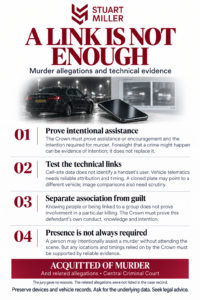
Refusing to fight a broad gang narrative
- The problem: the Crown’s picture was of a group, with our client placed within it.
- The legal point: guilt is individual. The Crown must prove this defendant’s act, knowledge and intention.
- The action: the defence refused to fight the case as a broad gang narrative.
- Why it mattered, as the record frames it: the contest moved to the technical evidence.
Challenging the facial recognition claims
The defence challenged them. The record does not say how, or which kind of facial evidence was used.
Challenging the interpretation of cell-site data
The defence challenged how the data was read. The record does not identify the handsets or the analysis.
Challenging the vehicle telematics
The defence challenged it. The record does not say what the telematics showed.
Pressing the absence of a reliable scientific link
The defence case was that nothing reliable placed our client where the Crown needed him to be at the critical times. That is a defence submission, not a finding.
A spokesman for Stuart Miller Solicitors said:
“Joint enterprise logistics cases can look neat on paper. Under expert scrutiny, the neatness often disappears.”
The record does not say how that scrutiny was applied. It does not say whether the defence instructed its own experts or tested the Crown’s through cross-examination, and it records no application or disclosure request. We claim none. We do not say any one step produced the verdict. A jury gives no reasons.
The Verdict
The jury at the Central Criminal Court acquitted our client of murder and related allegations. The record does not list the related allegations.
Precisely, this was a jury verdict after a trial in which the evidence was heard and tested. It means the Crown did not prove its case so that the jury was sure. A jury gives no reasons, so we cannot say why it decided as it did.
It is not a finding that nobody was killed or that the shootings did not happen. It is not a finding about who else was responsible, or that any witness or expert was dishonest or mistaken. The record says nothing about other defendants, and we say nothing either.
Some things do not end with a verdict:
- Bail conditions end, and seized property and devices should be returned.
- Ask what police records, phone downloads and any samples are held, and for how long (Police and Criminal Evidence Act 1984, as amended).
- If you paid privately, ask whether a defendant’s costs order is available. Limits apply.
- If the case attracted publicity or you have safety concerns, tell your solicitor.
Ask your solicitor to confirm in writing what was on the indictment, how each count ended and whether anything remains.
What to do now if you are accused of facilitating a murder
What helps tonight depends on the stage you are at.
Ask for a solicitor before commenting on images or data

Police station advice is free. You can ask for the duty solicitor or name a firm. If officers show you images or phone data, take advice before you comment. In some circumstances a court can draw an inference if you later rely on something you could reasonably have mentioned when questioned. How and when you give an account is a decision to take with a solicitor first.
Ask exactly what the Crown says you did
Which vehicles, which dates, which places? Who says it was you, and on what evidence? You cannot answer a case you have not had set out.
Ask for the underlying data
A summary is not the data. Your solicitor can ask for handset and mast records, device extractions, telematics logs and images in their original form.
Be candid about vehicles, phones and accounts
Tell your solicitor which vehicles you own, use or have dealt in, which phones and accounts you use, and who else has had access to them. Some answers feel awkward. Your solicitor can only judge the technical evidence if they know what is true.
Preserve; do not dispose
Do not sell, scrap or hand over vehicles, phones or devices, and do not delete messages or reset anything. Keep receipts, logbooks, insurance papers, work records and anything showing where you were. CCTV and app data can be overwritten quickly.
Keep away from the others involved
Do not contact co-suspects or witnesses, and do not compare accounts. Where accounts may conflict, do not assume you can share a legal team.
FAQs
-
What must the prosecution prove if I am accused of facilitating a murder?
That someone else committed murder, that you did something that assisted or encouraged it, and that you intended to assist or encourage it, knowing the facts that made it a crime (Accessories and Abettors Act 1861, s.8; R v Jogee). Foresight is evidence of intention, not a substitute. Every element must be proved so that the jury is sure.
-
Can I be convicted of murder if I only supplied a vehicle and was not at the scene?
Potentially. A helper can be guilty without being present, but only if the Crown proves you knew what the vehicle was for and intended to help a killing. The vehicle alone is not enough. Supplying a stolen vehicle may also be a separate offence, whatever the verdict on murder.
-
What is a cloned number plate and why does it matter in evidence?
A cloned plate is a number plate copied from another vehicle. A record tied to a plate, such as a camera sighting, may therefore relate to a different vehicle from the one expected. It does not by itself show which vehicle was present or who was driving, so the Crown must connect the record to a particular vehicle and person.
-
What is vehicle telematics and how reliable is it?
Telematics is data logged by a device in or on a vehicle, such as location and time. Its value depends on the device, the accuracy of its clock, how the data was recovered and whether it is correctly attributed to a vehicle. It does not show who was driving or what they knew, so it has to be read with other evidence.
-
Can I challenge technical evidence, and do I need my own expert?
You can test it. Depending on the issues, that may mean asking for the underlying data, cross-examining the Crown's experts, legal argument or instructing an independent expert, who owes a duty to the court. Not every case needs a defence expert. Expert costs may need prior approval under the legal-aid rules, so raise the question early.
-
Does being linked to a gang make me guilty?
No. Belonging to a group or knowing its members does not prove that you helped with a particular killing. Gang evidence can be prejudicial, and the judge decides whether it is admissible and what it may be used for (Criminal Justice Act 2003, Part 11, Chapter 1). The Crown must still prove your own knowledge, intention and conduct.