-

Top 1% of Defence Law Firms
-

Defended over 50,000 Cases
-

5 star google reviews
-

40 Years of Criminal Law Expertise
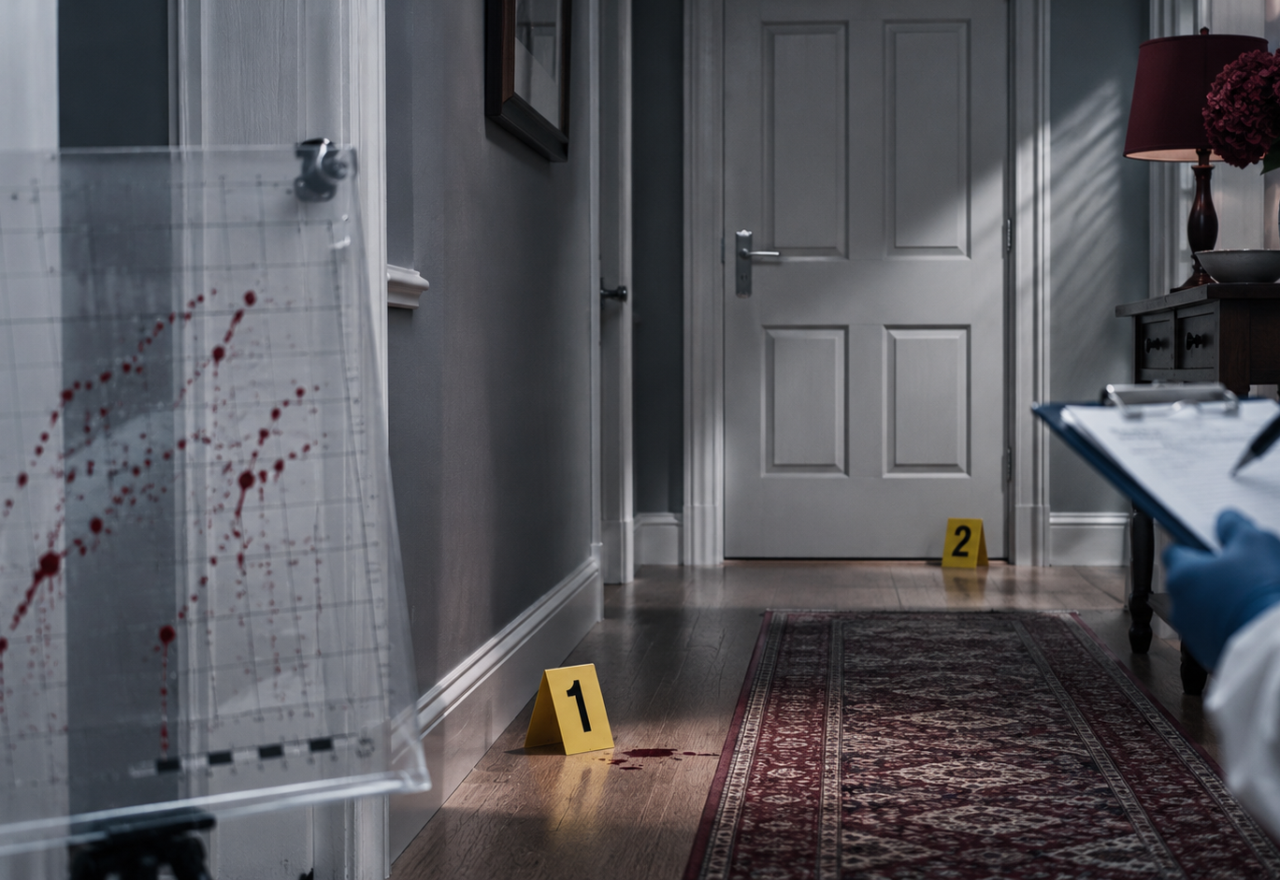
A fatal stabbing, a shared home, and two competing explanations
A person died. The fatal injury was a stab wound. It happened inside a home our client shared with the deceased.
The Crown said our client killed him. Our client said he killed himself.
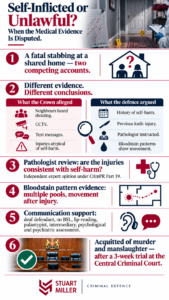
The evidence was not simple. Neighbours had heard shouting and loud bangs during the night. CCTV showed the deceased leaving the property earlier in the evening to buy alcohol. Text messages between the couple showed they had been arguing. The Crown’s medical experts said the injuries were atypical of self-harm.
But there was another side. Previous police attendances at the property had involved reports of self-harm. Weeks before the death, our client had sustained a knife injury to her own leg and attended hospital. The scene showed multiple pools of blood throughout the property, raising questions about what happened after the injury was inflicted.
If you are reading this because someone has died and you have been accused of causing their death, two questions are probably running together. How can the prosecution prove who caused the fatal injury? And what happens when the medical and forensic evidence does not support the Crown’s interpretation? This guide answers both. It uses our client’s case to explain what the Crown must prove in a murder trial where self-infliction is the defence, and what a team of experts can reveal when the evidence is tested properly.
Stuart Miller Solicitors acts for people accused of serious violent offences, including murder and manslaughter. Our client was acquitted of both murder and manslaughter after a three-week trial at the Central Criminal Court. This guide uses her case to explain the law, the evidence and the process.
The Allegation
The Crown alleged that our client murdered the deceased at their shared home. The prosecution’s case was that she unlawfully inflicted the fatal stab wound and that she intended to kill or cause really serious harm.
The Crown relied on several strands of evidence:
- Neighbour accounts: Neighbours reported hearing shouting and loud bangs during the night.
- CCTV footage: Cameras showed the deceased leaving the property earlier in the evening to purchase alcohol.
- Text messages: Communications between the couple showed that they had been arguing.
- Medical interpretation: The Crown considered the fatal injuries to be atypical of self-harm.
Our client’s account was that the deceased had inflicted the fatal stab wound on himself. The defence pointed to a history of reported self-harm, including previous police attendances at the property. Weeks before the death, our client had herself sustained a knife injury to her leg and had attended hospital, a fact that underscored the presence of knives and the reality of self-harm in the household.
The defence instructed a pathologist to review the post-mortem report and comment on whether the injuries were consistent with self-harm. A bloodstain pattern expert examined scene images showing multiple pools of blood throughout the property. The defence relied on this evidence to support its position that the deceased had moved around the property after sustaining the injury.
The record does not say the exact number of previous police attendances, the dates of those attendances, the precise wording of the neighbours’ statements or the full contents of the text messages. It does not say the exact medical findings, the pathologist’s final conclusions, the detailed bloodstain pattern measurements or the precise wording of the experts’ evidence to the jury. We have not guessed at any of these matters.
The dispute the record identifies is about causation. How was the fatal injury caused, and did the medical and scene evidence support the prosecution’s account or the defence’s?
Murder and manslaughter: the law in plain English
What the Crown must prove
Murder is a common law offence in England and Wales. There is no single statutory definition. The prosecution must prove two things so that the jury is sure:
- The defendant unlawfully caused the death of another person. Causation does not require the defendant to be the sole cause, but the Crown must prove that the defendant’s acts were a significant contributing cause of death.
- The defendant intended to kill or cause really serious bodily harm. This is sometimes called malice aforethought. It does not mean the Crown must prove a long-standing plan or premeditation. The question is whether the required intention existed at the moment the fatal act was committed.
If the Crown cannot prove either element, the defendant is entitled to an acquittal.
What “unlawful killing” means
A death is not automatically murder because another person was present or involved in the events leading up to it. The Crown must prove that the defendant caused the death unlawfully.
In this case, our client maintained that the fatal injury was self-inflicted. That made the question of how the injury occurred the central issue in the trial. If the jury was not sure that our client caused the fatal wound, the Crown’s case could not succeed.
Self-infliction as a defence
The possibility of self-infliction is not a formal “defence” in the technical sense, the burden of proof remains on the Crown throughout. But where the defence case is that the deceased caused the fatal injury to himself, the jury must consider:
- the medical findings and the nature of the injury;
- the scene evidence and any forensic interpretation;
- the accounts of witnesses and the reliability of their observations;
- the history of the deceased, including any known self-harm; and
- whether the evidence, considered as a whole, proves the prosecution’s account beyond reasonable doubt.
An expert cannot decide who committed an offence. Their role is to provide an independent professional opinion within their field, helping the court understand technical evidence that falls outside the jury’s own experience.
The difference between murder and manslaughter
Manslaughter is a form of unlawful killing that does not amount to murder. It includes several legal categories:
- Voluntary manslaughter: the elements of murder are present, but a partial defence, diminished responsibility or loss of control, reduces the offence.
- Involuntary manslaughter: the Crown does not prove the intent required for murder, but the legal elements of unlawful act manslaughter or gross negligence manslaughter are established.
Our client was charged with both murder and manslaughter. The jury acquitted her of both. That means the Crown did not prove murder, and it did not prove any form of manslaughter either.
The burden of proof
The burden of proof remains with the prosecution from start to finish. A defendant does not have to prove an alternative account of events. The jury must consider the prosecution evidence as a whole, and if it is not sure that the defendant committed the offence, it must return a not guilty verdict. Suspicion, even strong suspicion, is not enough.
Forensic evidence and the limits of expert opinion
Why a post-mortem report needs independent review
A post-mortem examination is a medical examination of a deceased person to help establish the cause and circumstances of death. In a suspected homicide, the medical evidence is often the foundation of the Crown’s case.
But a post-mortem report is not the final word. The findings and their interpretation may need careful scrutiny. The Crown’s pathologist may describe injuries as “atypical of self-harm,” but that description is an opinion, not a fact. It depends on the findings, the expert’s reasoning and the wider evidence.
A defence pathologist can review the same post-mortem report and provide an independent opinion. The expert’s role is not to advocate for the defendant. Under Part 19 of the Criminal Procedure Rules 2025, an expert’s overriding duty is to help the court with objective and unbiased opinion evidence within their area of expertise.
In this case, the defence instructed a pathologist to examine the post-mortem report and comment on whether the injuries were consistent with self-harm. The jury was therefore able to consider an independent medical assessment rather than being left only with the prosecution’s interpretation.
What bloodstain pattern evidence can and cannot show
Bloodstain pattern analysis involves examining the location, shape and distribution of bloodstains to help interpret events at a scene. Depending on the quality of the material and the expert’s findings, it may assist with questions about:
- the possible location of an injury;
- the movement of a person after an injury;
- the possible sequence of events; and
- whether a proposed account is consistent with the observed patterns.
It has limits. Bloodstain patterns do not automatically identify the person responsible, establish intent or provide a complete reconstruction of events. The expert’s methods, assumptions and conclusions must be examined carefully.
In this case, the defence instructed a bloodstain pattern specialist to review scene images showing multiple pools of blood throughout the property. The defence relied on this evidence to support its position that the deceased had moved around the property after sustaining the injury, a fact that was consistent with self-infliction and harder to reconcile with the Crown’s account.
Why the evidence must be considered together
A forensic finding rarely answers every question in a murder case. Medical evidence, scene photographs, witness accounts, CCTV and communications each provide different pieces of information. Their significance depends on how they fit together.
The jury must decide whether the prosecution has proved its case beyond reasonable doubt. An expert’s opinion is one part of that assessment, not a substitute for the jury’s decision. The record says the jury acquitted our client of both murder and manslaughter. We cannot say which pieces of evidence mattered most.
Communication needs and effective participation at trial
Our client’s circumstances
Our client was deaf. She did not use British Sign Language. She relied on lip-reading and transcription to communicate. Following the charge, she experienced a period of mutism, an inability to speak, as a result of the trauma she had endured.
These facts are not incidental. They go to the heart of whether our client could participate effectively in her own trial.
The legal framework
A defendant must be able to understand the proceedings, follow the evidence, communicate with their legal team and give instructions. Where a defendant has communication difficulties, the court must consider what adjustments are necessary to ensure a fair trial.
Part 18 of the Criminal Procedure Rules addresses assistance for vulnerable participants, including intermediary arrangements for defendants where necessary. The Equal Treatment Bench Book provides guidance to judges on the adjustments required for deaf defendants and those with other communication needs.
The support arranged
The defence instructed a psychologist and a psychiatrist to assess our client’s needs. An intermediary was appointed to facilitate communication between our client and her legal team. A palantypist, a specialist speech-to-text reporter, was provided throughout the trial to give our client a real-time written transcript of the proceedings.
These arrangements were not luxuries. They were essential to ensuring that our client could understand the evidence being given against her, follow the arguments being made on her behalf and participate in the decisions that would determine the rest of her life.
The record does not say precisely what recommendations the psychologist and psychiatrist made or what specific directions the judge gave to the jury about our client’s communication needs. We have not guessed.
What was at stake
Murder carries a mandatory life sentence. There is no discretion. The judge must impose a life sentence and set a minimum term under Schedule 21 of the Sentencing Act 2020. The starting point depends on the circumstances of the offence. In the most serious cases, a whole-life order may be imposed.
Manslaughter carries a discretionary maximum of life imprisonment. The appropriate sentence depends on the type of manslaughter, the defendant’s culpability and the harm caused. The Sentencing Council’s manslaughter guidelines set starting points and ranges for each category.
Had our client been convicted of murder, she would have faced a life sentence with a substantial minimum term, potentially decades in prison. Had she been convicted of manslaughter, the sentence would have been lower but still significant.
Our client was acquitted of both offences. She received no sentence. The difference between a life sentence and freedom is the most consequential distinction in the criminal law.
Other consequences are possibilities, not facts about our client. Depending on the circumstances, a criminal allegation or conviction can affect employment, housing, immigration status, family arrangements and personal relationships. Those consequences should not be assumed in this case.
The wait, and what a three-week trial means for a defendant and family
The record gives limited detail about the timeline, and we have not built one beyond what is stated. It confirms that our client was acquitted following a three-week trial at the Central Criminal Court.
A murder investigation involving disputed medical and forensic evidence generates a vast amount of material: post-mortem reports, scene photographs, bloodstain pattern analyses, CCTV footage, phone extractions, text message downloads, witness statements and expert reports from multiple disciplines. The defence must review all of it, identify the points of dispute and instruct its own experts to test the Crown’s conclusions.
Where the cause of death is contested, the expert evidence may require particularly detailed review. The parties must examine reports, clarify areas of disagreement and prepare questions for expert witnesses. That process cannot be rushed.
For a defendant who is deaf, who has experienced trauma-induced mutism and who relies on lip-reading and transcription, the preparation period carries additional challenges. Every consultation with the legal team, every review of the evidence and every decision about trial strategy must be conducted through the appropriate communication channels.
The record does not say how long the investigation lasted before the trial or how our client managed the waiting period. We have not guessed.
How the defence was built
The record describes the defence strategy in clear terms. We set out what it says and stop where it stops.
Examining the history of reported self-harm
- The problem: the Crown alleged that our client unlawfully caused the fatal injury. The prosecution’s medical evidence described the injuries as atypical of self-harm.
- The legal point: the jury had to decide whether the Crown proved that our client caused the death. Relevant background evidence about the deceased’s history could assist the jury in assessing the competing accounts.
- The action: the defence reviewed previous police attendances at the property involving reports of self-harm and identified an earlier incident in which our client had herself sustained a knife injury to her leg and attended hospital.
- Why it mattered: the history provided context for the defence account and demonstrated that self-harm and knife injuries were not unknown in the household. It did not, by itself, establish how the fatal injury occurred, but it gave the jury a factual basis for considering the self-infliction account.
Instructing an independent pathologist
- The problem: the Crown’s medical evidence described the fatal injuries as atypical of self-harm. That interpretation was central to the prosecution’s case.
- The legal point: expert medical opinion can assist the jury with matters outside ordinary experience, but the expert must remain objective and work within their professional expertise (Criminal Procedure Rules 2025, Part 19). The defence is entitled to its own expert opinion.
- The action: the defence instructed a pathologist to examine the post-mortem report and comment on whether the injuries were consistent with self-harm.
- Why it mattered: the jury could consider an independent medical assessment rather than being left only with the prosecution’s interpretation. The pathologist’s evidence allowed the jury to weigh competing expert opinions on the central question in the case.
Examining the bloodstain patterns
- The problem: the scene showed multiple pools of blood throughout the property. Their significance was disputed.
- The legal point: bloodstain pattern evidence may assist with interpreting movement and the possible sequence of events, but it cannot independently identify who caused an injury.
- The action: the defence instructed a bloodstain pattern specialist to review the scene images.
- Why it mattered: the defence relied on the review to support its position that the deceased had moved around the property after sustaining the injury. That finding was consistent with the self-infliction account and challenged the Crown’s narrative of events.
Addressing our client’s communication needs
- The problem: our client was deaf, did not use BSL, relied on lip-reading and transcription, and had experienced a period of mutism following the charge.
- The legal point: a defendant must be able to understand and participate effectively in criminal proceedings. Communication needs must be identified and appropriate assistance arranged (Criminal Procedure Rules 2025, Part 18; Equal Treatment Bench Book).
- The action: the defence instructed a psychologist, a psychiatrist and an intermediary. A palantypist was provided throughout the trial to give our client a real-time written transcript of the proceedings.
- Why it mattered: these arrangements addressed the practical barriers to communication and participation during a three-week murder trial. Without them, our client could not have followed the evidence, instructed her legal team or participated in her own defence.
A spokesman for Stuart Miller Solicitors said:
“A serious allegation demands that every strand of evidence is tested, not accepted at face value. The medical evidence, the bloodstain patterns, the history of self-harm and the communications all had to be examined independently. And the person at the centre of the case, a deaf woman who had experienced profound trauma, had to be able to understand and participate in the process. The jury heard all of it, and they acquitted.”
We do not say any one step produced the acquittals. A jury gives no reasons.
The verdict, and what it did and did not resolve
After a three-week trial at the Central Criminal Court, our client was acquitted of murder and manslaughter.
Precisely:
- It was an acquittal after a full trial. The Crown’s evidence was heard and tested over three weeks. It means the Crown did not prove its case so that the jury was sure.
- The acquittal covers both murder and manslaughter. The jury was not satisfied that our client committed either offence.
- A jury gives no reasons. We cannot say whether the pathology evidence, the bloodstain patterns, the self-harm history, the communication support or anything else mattered most.
- It is not a finding about every disputed fact. The acquittals should not be presented as a judicial finding that every part of our client’s account was proved. The jury’s verdict means the Crown did not meet its burden of proof.
- No sentence was imposed. Our client was acquitted of all charges. She received no sentence.
Some things to consider after an acquittal:
- Ask your solicitor whether a defendant’s costs order is available if you funded your defence privately. Limits apply.
- Ask whether any bail conditions or other restrictions remain in place and need to be formally discharged.
- Property and devices seized during the investigation should be returned where no longer required. Ask your solicitor to confirm the process.
- Ask what data police retain from forensic samples, phone extractions and search records, and for how long.
Ask your solicitor to confirm in writing what was resolved and what, if anything, remains.
What to do now if you are accused of murder following a fatal stabbing
What helps depends on the stage you are at.
Ask for a solicitor before answering any questions

A murder allegation requires urgent specialist legal advice. If police want to interview you about a suspected homicide, ask for legal advice before answering questions. You should not assume that remaining silent is always the right approach, or that answering questions without advice is safe. Police station advice is free. You can ask for the duty solicitor or name a firm.
Preserve everything that may be relevant
Do not delete messages, photographs, call records or other material that may be relevant. Do not edit, rearrange or attempt to recreate evidence. Tell your solicitor about material that may support your account, including details about potential witnesses, available CCTV and any history of self-harm or mental health difficulties involving the deceased.
Tell your legal team about medical and communication needs
If you are deaf, have difficulty speaking, have a mental health condition or need help understanding questions, tell your solicitor as early as possible. Explain how you communicate most effectively and whether you need an intermediary, a palantypist or other assistance. In this case, the communication support arranged for our client was essential to ensuring a fair trial.
Ask how the forensic evidence will be examined
Find out whether the prosecution relies on a post-mortem report, bloodstain pattern analysis or other specialist evidence. Your solicitor can consider whether independent expert advice is needed and whether the prosecution’s interpretation should be challenged. A post-mortem report is an opinion, not a fact, and the defence is entitled to its own expert review.
FAQs
-
Can I be convicted of murder if the fatal injury may have been self-inflicted?
The Crown must prove that you unlawfully caused the death and intended to kill or cause really serious bodily harm. If the jury is not sure that you caused the fatal injury, it cannot properly convict you of murder. Medical evidence, scene evidence, witness accounts and the history of the deceased may all be relevant. The burden of proof remains on the Crown throughout. You should obtain specialist advice before discussing the evidence with investigators.
-
What if the post-mortem report says the injuries are atypical of self-harm?
A medical description such as "atypical" does not automatically establish who caused an injury. Its meaning depends on the findings, the expert's reasoning and the wider evidence. A defence pathologist may review the report and provide an independent opinion. Under Part 19 of the Criminal Procedure Rules 2025, expert evidence must be objective, unbiased and within the expert's area of expertise. The jury weighs competing expert opinions alongside the rest of the evidence.
-
Can bloodstain pattern evidence prove who caused a fatal injury?
No, not by itself. Bloodstain pattern evidence can help explain the possible location and movement of people after an injury. It does not identify the person responsible or prove intent. The expert's methods, assumptions, scene material and conclusions should be examined carefully. The jury considers that evidence alongside the rest of the case, including the medical findings and witness accounts.
-
What if neighbours heard shouting or loud noises?
A neighbour's evidence may be relevant to the events surrounding a death. However, hearing shouting or a noise does not necessarily establish what happened inside a property or who caused an injury. The court will consider what the witness actually heard, when they heard it, what they could reliably observe and whether there is an innocent explanation for the sounds. The evidence must be assessed alongside the other material in the case.
-
Can text messages showing an argument prove that I committed murder?
Arguments or hostile messages may form part of the background to a prosecution case. They do not automatically prove that a person caused a death or possessed the intention required for murder. The Crown must prove the legal elements of the offence, not simply show that a relationship was difficult. The full context and timing of communications may be important, and the defence is entitled to challenge the Crown's interpretation of them.
-
What support can I receive if I am deaf or have difficulty communicating during a criminal trial?
You should tell your solicitor about your communication needs as early as possible. Depending on your circumstances, the court may consider an intermediary, a palantypist, lip-reading support or other arrangements to help you participate effectively. Part 18 of the Criminal Procedure Rules addresses assistance for vulnerable participants, and the Equal Treatment Bench Book provides guidance to judges on the adjustments required. The appropriate support will depend on an assessment of your needs and the court's decision.