-

Top 1% of Defence Law Firms
-

Defended over 50,000 Cases
-

5 star google reviews
-

40 Years of Criminal Law Expertise


Cars, bags and phones
Driving. Carrying bags. Holding phones.
According to the Crown, that was how our client helped create cover around a shooting. Each is an ordinary thing to do. The Crown’s case was a detailed surveillance and phone timeline that put those movements in order and invited a jury to treat them as proof that he had agreed to a murder.
The case record gives no dates, no places and no description of what the surveillance showed. We have not guessed at any of it.
It does record the harder part. The defence accepted some of the surrounding associations, and denied any agreement to kill. That is an uncomfortable place to stand. When part of the Crown’s picture is not in dispute, the fight is about what it means.
If you are in this position, or love someone who is, you may be wondering how to answer a timeline in which some entries are true. After a lengthy trial, the jury acquitted our client of conspiracy to murder.
Stuart Miller Solicitors acts for people accused of murder, conspiracy and other serious violence, including cases built on surveillance, vehicle and phone timelines. This guide uses that case to explain what the Crown must prove, why ordinary movements can be over-read and what to do now.
What was alleged
The Crown alleged that our client assisted a conspiracy to murder by handling vehicles, routes and phone movements. It said he helped create cover around a shooting by driving, carrying bags and holding phones. Those are the Crown’s allegations. They are not findings.
The Crown’s evidence was a detailed surveillance and phone timeline. It invited the jury to treat the movements it set out as proof of agreement to murder.
The defence case was different. It accepted some of the surrounding associations but denied any agreement to kill. Its position was that ordinary social contact, favours and presence were being over-interpreted into conspiracy.
The dispute was therefore narrow. It was not whether a shooting had happened, and it was not whether our client knew the people around him. It was whether those facts proved that he had joined a plan to kill.
The case record does not say whether anyone was hurt, what count or counts were charged, who else was prosecuted or which associations the defence accepted. We have added none of it.
Accused of assisting a conspiracy to murder: the law in plain English
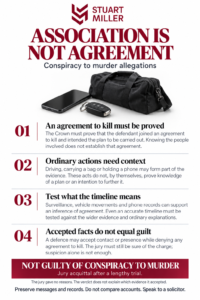
What conspiracy to murder requires
A conspiracy is an agreement. Under section 1 of the Criminal Law Act 1977, it is an agreement between two or more people to pursue a course of conduct which, if carried out as intended, will involve the commission of an offence. For conspiracy to murder, the plan agreed must be a plan to kill.
The defendant must be a party to that agreement and must intend that it be carried out (R v Saik [2006] UKHL 18). Nobody has to carry out the killing for the conspiracy to exist, and the Crown does not have to prove that every conspirator was present at any scene. But it must prove that this defendant joined.
“Assisting a conspiracy” is everyday language. In law, the question is whether he was a party to the agreement.
An agreement can be inferred, but it must be proved
Agreements to commit serious crime are rarely written down. The Crown may invite a jury to infer an agreement from conduct: movements, contact, timing and what people did afterwards. That is legitimate.
But the jury may convict only if it is sure. It has to be sure that what the movements show is an agreement to kill, and not ordinary contact or favours. Suspicion is not enough, and a pile of small inferences is only as strong as each of them.
Helping is not the same as agreeing
Driving someone, carrying a bag and holding a phone can each be part of a plot, if done knowing the plan and intending to further it. The same acts are innocent if done as a favour with no knowledge of any plan.
Suspecting that something might happen is not the same as intending it to happen. That gap, between association and agreement, was the whole case.
Offences that sound alike
Conspiracy to murder is an agreement to kill. It can be complete before anyone is hurt.
Assisting an offender (Criminal Law Act 1967, s.4) is different. It involves doing something with intent to impede the arrest or prosecution of someone you know or believe is guilty of a relevant offence. There are also offences of encouraging or assisting crime (Serious Crime Act 2007, ss.44–46). Each has its own elements, timing and maximum sentence.
The details published here do not say whether any count other than conspiracy to murder was on the indictment. The verdict we describe is for conspiracy to murder.
What a timeline can and cannot show
A surveillance and phone timeline can be accurate and still incomplete. Surveillance shows where people and vehicles were seen. A handset record shows that a device connected and, roughly, where. Neither shows what was said, why people were there or what anyone knew.
A timeline can be right about every entry and still be wrong about what the entries add up to. That is a question for the jury.
What was at stake
Conspiracy to murder carries a maximum sentence of life imprisonment (Criminal Law Act 1977, s.3). Murder carries a mandatory life sentence. Conspiracy to murder does not. Its maximum is life, but the sentence is discretionary, and a maximum is not a prediction.
The court looks at the role proved or admitted, the degree of planning and the harm intended. We state no category or starting point, because the facts needed to assign one are not in the record. Nobody should be sentenced for a role the Crown cannot prove.
Before any verdict, someone accused of this offence may be remanded or bailed on restrictive conditions. A conviction can affect licence conditions on release, work, study, housing and family life. For someone without British citizenship, immigration consequences may follow.
Those are possibilities in cases like this, not facts about our client. The record says only that the trial was lengthy.
The wait, and living with a lengthy trial
The record gives no timeline and no duration, so we have not built one. What follows is general context.
A murder conspiracy case runs from arrest and interview through charge, sending to the Crown Court (Crime and Disorder Act 1998, s.51), preparation and trial. A case built on surveillance and phones produces a great deal of material. The defence has to review it, ask what else exists and test how the timeline was assembled. Surveillance material can raise disclosure questions of its own, including material the prosecution says is sensitive. The court decides what must be disclosed (Criminal Procedure and Investigations Act 1996).
Three measures of delay are easily confused: time under investigation, time from charge to trial and time spent in custody. If someone quotes you a figure, ask which one it is. If you are remanded, custody time limits apply. They are set by regulations and can be extended, so ask your solicitor for the current limit.
A lengthy trial asks something of everyone in it. You sit through weeks of evidence about a shooting that you say you had no agreement to. Family members hold work, money and caring responsibilities together. Those are general pressures, not a description of our client’s experience, which the record does not give.
How the defence was built
The record describes the defence in short compass. We set out what it says and stop where it stops.
Accepting what could be accepted, contesting what it meant
- The problem: the Crown’s timeline contained associations that the defence accepted.
- The legal point: the live issue was never contact. It was whether there was an agreement to kill.
- The action: the defence accepted some of the surrounding associations and denied any agreement to kill.
- Why it may have mattered: the record does not explain the choice. As a general matter, contesting facts that cannot realistically be contested can cost a defence its credibility and pull a trial into disputes that do not decide it. Conceding them can narrow the case to the inference.
The record does not say which associations were accepted, and we do not say.
An ordinary explanation
The defence case was one of ordinary social contact, favours and presence. That is a defence case, not a finding of the court. It does not describe who asked for what, or why.
Separating association from agreement
The Crown asked the jury to read the movements as proof of agreement. The defence case was that ordinary things were being over-interpreted into conspiracy. A spokesman for Stuart Miller Solicitors said:
“Conspiracy cases often depend on stacking ordinary movements until they look sinister. The defence has to separate association from agreement.”
What the record does not say
It does not record an expert, an application, a disclosure request or any particular cross-examination, so we claim none of them. We do not say that any one step produced the verdict. A jury gives no reasons, and the record does not say what persuaded it.
The Verdict
After a lengthy trial, the jury acquitted our client of conspiracy to murder.
Precisely, this was a jury verdict after a trial in which the evidence was heard and tested. It is not the Crown dropping the case. It means the Crown did not prove its case so that the jury was sure.
It is not a finding that nothing happened, that no conspiracy existed or that the Crown’s timeline was wrong. The defence accepted some associations, so the verdict does not mean those did not exist. A jury gives no reasons, so we cannot say why it decided as it did. The record says nothing about other defendants, and we say nothing either.
Some things do not end with a verdict:
- Bail conditions end, and seized property and devices should be returned.
- Ask what police records, phone downloads and any samples are held, and for how long. The rules depend on the circumstances (Police and Criminal Evidence Act 1984, as amended).
- If you paid privately, ask whether a defendant’s costs order is available. Limits apply.
- Employers, regulators or immigration advisers may need accurate information, depending on your circumstances.
Ask your solicitor to confirm in writing what was resolved, including whether any other count was on the indictment.
What to do now if you are accused of assisting a conspiracy to murder
Ask for a solicitor before answering questions

Police station advice is free. You can ask for the duty solicitor or name a firm. There is no single right approach to interview. In some circumstances a court can draw an inference if you later rely on something you could reasonably have mentioned when questioned. How and when you give your account is a decision to take with a solicitor first.
Be straight with your solicitor about the favours and contacts
If you did give someone a lift, hold a phone or carry a bag, say so, even if it feels damaging. A defence that accepts some facts and denies agreement only works if it matches what happened. Your solicitor can only judge how to deal with the Crown’s timeline if they know which parts of it are true.
Write a private chronology
Note who asked you for what, when and why, and where you were. Keep it for your solicitor only. Do not share it with friends or in group chats.
Preserve what shows why you were there
Messages asking for a favour, work records, tickets, receipts and location history can show an ordinary purpose. Delete nothing, and do not reset devices. CCTV from shops, homes and vehicles is often overwritten within days, so tell your solicitor where it might exist.
Do not compare accounts with anyone
Do not contact the others involved, witnesses or anyone connected to the shooting, and do not try to line up accounts. It can be read as interference. Where accounts may conflict, do not assume you can share a legal team.
Ask what the Crown says you did
Ask for the timeline and the data behind it. Which phone is said to be yours? Who says you held another person’s handset? What is the Crown’s evidence about what you knew?
Get advice before giving device access
Whether you can be required to unlock a phone depends on the legal power used, and refusal can itself be an offence in some circumstances. Take advice first.
Raise the practical problems early
If you may be remanded, tell your solicitor about a stable address, work and caring responsibilities. Ask early about funding, including any expert work, because it takes time to arrange.
FAQs
-
What must the prosecution prove if I am accused of helping in a conspiracy to murder?
That you were a party to an agreement with at least one other person to carry out a killing, and that you intended it to be carried out (Criminal Law Act 1977, s.1; R v Saik). Driving, holding a phone or knowing the people involved can be evidence, but none of it is enough unless the jury is sure you agreed.
-
Can holding or lending a phone be used as evidence?
It can be part of the Crown's case. Records may show a handset's contact and approximate movement, and the Crown may say who held it and why. But a phone record does not show what was said, what anyone knew or whether the holder agreed to a killing. The Crown must prove who used the phone and what it means.
-
Can being seen with the people involved be used against me?
Yes, the Crown can rely on association as part of a wider case. But association is not agreement. People spend time with friends, relatives and acquaintances for ordinary reasons. The prosecution must prove that you joined the plan, not simply that you were around people who did.
-
Do I have to have known about the plan beforehand?
To join an agreement you must know what is planned and agree to it. Learning of an offence only afterwards and then helping may amount to a different offence, such as assisting an offender, which has its own elements. Suspecting that something might happen is not the same as intending it to.
-
What is the difference between conspiracy to murder and assisting an offender?
Conspiracy to murder is an agreement to kill, and it can be complete before anyone is hurt. Assisting an offender (Criminal Law Act 1967, s.4) means doing something with intent to impede the arrest or prosecution of someone you know or believe is guilty of a relevant offence. The elements, timing and maximum sentences differ.
-
If the defence accepts some of the Crown's facts, does that mean I will be convicted?
No. A defence may accept facts that are not realistically in dispute, such as knowing people or being somewhere, while denying any agreement to kill. Accepting facts is not accepting guilt. Whether to do so is a decision to take with your solicitor, and it has to fit with what you told police and the evidence.