Police Freeze Your Bank Account UK | What Happens & Your Rights
What Happens If Police Freeze Your Bank Account in the UK?
🎧 Listen to the Audio Summary
Can Police Freeze Your Bank Account in the UK?
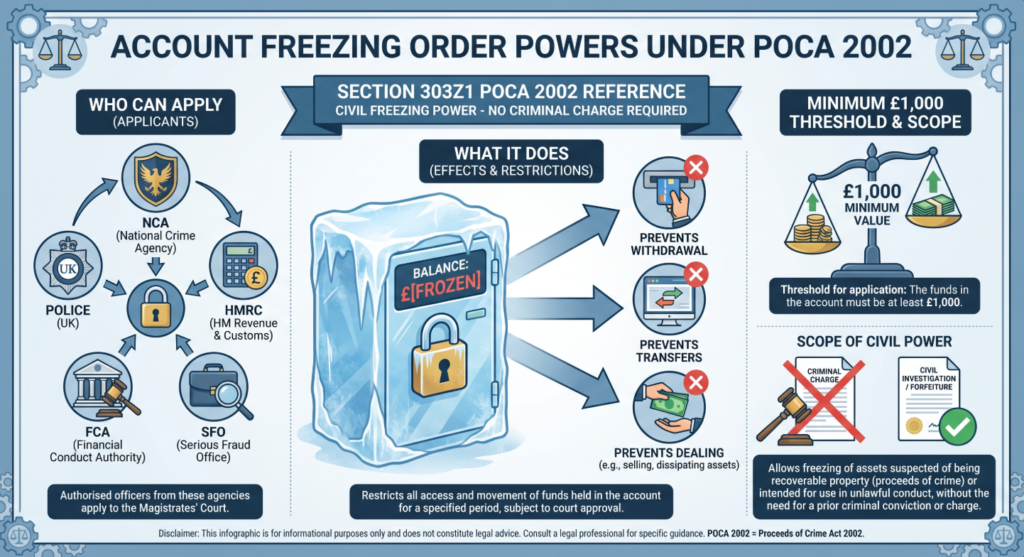
Yes. Police and other authorised enforcement agencies have the power to apply for an Account Freezing Order under Section 303Z1 of the Proceeds of Crime Act 2002, which prevents you from withdrawing or dealing with the funds in your account.
Legal Power
Legislation
Who Can Apply
Account Freezing Order (AFO)
Section 303Z1 POCA 2002
Police; NCA; HMRC; FCA; SFO; Local authorities
Account Forfeiture Order
Section 303Z14 POCA 2002
Same enforcement agencies
Restraint order
Section 41 POCA 2002
Prosecution in criminal proceedings
Civil recovery freezing order
Section 245A POCA 2002
NCA civil recovery
Unexplained Wealth Order
Section 362A POCA 2002
NCA; SFO
What an AFO Does
Effect
Prevents withdrawal
Cannot take money out of account
Prevents transfers
Cannot move money elsewhere
Prevents dealing
Cannot use funds to pay debts
Account remains open
Account is not closed
Incoming payments
May still be credited depending on order terms
Does not mean charged
AFO does not require criminal charge
Who Can Seek an AFO
Authorised Enforcement Officers
Police
Specifically authorised investigating officers
National Crime Agency
Serious organised crime
HMRC
Tax fraud; VAT fraud
Financial Conduct Authority
Financial services offences
Serious Fraud Office
Complex fraud cases
Local authorities
Trading standards; benefit fraud
The Minimum Amount
POCA 2002 Requirements
£1,000 minimum
Account must contain at least £1,000
Below this
AFO cannot be made
Effect
Smaller amounts cannot be frozen under AFO
Why AFOs Are Used
Reasons
Preserve evidence
Prevent dissipation of funds
Protect against money laundering
Stop further movement of criminal proceeds
Alternative to restraint order
Does not require criminal proceedings
Speed
Can be obtained quickly
Low bar
Reasonable grounds to suspect; lower than criminal standard
How Long Can Police Freeze a Bank Account in the UK?
An Account Freezing Order initially lasts for up to 2 years. This is the maximum initial period, but extensions are available.
Duration
Position
Initial AFO
Up to 2 years from date of order
Extension
Further period applied for before expiry
Maximum extension
No statutory maximum on total duration
In practice
Can last several years in complex cases
Review
Can apply to vary or discharge
The Two-Year Period
What Happens
During AFO
Investigation proceeds
No charge required
AFO does not require criminal proceedings
Forfeiture application
Authority may apply for forfeiture during period
End of period
Order expires unless extended or forfeiture ordered
If no forfeiture
Funds released at end of period
If forfeiture ordered
Money permanently taken
Can the AFO Be Extended?
Yes
Application to court
Enforcement authority applies before expiry
Grounds
Investigation continuing; forfeiture proceedings not concluded
You can oppose
Make representations against extension
Solicitor essential
To represent you at extension hearing
No automatic extension
Court must approve
Forfeiture Application Timeline
What Happens Next
During AFO period
Authority gathers evidence
Forfeiture application
Made to magistrates’ court
Standard of proof
Balance of probabilities
If forfeiture granted
Money taken permanently
If not granted
Money returned at end of AFO
What Is an Account Freezing Order Under UK Law?
An Account Freezing Order (AFO) is a civil court order made by a magistrates’ court under Section 303Z1 of the Proceeds of Crime Act 2002, which prohibits a person from making any payment from or dealing with the funds in a frozen bank or building society account.
Key Features of an AFO
Details
Court
Magistrates’ court
Application
Made without notice in most cases
Standard
Reasonable grounds to suspect
Criminal charge
Not required
Civil standard
Lower than beyond reasonable doubt
Duration
Up to 2 years; extensions possible
Effect
Account frozen; cannot deal with funds
The “Reasonable Grounds to Suspect” Test
What Authorities Must Show
Lower than criminal standard
Not beyond reasonable doubt
Lower than civil standard
Not balance of probabilities
Objective test
Would a reasonable person suspect?
Basis for suspicion
Transaction patterns; intelligence; SAR
No proof of crime
Suspicion sufficient
Challenge possible
Grounds can be challenged at hearing
What Happens in the Account
Money During AFO
Money remains in account
Not seized; not taken
Bank holds it
Under court order
Interest
May continue to accrue
New credits
Depending on exact terms of order
Not given to authorities
Unless forfeiture order follows
Returned if no forfeiture
At end of AFO period
Difference: AFO vs Restraint Order
Comparison
AFO
Civil power; no criminal proceedings required; magistrates’ court
Can Police Freeze Your Bank Account Without Telling You in the UK?
Yes. Account Freezing Orders are almost always applied for without notice, meaning the order is made before you are informed, giving you no opportunity to object in advance.
Without Notice Application
Why It Happens
Standard practice
AFOs almost always without notice
Risk of dissipation
If told in advance; money could be moved
Court power
Can make order without hearing from you
When you find out
When bank informs you; or card is declined
First knowledge
Often when trying to use account
What Must Happen After
Your Rights Post-Order
Served with order
You must be served with a copy
Notice of proceedings
Told about any forfeiture proceedings
Right to apply to vary or discharge
Can apply to court to challenge
Hearing
Can be listed to consider your representations
Solicitor
Essential to instruct immediately
Bank’s Role
What Bank Does
Receives order
Bank served with AFO
Freezes account
Must comply with court order
Informs customer
Usually notifies account holder
Tipping off concern
Limited by anti-tipping off provisions in some cases
Cannot disclose SAR
If SAR filed; cannot tell you
Suspicious Activity Reports
How They Relate
Bank files SAR
If suspicious activity identified
NCA receives
Assesses; may disseminate
Can lead to AFO
NCA or police may then apply
Cannot tell you
Tipping off prohibition
Your first knowledge
May be the AFO itself
What Are Your Rights If Police Freeze Your Bank Account?
Despite the without-notice nature of AFOs, you have important legal rights once you become aware of the order.
Right
Legal Basis
What It Means
To be served with order
POCA 2002
Must receive copy of the order
To apply to vary or discharge
Section 303Z9 POCA 2002
Challenge the order in court
To legal representation
Common law; Article 6 ECHR
Represent yourself or instruct solicitor
To apply for living expenses
Section 303Z9 POCA 2002
Release of funds for reasonable expenses
To know the basis
Article 6 ECHR
Must be told grounds for the order
To oppose forfeiture
Section 303Z14 POCA 2002
Challenge any forfeiture application
To appeal
Section 303Z16 POCA 2002
Appeal to Crown Court
Article 1, Protocol 1 ECHR
Right to Peaceful Enjoyment of Property
What it protects
Peaceful enjoyment of possessions
Application
AFO interferes with your property rights
Proportionality
Order must be proportionate
Public interest
Must serve legitimate public interest
Challenge basis
Can argue order disproportionate
Article 6 ECHR
Fair Trial Rights
What it protects
Fair hearing
Application
Right to be heard on AFO and forfeiture
Practically
Right to attend; make representations; be legally represented
Forfeiture proceedings
More significant Article 6 concerns
Who Can Apply to Vary or Discharge?
Standing
Account holder
Primary right to challenge
Third parties
Others with interest in account
Businesses
Where business account is frozen
Joint account holders
Both may have rights
Legal owner
Anyone with legal interest
How to Challenge an Account Freezing Order in the UK
Challenging an AFO requires a specific legal process. The grounds for challenge and the evidence required are important to understand.
Grounds for Challenge
How to Argue
No reasonable grounds
Suspicion was not objectively reasonable
Disproportionate
Order more restrictive than necessary
Wrong account
Order applies to wrong account
Legitimate source of funds
Money has innocent explanation
Procedural defect
Application did not comply with requirements
Delay
No forfeiture applied for within reasonable time
The Application to Vary or Discharge
Section 303Z9 POCA 2002
Where made
Magistrates’ court that made order
Who can make it
Account holder; anyone affected
What you must show
Grounds for variation or discharge
Evidence
Must provide evidence supporting grounds
Hearing
Usually listed for hearing
Both sides heard
Enforcement authority can respond
Proving Legitimate Source of Funds
Key Evidence
Employment records
Payslips; P60; bank statements showing salary
Business accounts
Legitimate business income
Tax records
HMRC records; tax returns
Property transactions
Proceeds of house sale
Inheritance
Documentation from estate
Gifts
Evidence of donor; their means
Investment returns
Brokerage statements
Benefit of the doubt
Any credible explanation raises doubt
What Makes a Strong Challenge
Evidential Strength
Clear paper trail
Documents showing origin of funds
Consistent with account history
Income matches lifestyle and deposits
No contradictory evidence
Nothing pointing to criminal source
Expert evidence
Forensic accountant if complex
Early action
Challenge promptly; do not wait
Appeal to Crown Court
Section 303Z16 POCA 2002
If magistrates refuse
Can appeal to Crown Court
De novo hearing
Fresh consideration
Both sides again
Full hearing
Costs
May be ordered
Time limit
Must act promptly
Can You Apply for Living Expenses From a Frozen Account?
Yes. One of the most important provisions is the ability to apply to the court for funds to be released for reasonable living expenses and legal costs.
Living Expenses Application
Section 303Z9 POCA 2002
Who can apply
Account holder
What can be released
Reasonable living expenses
Legal costs
Also included
Court decides
What amount is reasonable
Not automatic
Must apply; show need
Enforcement authority
Can oppose; but courts generally sympathetic
What Counts as Living Expenses
Examples
Rent or mortgage
Basic housing costs
Utilities
Gas; electricity; water
Food
Reasonable food costs
Essential transport
Getting to work; medical appointments
Medical costs
Prescriptions; treatment
Legal costs
Solicitor fees for challenging AFO
What Does Not Usually Qualify
Examples
Luxury spending
Holidays; expensive restaurants
Non-essential purchases
New cars; luxury goods
Business expenses
May be considered separately
Discretionary items
Non-essential spending
Practical Steps for Living Expenses
Process
Instruct solicitor
Application made by solicitor
Prepare schedule
Monthly expenses listed
Supporting documents
Bills; rent agreements; payslips
Application to court
Formal application
Enforcement authority response
Usually served on them
Hearing
Court considers application
Release of funds
If granted; account unfrozen to extent
What Is an Account Forfeiture Order?
An Account Forfeiture Order (AFO) is the permanent seizure of funds from a frozen account. It can be made without a criminal conviction, using only the civil standard of proof.
Forfeiture vs Freezing
Key Difference
Freezing order
Temporary; preserves funds pending investigation
Forfeiture order
Permanent; takes money from you
Standard
Both civil: balance of probabilities
No conviction needed
Forfeiture without criminal prosecution possible
Can challenge
Both orders can be challenged
Section 303Z14 POCA 2002
Forfeiture Application
Who applies
Enforcement authority
Court
Magistrates’ court
Standard
Balance of probabilities
What must be shown
Money is criminal property or intended for use in crime
Your right
To oppose; present evidence; attend hearing
If granted
Money permanently transferred to Consolidated Fund
What Should You Do If Your Bank Account Is Frozen?
Step 1: Do Not Panic, But Act Immediately
Why this matters: An AFO is a serious legal matter but it does not mean you are guilty of anything. However, time is critical. The order may have been made based on incomplete information, a misunderstanding, or a false allegation. Acting quickly to instruct a solicitor and gather evidence of legitimate funds gives you the best chance of challenging the order and recovering access to your money.
Step 2: Instruct a Specialist Solicitor Immediately
Why this matters: AFO proceedings are civil proceedings under POCA 2002 with specific procedural rules. You need a solicitor experienced in financial crime, asset recovery, and Proceeds of Crime Act proceedings. This is not general criminal defence work, it requires specialist knowledge of the civil recovery regime, forfeiture proceedings, and the specific legal tests that apply.
Step 3: Obtain a Copy of the Order
Why this matters: You are entitled to receive a copy of the Account Freezing Order. The order will identify the court that made it, the grounds relied upon, the account affected, and the duration. Understanding exactly what has been ordered is the first step to challenging it effectively. If you have not been served with a copy, your solicitor should request it immediately.
Step 4: Gather Evidence of the Legitimate Source of Your Funds
Why this matters: The most effective challenge to an AFO is demonstrating that the money in the account has a legitimate, lawful source. Gather all available evidence:
Payslips, P60s, bank statements showing regular salary deposits
Tax returns and HMRC records
Property sale proceeds documentation
Inheritance documentation
Business accounts and invoices
Any other records showing where the money came from
The stronger and more complete this evidence, the stronger your challenge.
Step 5: Apply for Living Expenses and Legal Costs
Why this matters: If the frozen account contains the money you need for daily living, you can apply to the court for funds to be released for reasonable living expenses and to fund your legal representation. Your solicitor will prepare a schedule of expenses and make the application urgently. Courts generally recognise that people need access to money to live, and this application should be pursued as a matter of priority.
Step 6: Challenge the Order Formally
Why this matters: An application to vary or discharge the AFO under Section 303Z9 POCA 2002 is the primary mechanism for challenging the order. Your solicitor will prepare the application, gather evidence, and represent you at the hearing. If the magistrates’ court refuses the discharge application, there is a right of appeal to the Crown Court. Do not simply accept the order — challenge it.
Frequently Asked Questions
How long can police freeze your bank account UK?
An Account Freezing Order initially lasts for up to 2 years, and extensions can be granted by the court. There is no statutory maximum on the total duration — in complex investigations, accounts can remain frozen for several years. During this period, the enforcement authority may apply for an Account Forfeiture Order, which would permanently take the money. If no forfeiture order is obtained by the end of the AFO period, the funds must be released.
Can the police freeze your bank account without telling you UK?
Yes. Account Freezing Orders are almost always obtained without notice, meaning the court makes the order before you are informed, giving you no opportunity to object in advance. Your first indication that your account has been frozen may be your bank card being declined or a transfer being blocked. You must be served with the order after it is made and then have the right to apply to vary or discharge it.
What should you do if your bank account is frozen by police UK?
Instruct a specialist solicitor immediately, obtain a copy of the order, gather evidence of the legitimate source of your funds, and make an urgent application for living expenses. Do not ignore the order or assume it will resolve itself. Challenge it formally through an application to vary or discharge under Section 303Z9 POCA 2002. The longer you wait, the harder it may become to gather evidence and the greater the risk that forfeiture proceedings are initiated.
Can you still pay bills if your bank account is frozen UK?
Not from the frozen account without a court order. Once an Account Freezing Order is in place, you cannot make payments from the affected account. However, you can apply to the court for funds to be released for reasonable living expenses, including rent, utilities, food, and essential transport. Your solicitor can make this application urgently. You should also consider whether you have other accounts or resources that can meet immediate expenses while the application is processed.
What is an account freezing order and how does it work UK?
An Account Freezing Order is a civil court order made by a magistrates’ court under Section 303Z1 of the Proceeds of Crime Act 2002, which prohibits you from withdrawing or dealing with the funds in a bank or building society account. It is obtained without notice by an enforcement authority such as the police, NCA, or HMRC, on the basis of reasonable grounds to suspect that the funds are criminal property. It does not require you to have been charged with any offence. It initially lasts up to 2 years and can be followed by an Account Forfeiture Order permanently removing the funds.
How do you get your bank account unfrozen after a police investigation UK?
By making a formal application to the magistrates’ court to vary or discharge the Account Freezing Order under Section 303Z9 POCA 2002. You must show grounds for the discharge — most powerfully, that the money in the account has a legitimate source. Your solicitor will prepare and present the application, supported by evidence of legitimate funds. If the application is refused, there is a right of appeal to the Crown Court. If no forfeiture order is obtained, the funds will be released at the end of the AFO period.
This website uses cookies to ensure you get the best experience on our website.SettingsACCEPT
Privacy & Cookies Policy
Privacy Overview
This website uses cookies to improve your experience while you navigate through the website. Out of these cookies, the cookies that are categorized as necessary are stored on your browser as they are essential for the working of basic functionalities of the website. We also use third-party cookies that help us analyze and understand how you use this website. These cookies will be stored in your browser only with your consent. You also have the option to opt-out of these cookies. But opting out of some of these cookies may have an effect on your browsing experience.
Necessary cookies are absolutely essential for the website to function properly. This category only includes cookies that ensures basic functionalities and security features of the website. These cookies do not store any personal information.
Any cookies that may not be particularly necessary for the website to function and is used specifically to collect user personal data via analytics, ads, other embedded contents are termed as non-necessary cookies. It is mandatory to procure user consent prior to running these cookies on your website.